 Belgique
 España
 France
 Germany
 India
India
 Italia
 Luxembourg
 Netherlands
 Polska
 Portugal
 Suisse
 United Kingdom
 United States
What Is the Average Salary in Spain Today?


Figuring out the average salary in Spain is the first step for anyone planning to work, hire, or build a life in this vibrant country. While the figures might seem modest compared to some of its northern European neighbours, the story is more complex and surprisingly positive. That’s the case when you factor in Spain’s lower cost of living and exceptional work-life balance.
This guide breaks down what you need to know about the average income in Spain. It includes everything from regional variations and professional earnings to how your salary translates into everyday living.
Overview of the average salary in Spain
When discussing the average salary in Spain, it’s essential to distinguish between gross and net figures. The gross salary is your total income before any deductions, while the net salary is what lands in your bank account after taxes and social security contributions.
In 2025, the average gross annual salary in Spain is about €31,600, which translates to about €2,633 per month. After deductions, the average monthly net average income in Spain is around €1,700 to €1,800.
It’s crucial to understand that Spanish salaries are typically divided into 14 payments per year. Employees receive 12 monthly payments plus two extra payments, often called pagas extraordinarias. They are usually issued in July and December. Some employers prorate this into 12 larger monthly payments. Therefore, the gross annual figure of €31,600 includes these extra payments.
A key point for financial planning is the difference between the average and the median salary. The average can be skewed higher by top earners. In comparison, the median salary is lower, sitting around €23,000 annually.
Salary levels by profession and industry
Your career field is arguably the single most significant factor determining your earning potential in Spain. The disparity between high-demand sectors and more traditional industries is substantial.
The average salary by profession varies dramatically. High-paying jobs in Spain are typically found in technology, finance, law, and healthcare. Meanwhile, tourism, hospitality, and retail offer more modest compensation.
The table below provides a clear snapshot of what you can expect to earn in various fields across Spain.
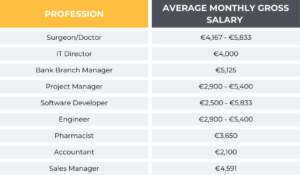
Experience also plays a big role. Entry-level positions often command 40-60% less than senior roles. For example, a junior software developer might start at around €28,000, while a senior developer with specialised skills can command over €70,000.
Furthermore, education fuels higher earnings. Note that holding a Master’s degree can lead to a 27% premium over a Bachelor’s degree, and a PhD can add a further 42% in certain research fields.
Regional salary differences across Spain
Where you choose to live and work in Spain is one of the most decisive factors for your expected income levels. The economic landscape is not consistent, thereby creating significant disparities in employee wages across the country.
Generally, salaries are highest in the industrial and corporate north-central regions and more modest in the agricultural and tourism-dependent south.
High-earning regions:
- Madrid: As the nation’s capital and business hub, Madrid offers the highest average salary by profession. The average annual gross salary often exceeds €42,000, driven by high concentrations of corporate headquarters, financial services, and government institutions.
- Basque Country: A centre for industry and innovation, this region boasts an average annual gross salary of around €39,500. Its strong manufacturing and engineering sectors command a premium pay scale.
- Catalonia: Home to Barcelona, Catalonia has a diverse economy with strengths in technology, logistics, and industry. Salaries here are consistently above the national average, reflecting the demand for skilled professionals.
Mid-range regions:
- Navarre: With a reliable industrial base, particularly in the automotive sector, Navarre offers competitive wages. They align with or slightly exceed the national average.
- Aragon: Another important logistics and manufacturing corridor, Aragon provides solid income levels that are close to the Spanish average.
Lower-earning regions:
- Andalucia: Despite its economic growth, Andalucia’s heavy reliance on seasonal tourism and agriculture results in a lower average annual gross salary.
- Extremadura: One of the least densely populated regions, its economy is largely based on agriculture and traditional industries. This leads to the lowest average wages in the country.
- Canary Islands & Balearic Islands: While tourism creates many jobs, these are often seasonal and lower-paid. The annual average salary is pulled down by the seasonal nature of work, despite the high cost of living in tourist centres.
This geographic wage gap means a job offer must be evaluated in a local context.
Cost of living compared to salaries
The true value of a salary is not just in the number but in what it can buy. This is where the financial equation becomes particularly attractive for expats working in Spain. While the average income in Spain is lower than in countries like Germany, the UK, or the US, this is balanced by a lower cost of living.
For a single person
The monthly cost of living is estimated to be around €711. That’s excluding rent. Furthermore, rent for a one-bedroom apartment in a city centre can range from €700 to over €1,200 in prime areas of Madrid or Barcelona. When all expenses are considered, a single person can live comfortably on a net monthly salary of around €2,700.
For a family
A net monthly income of €4,000 is a good target for a comfortable lifestyle. That includes housing, utilities, groceries, transportation, and leisure activities. This lower cost of living enhances purchasing power. For instance, rent in Spain is about 40% cheaper than in the United Kingdom.
When you add Spain’s reliable public services, the financial pressure is further reduced. This means that even with a lower salary, your disposable income and quality of life can be very high.
Finally, the pay scale relative to living costs is most favourable in smaller cities like Valencia or Seville. That’s where salaries are decent, but housing costs are more affordable than in the two largest metropolises.
Minimum wage and worker rights in Spain
Spain has a strong approach to worker protections, starting with the national Minimum Interprofessional Salary (Salario Minimo Interprofesional or SMI). For 2025, the government has set the monthly SMI at €1,184 (for 14 payments) or €1,381 (if paid in 12 monthly instalments). This adds up to an annual gross income of €16,576. This represents a 4.4% increase from 2024 and is part of a longer-term trend of raising the wage floor to improve living standards.
Furthermore, the standard workweek is capped at 40 hours, with plans to reduce it to 37.5 hours by the end of 2025. Workers are entitled to a minimum of 30 calendar days of paid vacation per year, plus 14 public holidays. These policies reinforce Spain’s commitment to a healthy work-life balance.
Collective bargaining agreements
A cornerstone of the Spanish labour system is the widespread use of collective bargaining agreements (convenios colectivos). These agreements are negotiated by unions and employer associations for specific industries or sectors. They often set wages and working conditions that are more favourable than the national minimums. If your job is governed by such an agreement, your employer must adhere to its terms. It’s always wise to check if a convenio applies to your position.
Finally, if you believe you are being paid below the legal minimum or the agreed-upon pay scale for your role, you can file a complaint with the Labour and Social Security Inspection (Inspeccion de Trabajo y Seguridad Social).
Salary trends and forecast for 2025
The Spanish economy has shown remarkable resilience, and this strength is feeding into the job market and employee wages. Here are the notable points regarding salary trends:
- Wage growth outpaces inflation: Wage growth is projected to increase by around 4% on average in 2025. This surpasses inflation rates and leads to potential gains in purchasing power for workers.
- Sector specific surges: High-demand industries like technology and pharmaceuticals are seeing even stronger growth. Here you can expect salary increases forecast between 5% and 10% as companies compete for specialised talent.
- Strong economic foundation: Spain’s economy is a key driver, with GDP growth of 3.2% in 2024 projected to continue at a solid pace. This supports wage growth and job creation.
- Skills gap drives premiums: Employers are increasingly prioritising skills and real-world experience. This leads to significant salary premiums for professionals in fields like AI, cybersecurity, and renewable energy.
- Regional disparities persist: Salary growth is uneven across Spain, with dynamic regions like Madrid and the Basque Country experiencing stronger wage pressures compared to areas reliant on tourism or agriculture.
Final thoughts
While the average salary in Spain is moderately positioned within Europe, it is powerfully balanced by a lower cost of living and a highly skilled workforce. The forecast for 2026 points towards real wage growth, particularly in high-demand sectors like tech and engineering.
This makes Spain an increasingly attractive destination for talent acquisition and business expansion. Understanding the regional variations and legal frameworks is key to crafting competitive compensation packages that attract and retain the best talent in a dynamic market.
Ready to hire in Spain without the complexity? Our Employer of Record (EOR) service at Hightekers can support the entire process. That includes managing everything from local payroll and compliance with Spanish labour laws to ensuring competitive benefits. Let us handle the administrative burden so you can focus on growing your team and business.
Find out how we simplify hiring in Spain
Frequently asked questions
What is a good salary in Spain for a single person?
A good net monthly salary for a single person to live comfortably in most Spanish cities is around €2,700. This should cover a nice apartment, utilities, groceries, social activities, and still allow for savings.
In more expensive cities like Madrid or Barcelona, you may need closer to €3,000 net for a similar lifestyle, while in smaller cities, €2,300-€2,500 could be sufficient.
How does Spain’s average salary compare to other European countries?
Spain’s average salary is about 20% below the European Union average. For comparison, the average gross annual salary is around €31,600 in Spain, versus approximately €36,000 in the EU, €49,200 in Germany, and €56,800 in Denmark.
However, Spain’s lower cost of living significantly narrows this gap in terms of actual quality of life and disposable income.
What are the highest-paying industries in Spain?
The highest-paying industries in Spain are typically finance and insurance, information technology and communication, and electricity and gas supply. These sectors offer average annual gross salaries that can range from €37,000 to over €55,000.
Within these sectors, specialised roles like surgeons, IT directors, and top-level managers command the highest salaries.
Do expats earn more than locals in Spain?
There is no uniform rule, but expats often fall into two categories. Those filling high-demand, specialised roles that are hard to fill locally (like in tech or science) may earn higher-than-average salaries.
Furthermore, expats working remotely for foreign companies may maintain international salary levels. However, expats are subject to the same local market rates and collective agreements as Spanish workers.
How much tax will I pay on my salary in Spain?
Spain has a progressive income tax (IRPF). For 2025, the rates start at 19% for earnings up to €12,450 and rise to 47% for income over €300,000.
Furthermore, social security contributions add another approximately 6.4% in deductions. Your final tax burden will depend on your total annual income and the region. That’s because regional governments also set their own tax rates.


