 Belgique
 España
 France
 Germany
 India
India
 Italia
 Luxembourg
 Netherlands
 Polska
 Portugal
 Suisse
 United Kingdom
 United States
Spain Digital Nomad Visa: Everything You Need to Know in 2026


Imagine working with your laptop perched on a sun-drenched terrace overlooking the Mediterranean. This isn’t a holiday fantasy, but a tangible reality made possible by the Spain Digital Nomad Visa. Introduced in 2023 as part of the groundbreaking Spanish startup law, this visa is an open invitation for remote workers and professionals.
This guide cuts through the complexity to give you a clear roadmap to securing your visa in 2026. We’ll walk you through every requirement, form, and step of the process, thereby empowering you to make your move to Spain with confidence.
Overview of the Spain Digital Nomad Visa
The Spain Digital Nomad Visa, officially known as the Telework Visa, is a residence permit designed for non-EU/EEA citizens. It’s for those who wish to live in Spain while working remotely for companies based outside of the country. It legally recognises the modern reality of remote work, allowing you to use digital tools to perform your job from anywhere within Spanish borders.
The visa was launched to attract international talent and boost the economy under the Startup Law. It translates into a legal pathway to enjoy Spain’s famous quality of life without putting your career on hold.
Main benefits and duration
The advantages of choosing Spain for your remote work journey are significant:
- Extended legal residence: The initial visa is valid for up to 12 months if applied for from outside Spain. If you are already in Spain legally, you can apply directly for a residence permit valid for up to three years. The visa can be renewed for up to a total of five years.
- Path to permanent residency: After five years of continuous legal residence, you may become eligible to apply for permanent residency. Furthermore, Spanish citizenship can be considered after ten years.
- Family inclusion: The visa allows you to bring family members, including your spouse or unmarried partner, dependent children, and dependent parents.
- Travel freedom: As a legal resident of Spain, you can travel visa-free across the 27 countries of the Schengen Area.
- Tax benefits: Those who become tax residents in Spain may qualify for a special tax regime known as the Beckham Law. This applies a flat tax rate of 24% on income up to €600,000 for a period of up to six years.
- Work flexibility: If you are professional or self-employed, up to 20% of your income can come from Spanish clients, with the majority (80%) originating from outside Spain.
Who qualifies & key requirements
The Spain Digital Nomad Visa is designed for a specific profile, which is the legitimate remote professional. The Spanish government has set clear criteria to ensure applicants have a stable and location-independent career.
Who can apply?
The visa targets non-EU/EEA citizens who are at least 18 years old, and your professional status must fall into one of these categories:
- Remote employee: You work for a company located outside of Spain and have a contract that permits you to work remotely.
- Freelancer or self-employed professional: You work for yourself and provide services to clients that are primarily based outside of Spain.
Key eligibility criteria
Meeting the following digital nomad visa Spain requirements is essential for a successful application.
- Proof of remote work: You must demonstrate that you can perform your job exclusively using computers and telecommunication systems. This involves providing a letter from your employer confirming your remote work arrangement or contracts with your international clients.
- Professional qualifications: You need to prove your expertise through a university degree, a professional certificate, or at least three years of relevant professional experience.
- Stable professional relationship: You must have been with your current employer or have had a professional relationship with your clients for a minimum of three months prior to applying. Furthermore, your employer or the company you work for must have been actively operating for at least one year.
- Clean criminal record: Applicants must provide a clean criminal record certificate from every country they have resided in for the past two years. This document must be officially translated into Spanish.
- Comprehensive health insurance: You must have private health insurance from a provider authorised to operate in Spain. This insurance must offer coverage equivalent to Spain’s public health system, with no co-payments or limits.
Minimum income requirements
Financial self-sufficiency is an important aspect of the application. The income requirements are calculated as a percentage of Spain’s Minimum Inter-professional Salary (SMI). For 2026, the figures are as follows:
- Main applicant: 200% of the monthly SMI = €2,368 per month.
- First family member: An additional 75% of the monthly SMI = €888 per month.
- Each additional family member: An additional 25% of the monthly SMI = €196 per month.
You can prove your income through employment contracts, recent bank statements, and payslips.
How to apply: Step-by-step process
The application process requires attention to detail and careful preparation. Here is a step-by-step breakdown of what to expect.
Step 1: Gather the required documents
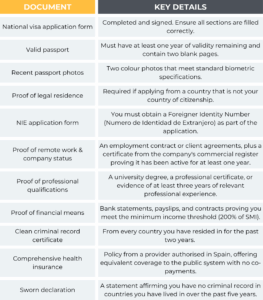
This is the most critical phase. Here’s a table showing the most important documents you can’t overlook:
Step 2: Choose your application route
You have two options, each with implications for the initial permit’s length:
- Apply from abroad: Submit your application at the Spanish Embassy or Consulate in your country of legal residence. This typically results in a visa valid for up to one year.
- Apply from within Spain: If you are already in Spain legally (like on a tourist visa allowing a 90-day stay), you can apply for the telework residence permit directly at the Immigration Office (Oficina de Extranjeria). This can grant a permit valid for up to three years from the start.
Step 3: book and attend your appointment
Contact your local Spanish Consulate to book an appointment. This often involves sending an email with your details and supporting documents. Be prepared to pay a visa fee of approximately €80 at this stage. Make sure to attend the appointment with all your original documents and copies.
Step 4: Application processing and decision
Are you wondering about how long the digital nomad visa in Spain will take to process? It can vary from 15 to 45 days. The consulate will inform you of their decision. If approved, you will have a limited time (usually one month) to collect your visa.
Step 5: Enter Spain and complete formalities
Once you have the visa, you can move to Spain. After arrival, you must complete a few key steps:
- Apply for the TIE: Within 30 days of arrival, you must apply for the Foreigner Identity Card (Tarjeta de Identidad de Extranjero) at a local police station. This card is your physical proof of legal residency.
- Register your address: Go to your local town hall (Ayuntamiento) to register on the padron (municipal register). This is essential for accessing local services.
- Open a bank account: A Spanish bank account will simplify managing your finances and tax obligations.
Taxes and financial considerations
Understanding your tax obligations is crucial for a smooth transition to Spain. If you spend over 183 days in a year in the country, you will likely become a tax resident. A significant benefit for eligible digital nomad visa holders is the special tax regime known as the Beckham Law. This allows you to be taxed as a non-resident for six years. It applies a flat income tax rate of 24% on income up to €600,000, instead of the standard progressive rates.
Family, living costs & cities to consider
The Spain Digital Nomad Visa permits you to include immediate family members, such as a spouse and dependent children. Note that additional income is required for each. Spain’s cost of living is a major advantage, being significantly more affordable than many Western European nations, though costs vary by location.
For city choice, consider:
- Vibrant Barcelona for its international scene
- Valencia for a perfect beach-city balance
- Malaga for its growing tech community
- The capital Madrid for its professional opportunities
Each offers a unique blend of lifestyle, networking, and living costs to suit different preferences.
Pros & cons of the Spain Digital Nomad Visa
Before making your decision, it’s wise to weigh the advantages against the potential challenges.
Advantages
- Legal clarity: The visa provides a legal framework for working remotely from Spain, thereby eliminating the uncertainty of working on a tourist visa.
- High quality of life: Spain consistently ranks high for healthcare, safety, and lifestyle, offering a fantastic environment to live and work.
- Schengen access: The ability to travel freely across Europe is a significant perk.
- Path to long-term residency: The visa offers a tangible route to permanent residency and even citizenship.
- Tax incentives: The potential benefit of the Beckham Law can lead to substantial tax savings.
Potential challenges
- Administrative process: The application can be paperwork-intensive, requiring document legalisation and translations.
- Bureaucracy in Spain: Dealing with Spanish administration after arrival can require patience.
- Language barrier: While many Spaniards in cities speak English, daily life and official procedures are conducted in Spanish. Learning the basics is highly beneficial.
- Variable interpretation: Some requirements might be interpreted slightly differently by different consulates or immigration offices.
Additional resources & tips
To ensure a smooth application and transition, begin preparing your documents months in advance. That’s because obtaining documents and sworn translations can be time-consuming.
Additionally, always verify the specific requirements with the Spanish Consulate responsible for your application, as procedures can vary. Note that learning basic Spanish will greatly ease your daily life and integration.
Which option is right for you?
While the digital nomad visa is a strong solution for many remote professionals, it may not be the right fit for everyone. Depending on your situation, other legal and compliant options are available:
- If you only work with foreign clients and want a simple visa, the Digital Nomad Visa could be a great choice. It allows you to reside in Spain without needing to register as a business locally, provided you meet the financial and insurance requirements.
- If you want full autonomy and plan to work with Spanish clients, becoming an autónomo (self-employed worker) is a suitable option. This gives you the flexibility to operate within the Spanish market but involves higher taxes, administrative responsibilities, and social security contributions.
- If you want a hassle-free way to work remotely from Spain for a non-Spanish company, Our Employer of Record service can be the ideal alternative. The EOR acts as your legal employer in Spain, managing payroll, tax contributions, compliance, and employee benefits on behalf of your actual employer abroad. This solution is perfect for remote workers who want to keep their existing job with a foreign company while living in Spain — without dealing with complex visa paperwork or freelance bureaucracy.
Learn more about our EOR solutions in Spain
Frequently asked questions
Can I work for a Spanish company with this visa?
Yes, but with a key limitation. If you are a professional or self-employed, a maximum of 20% of your total professional income can come from Spanish companies or clients. The remaining 80% must originate from outside Spain.
Can I apply for the visa from within Spain?
Yes. If you are in Spain on a legal tourist stay, you can apply for the telework residence permit at the Immigration Office before your tourist status expires. This application from within Spain can lead to an initial three-year residence permit.
Can I bring my unmarried partner?
Yes. The visa explicitly includes unmarried partners (pareja de hecho). You will need to provide documentation proving the stability of your relationship, which may vary depending on the consulate’s requirements.


