 Belgique
 España
 France
 Germany
 India
India
 Italia
 Luxembourg
 Netherlands
 Polska
 Portugal
 Suisse
 United Kingdom
 United States
A Complete Guide to VAT in Spain for Expats


For expats and freelancers in Spain, the VAT system can feel like a fortress of bureaucracy. Between the complex registration requirements and the strict compliance rules, many find themselves overwhelmed before they’ve even issued their first invoice.
Yet understanding this system is non-negotiable for anyone looking to build a legitimate business on Spanish soil. The good news is that with proper guidance, what seems daunting becomes manageable. This comprehensive guide will walk you through every aspect of VAT in Spain.
Basics of VAT in Spain
Value-Added Tax (VAT), known in Spain as Impuesto sobre el Valor Anadido (IVA), is a consumption tax applied to most goods and services. Unlike income tax that targets what you earn, VAT targets what you spend. As an indirect tax, businesses collect it from customers and remit it to the government, making them essentially tax collectors on the state’s behalf.
For expats running businesses or working as freelancers in Spain, understanding VAT is a practical necessity with real financial implications. The Spanish tax authority (Agencia Tributaria or Hacienda) treats VAT seriously, and errors can lead to significant penalties.
For tourists, understanding VAT unlocks potential refunds on purchases made during their Spanish travels. The system touches nearly every commercial transaction in Spain, from your morning coffee to the software services you provide international clients.
How VAT works in Spain
The Spanish VAT system operates on a simple but frequently misunderstood principle. It’s a tax on the value added at each stage of production and not on the total selling price. Here’s how it works in practice:
A supplier sells materials to a creator for €120, which includes €20 VAT. The creator pays €120 but can reclaim the €20 VAT from the tax authority, so their net VAT cost is zero.
When the creator sells the finished product to a customer for €220 (which includes €44 VAT), they keep the €20 VAT they already paid on materials and send €24 to the government. That’s the difference between the VAT they collected from their customer (€44) and the VAT they paid their supplier (€20). The customer, as the end user, bears the full VAT cost without reclamation rights.
Who must follow Spanish VAT rules?
Spanish VAT obligations typically apply to:
- Businesses and freelancers with permanent establishment in Spain.
- Companies importing goods into Spain from outside the EU.
- Businesses conducting intra-community acquisitions of goods (buying from EU member states).
- Foreign businesses selling certain goods online to Spanish consumers.
Unlike some EU countries, Spain doesn’t offer general VAT registration thresholds for non-resident companies. This means you may need to register from your first euro of taxable sales. However, for e-commerce businesses selling to Spanish consumers, a €10,000 threshold applies before VAT registration becomes mandatory.
VAT rates in Spain
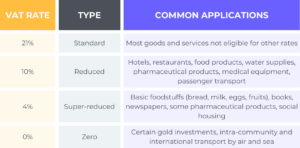
The country uses a multi-tier VAT Spain rate structure with different levels applying to different categories of goods and services. As of 2025, the standard rate stands at 21%, with two reduced rates and a zero rate for specific items.
Here’s a table summarising the VAT rates:
VAT registration in Spain
Navigating Spanish VAT registration is the first major hurdle for expat entrepreneurs. The process varies depending on your business structure and location, but certain fundamentals remain constant.
Who must register?
VAT registration is mandatory for:
- Businesses with a permanent establishment in Spain making taxable supplies.
- Foreign companies regularly selling goods to Spanish consumers (with the €10,000 threshold for e-commerce).
- Companies importing goods into Spain from outside the EU.
- Businesses acquiring goods from other EU member states.
- Freelancers and self-employed professionals conducting taxable activities.
Understanding what a VAT registration number
Your VAT registration number in Spain is your Numero de Identificación Fiscal (NIF). For legal entities, this typically follows formats like X12345678, 12345678X, or X1234567X, beginning with letters that may indicate company type. Also, the VAT number used for EU trade adds the prefix “ES” to your NIF.
Individuals might encounter related identification numbers like the NIE (Numero de Identificación de Extranjero). That’s essential for foreign residents opening bank accounts, signing rental contracts, or forming companies. Since 2008, the CIF (Código de Identificación Fiscal) used for legal entities was replaced by the NIF, which now serves both individuals and businesses.
The registration process
To obtain your Spanish VAT number, you’ll need to:
- Complete Form 036 (or simplified Form 037), including application for entry in the Intra-Community Operators Register (ROI) by ticking box 582.
- Provide supporting documentation, which may include:
- Proof of identity (passport for individuals).
- VAT certificate from your home country (for EU businesses).
- Company incorporation documents.
- Power of attorney if using a representative.
- Submit to the local tax office, either in person or online.
Failure to properly complete Form 036, specifically box 582 for ROI registration, will exclude your business from the VIES (VAT Information Exchange System). This prevents you from conducting EU transactions with zero-rate VAT.
Non-EU businesses typically need to appoint a fiscal representative in Spain who shares joint liability for their tax obligations. While EU-based businesses aren’t required to have a representative, many still choose to work with one to navigate local compliance complexities.
VAT compliance and filing in Spain
Once registered, businesses enter the ongoing world of VAT compliance Spain obligations. Spanish VAT administration demands attention to detail and strict deadline adherence.
Filing frequency and deadlines
Most businesses file VAT returns quarterly, with the following deadlines:
- First quarter (January-March): First 20 calendar days of April.
- Second quarter (April-June): First 20 calendar days of July.
- Third quarter (July-September): First 20 calendar days of October.
- Fourth quarter (October-December): First 30 calendar days of January.
Note: Businesses with annual turnover exceeding €6,010,121 must file monthly returns. Additionally, all VAT-registered businesses must submit an annual summary declaration (Form 390) recapping the year’s transactions.
Required reporting and record-keeping
Spanish VAT compliance extends beyond just filing returns. Businesses must also:
- Issue proper invoices for all taxable supplies.
- Maintain detailed records, including sales ledger (invoices issued), purchase ledger (invoices received), investment assets register, and record of intra-community transactions.
- Keep all records for at least 10 years.
Electronic invoicing and SII
Spain is progressively moving toward digital tax administration. The Immediate Supply of Information (SII) system requires businesses to submit invoice data electronically within four days of issuance. While currently mandatory for larger businesses and voluntary for others, broader implementation is expected.
VAT deductions and input tax recovery
A crucial aspect of VAT management is recovering input VAT. That’s the tax you’ve paid on business purchases. In Spain, you can generally deduct VAT incurred on business-related expenses, but with specific limitations:
- Hotel accommodation and restaurant meals: 100% deductible with proper business purpose documentation.
- Car expenses (rental, repair, fuel): 50% deductible when used for both business and personal purposes.
- Business gifts: 0% deductible unless promotional samples or low value (under €200 per year).
- Entertainment expenses: Generally 0% deductible.
Freelancers can also deduct various business expenses, including Spanish social security contributions, accounting services, professional subscriptions, office expenses, phone and internet, and vehicles used for work.
Those working from home can deduct 30% of utility expenses (water, electricity, gas, telephone, internet) proportional to the home area used for business. Our umbrella company in Spain can help you make the correct VAT deductions for your business.
VAT refunds and special cases
Spain’s VAT system includes mechanisms for recovering VAT in specific circumstances, both for tourists and foreign businesses.
VAT refunds for tourists
Non-EU residents can obtain VAT refunds on purchases made during their Spanish visit, provided:
- You take the goods out of the EU within three months of purchase.
- The store provides a Tax-Free Form (you may need to show your passport at purchase).
- You have unused goods in your luggage when leaving.
- The retailer participates in a VAT refund scheme.
At customs, present your passport, VAT forms, VAT invoices, and the purchased goods for inspection. Once customs approves your form, you can receive your refund immediately at a refund booth or via post. Furthermore, EU residents can also claim refunds if they’re leaving the EU for 12 months or more.
VAT refunds for foreign businesses
Businesses based outside Spain but within the EU can typically recover Spanish VAT through the electronic refund system in their home country. Additionally, non-EU businesses can claim refunds through a specific process outlined by the Spanish tax authority. That often requires the appointment of a fiscal representative.
Special VAT regimes
Spain offers several special VAT schemes that can simplify compliance in specific circumstances:
- MOSS (Mini One Stop Shop): For B2C e-commerce businesses selling digital services to EU consumers, allowing registration in a single member state for all EU VAT obligations.
- Group taxation: Companies within a group may be able to register as a single VAT entity.
- Cash accounting scheme: Businesses below certain turnover thresholds can account for VAT when payment is received rather than when the invoice is issued.
Summary
Understanding the Spanish VAT system is essential for any expat running a business or working as a freelancer in Spain. From understanding the different VAT Spain rate levels to obtaining your VAT registration number and maintaining ongoing VAT compliance in Spain. The system demands attention but becomes manageable with proper knowledge.
The fundamentals are clear: register when required, charge the correct rates, maintain meticulous records, file returns on time, and don’t overlook legitimate deductions. While the bureaucracy can seem intimidating, thousands of expat entrepreneurs successfully manage their Spanish VAT obligations every year.
Do you want to focus on growing your business in Spain? Let us handle the complexity.
Learn more about our EOR solutions in Spain
Frequently asked questions
How do I check if a Spanish VAT number is valid?
You can verify a Spanish VAT number through the European Commission’s VIES online database or directly on the Spanish Tax Agency (AEAT) portal. For businesses processing many validations, API services can automate this process.
Always confirm VAT numbers before engaging in transactions to ensure compliance.
Are there penalties for late VAT registration or filing?
Yes, Spain imposes financial penalties for late VAT registration, typically applied from when taxable supplies began. Late submissions also incur fines, with potential interest charges on overdue VAT payments. The Spanish tax authority applies strict deadlines for VAT obligations.
Is VAT registration required for freelance digital services to EU clients?
If your business is established in Spain, you must charge Spanish VAT on digital services to consumers in other EU countries. However, for B2B services where the client is VAT-registered, the reverse charge mechanism typically applies, with the client accounting for VAT in their country


