 Belgique
 España
 France
 Germany
 India
India
 Italia
 Luxembourg
 Netherlands
 Polska
 Portugal
 Suisse
 United Kingdom
 United States
How Contractors and Freelancers Differ


The once-rigid boundaries of the traditional 9-to-5 have dissolved, giving way to a global ecosystem of independent talent. For businesses and individuals alike, understanding this new terrain is an advantage.
At the heart of this shift lies an often misunderstood distinction: the contractor vs freelancer dynamic. While these terms are frequently used as if they are identical, they represent fundamentally different approaches to work, engagement, and career-building.
In recent years, these differences have become more pronounced, shaped by technology, regulation, and a globalised economy.
Who are contractors and freelancers?
Before we can unpack the contractor freelancer difference, we must first establish clear identities for these two types of independent workers. Both operate outside the permanent employee model, selling their expertise rather than their time in a company. However, their typical engagements, client relationships, and operational structures tell two distinct stories.
Contractors
Think of an independent contractor as a strategic specialist, often hired for a specific, well-defined project or to fill a specialised skill gap for a set period. Their engagement mirrors a professional services agreement.
They frequently operate through their own limited company or a dedicated umbrella company, which handles their administrative and tax obligations. Today, we see contractors in roles like interim Chief Technology Officer, cybersecurity programme lead, or a financial compliance expert brought in to navigate a new regulatory framework.
Furthermore, they often work on a single, large-scale project for one client at a time. This is sometimes integrating with an existing team for months or even a year.
Freelancers
In contrast, a freelance professional is all about agility. They are the creative designers, copywriters, SEO specialists, and software developers who thrive on variety and rapid project turnover. Additionally, a freelancer typically juggles multiple clients and projects simultaneously, moving from one brief to the next with fluidity.
They are often a sole trader, though may also incorporate for liability or tax reasons. Their work is defined by tasks and deliverables—a website design, a marketing campaign, a series of articles—rather than ongoing, deep integration.
The freelancer’s world is one of breadth, managing a portfolio of clients to ensure a steady, diverse stream of income. This fundamental distinction in identity sets the stage for the practical differences between contractors and freelancers we see today.
Key differences between contractors and freelancers
In recent years, the line between these two models has sharpened, driven by clearer global regulations and evolving business needs. Understanding these distinctions is critical for compliance, effective collaboration, and career planning. Let’s break down the core areas where the contractors vs freelancers comparison is most apparent.
Work structure and client relationships
The nature of the working relationship is the most visible differentiator.
- Contractors are most commonly paid on a day-rate or hourly basis. Also, their invoices are tied to time worked, and their contracts are often long-term, thereby providing a predictable income stream that mirrors a salary. This model values their sustained, focused input.
- Freelancers are predominantly paid on a project basis or a fixed fee for a specific deliverable. Their income is directly linked to output, not time. This requires them to be highly skilled at project scoping and pricing. Also, it’s not uncommon for a freelancer to have retainers with clients for ongoing work, but the foundation is payment for a defined piece of work.
Legal and compliance aspects
This is where the contractor vs freelancer distinction carries significant weight, especially with the global crackdown on disguised employment. The specific contract agreement terms are important.
Authorities like the UK’s IR35 and similar legislation in other countries scrutinise the working relationship to determine if a contractor is, in fact, a ‘de facto’ employee. The key tests revolve around control, substitution, and mutuality of obligation.
A genuine contractor should have the right to send a substitute to do the work and should not be under the direct control of the client. For freelancers, the risk of being deemed an employee is generally lower due to their multi-client portfolio and clear project-based work. However, understanding local tax and business registration laws remains essential to avoid misclassification.
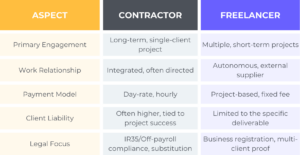
Key differences at a glance
Here’s a table to summarise the key differences:
Advantages of hiring contractors vs freelancers
As a business, your choice between a contractor and a freelancer should be a strategic one, dictated by the nature and needs of your project. There is no universally superior option, there is only the right fit for the task at hand.
When to choose a contractor
Hire a contractor when you need deep, sustained expertise and integration. The debate of contractors vs freelancers is settled in the contractor’s favour when your project requires:
- Specialised, long-term expertise: You need an interim manager, a specialist to lead a digital transformation, or an expert to handle a complex project that will last for several months.
- Team integration: The role requires the individual to work as part of your existing team, following your processes and using your internal systems on a daily basis.
- Knowledge transfer: A key reason for bringing in a contractor is to have them embed skills and knowledge within your permanent team before their contract concludes.
In these scenarios, the contractor acts as a strategic investment, providing senior-level focus and commitment that is difficult to find in a freelancer juggling multiple clients.
When to choose a freelancer
Engage a freelancer when you need agility, specific creative skills, and cost-effective solutions for defined tasks. The freelancer vs contractor balance tips towards the freelancer for:
- Specific, short-term projects: You need a new company logo, a set of web pages coded, a marketing video produced, or a defined consultancy report written.
- Budget control: With a fixed project fee, you know the exact cost upfront, making budgeting straightforward and eliminating the risk of scope creep on a time-based rate.
- Specialised skills on demand: You require a very specific skill set for a short period. For example, a data scientist to build a one-off machine learning model or a voice-over artist for a campaign.
Freelancers offer unparalleled flexibility and access to a global talent pool for task-oriented work. It allows you to scale your team’s capabilities quickly and efficiently without long-term commitment.
Trends impacting contractors and freelancers
The independent work sector is not static. Several powerful trends are reshaping the contractors vs freelancers landscape, creating new opportunities and challenges.
The rise of remote and hybrid engagement
The mass adoption of remote work has fundamentally altered the playing field. A business in London can now effortlessly engage a top-tier contractor based in Lisbon or a brilliant freelancer in Berlin. This has democratised access to talent but also intensified global competition.
For contractors, this means remote integration into teams is the new norm. For freelancers, it has expanded their potential client base exponentially, but also requires them to hone their communication and personal branding to stand out in a crowded market.
Technology as the great enabler
Technology platforms are the central nervous system of modern independent work. From sophisticated project management tools like Asana and Trello to communication hubs like Slack and Zoom, technology enables the seamless collaboration that makes remote work possible.
Furthermore, the rise of AI is automating administrative tasks, from scheduling to invoice generation. It frees up both contractors and freelancers to focus on higher-value, strategic work.
Platforms like Hightekers are simplifying global payroll and compliance, making it easier for businesses to hire internationally. Meanwhile, freelance marketplaces continue to evolve, offering more curated, high-quality talent matching.
The regulatory tightrope
Globally, governments are grappling with how to classify and tax independent workers. Regulations like IR35 in the UK and the EU’s draft rules on platform work are creating a more complex compliance environment. For independent contractors, this means status determination assessments have become a standard part of the engagement process.
There is a growing emphasis on ensuring working practices align with the contract agreement terms to avoid costly tax liabilities. For all independent professionals, staying informed about local tax laws and statutory rights is no longer optional. Instead, it’s a core part of running a sustainable business.
Making the right choice
So, how do you navigate this complex terrain and make the optimal decision? The choice between a contractor and a freelancer boils down to a simple but critical question: what is the fundamental nature of your need?
For clients and hiring managers: Begin with a clear project definition. Is this a role or a task? Do you need someone to fill a seat and follow your direction for six months, or do you need a specific, polished outcome delivered by a certain date?
Your answer will immediately point you towards a contractor or a freelancer, respectively. Always ensure your contracts accurately reflect the working relationship to mitigate compliance risks.
For independent professionals: Be intentional about the career you want to build. Do you thrive on deep immersion in one company’s challenges for a sustained period, valuing income predictability? If so, contracting is your path. Or do you crave variety, creative freedom, and the agility to work on multiple interesting projects at once?
If that sounds more appealing, build your brand as a freelancer. Understand the legal and financial implications of your chosen model in your country of operation.
Final thoughts
The evolving landscape of independent work demands a strategic and informed approach. The core distinction in the contractors vs freelancers debate is no longer just about semantics. Instead, it’s about aligning your specific project needs with the right operational model.
For complex, long-term initiatives requiring deep integration, a contractor provides the focused expertise. For agile, defined deliverables and specialised tasks, a freelancer offers unrivalled flexibility and speed.
Understanding the practical, financial, and legal differences between the two helps both professionals and businesses make smarter decisions — from setting rates and defining deliverables to ensuring compliance and sustainability.
If you’re an independent professional looking to focus on your craft without getting lost in admin and compliance, Hightekers can help. Our solution gives freelancers and contractors alike the peace of mind of stable employment while keeping their independence and optimising their income.
Contact us to learn more about Hightekers’ solution
Frequently asked questions
What is the main legal difference between a contractor and a freelancer?
The core legal difference often lies in the level of control and integration. A contractor may work under a client’s direction similar to an employee, triggering rules like IR35.
Whereas a freelancer operates as a true external business, with greater autonomy over their work. The specific contract agreement terms definitively outline this relationship.
Can a freelancer work with only one client?
Yes, but it increases their risk of being reclassified as an employee for tax purposes, similar to a contractor caught by IR35. Most genuine freelancers maintain multiple clients to demonstrate they are running an independent business and are not economically dependent on a single entity.
How has remote work affected the contractor vs freelancer dynamic?
Remote work has blurred geographical boundaries for both. However, it has particularly benefited freelancers by allowing them to easily service a global client portfolio. For contractors, remote work has made it feasible to integrate with international teams without relocation, expanding their opportunities significantly.
Can a professional switch between being a contractor and a freelancer?
Absolutely. Many professionals pivot between models based on market demand and career goals. An individual might act as a contractor on a six-month tech implementation, then operate as a freelancer for the next year.
They can take on multiple short-term design and consulting projects from various clients for variety.
Are contractors or freelancers more prevalent in specific industries?
Contractors are often found in sectors like information technology, engineering, and management consultancy for large projects. On the other hand, freelancers dominate creative fields (design, writing), digital marketing, and specialised technical trades.
However, the lines are blurring as all industries adopt more flexible, project-based talent models to meet modern demands.
What are the key financial management differences for the professional?
Contractors must manage longer payment cycles but predictable income, often requiring a corporate structure.
In comparison, freelancers need robust systems for chasing multiple invoices, managing volatile cash flow, and diligently setting aside taxes from each payment. That’s because their income is less consistent and more project-dependent throughout the year.


