 Belgique
 España
 France
 Germany
 India
India
 Italia
 Luxembourg
 Netherlands
 Polska
 Portugal
 Suisse
 United Kingdom
 United States
Gross vs Net Income for Freelancers: How to Calculate Your Real Earnings


For the freelance professional, the euphoria of landing a new client and seeing a healthy payment hit your bank account is a feeling like no other. But here lies the most common and costly misconception in the freelance world: believing that this initial sum is entirely yours to keep.
The chasm between what you earn and what you actually get to live on is the single most critical financial concept you must master. Confusing your gross with your net income isn’t just an accounting error, but a direct threat to your financial stability and the long-term health of your business.
This guide will demystify these terms. We’ll arm you with the knowledge to calculate your real earnings and take control of your financial future.
What is gross income for freelancers?
In the simplest terms, your gross income is the total amount of money you generate from your freelance work before anything is taken away. It is your revenue, the raw, unfiltered sum of all your client payments. Think of it as the top-line figure that shows the market value of your work before reality sets in.
This includes every pound, euro, or dollar paid to you for your services. Typically, your gross earnings encompass:
- Payments from all clients: Whether you have one retainer or twenty project-based clients, all their payments contribute to your gross income.
- Income from freelance platforms: Earnings from sites like Upwork, Fiverr, or PeoplePerHour form a core part of this total.
- Bonuses or late fees: Any additional compensation agreed upon with a client, such as a performance bonus or a fee for late payment, is included.
For example, if you complete projects for three clients in a month, charging £2,000, £3,000, and £1,500 respectively, your gross income for that month is £6,500. It’s a vital metric for measuring your business’s growth and scale, but it is dangerously misleading to use it for personal budgeting.
What is net income for freelancers?
This is your actual take-home pay, the profit your business generates after every single business expense and tax obligation has been accounted for. It is the number that truly matters for paying your rent, funding your groceries, and saving for your future. Think of it as the financial reality of your freelance enterprise.
Your gross income is systematically reduced by a host of deductions to arrive at your net figure. These include:
- Business expenses: The direct costs of running your freelance operation. This can include home office costs, software subscriptions, new hardware, marketing and advertising costs, professional development courses, and travel expenses directly related to client work.
- Taxes: This is the major deduction. The specific taxes for freelancers you pay will depend on your country of residence. However, they generally include income tax and often national insurance or similar social security contributions. Also, your tax is calculated on your profit (your gross income minus your allowable business expenses), not your total revenue.
- Other deductions: This might include fees for your accountancy software, bank charges, or contributions to your private pension.
Understanding your net income requires diligent monthly tracking. You cannot wait until the freelance tax deadline looms to scramble through your records. By then, the financial picture is historical.
Hence, monitoring your income and expenses monthly gives you a real-time view of your profitability, enabling proactive freelance financial planning and saving you from nasty surprises.
Gross vs net: key differences
The distinction between these two figures is the foundation of sound freelance finance. It’s the difference between your revenue and your profit, between being busy and being profitable. Let’s break down the gross vs net income comparison directly.
Your gross income is the starting point. Your net income is where you finish after all calculations. Consider this simple example for a UK-based freelancer:
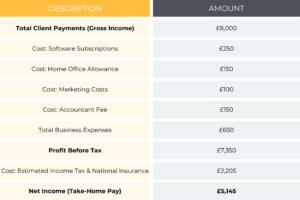
As the table illustrates, a seemingly impressive £8,000 a month translates to a spendable income of £5,145. This net figure is the only one that should inform your lifestyle choices and personal savings.
Furthermore, basing your spending on your gross income is a recipe for debt and financial stress. That’s because you’ll be spending money that is already earmarked for the tax authority and your business costs.
How to calculate your real earnings as a freelancer
Calculating your real earnings is not complex, but it does require consistency. By following a clear, step-by-step process, you can move from the ambiguity of gross figures to the clarity of your net worth.
Here is how to calculate your true take-home pay.
1.Tally your total gross income: For a given period (monthly or quarterly), add up every single payment you receive from clients. This is your starting point.
2. Identify and sum all your business expenses: Meticulously log every cost incurred in running your business. This is where you can explore legitimate tax benefits for freelancers, as many of these expenses are tax-deductible, effectively reducing your tax bill. Common expenses include office supplies, a proportion of your utility bills if you work from home, professional indemnity insurance, and costs for any freelance accounting software you use.
3. Calculate your profit: Subtract your total business expenses from your total gross income. The result is your taxable profit.
4. Estimate your tax liability: This is the tricky part, as freelance tax rules vary. You will need to understand the income tax bands and rates in your country of residence. For instance, in the UK, you would calculate your income tax and National Insurance contributions based on your profit figure. This step is crucial for how to calculate income tax for freelancers. Also, it is wise to set aside a percentage of each payment into a separate, high-yield savings account for taxes.
5. Arrive at your net income: Finally, subtract your estimated tax liability from your profit. The remaining amount is your net income.
To simplify this process, don’t shy away from technology. Using dedicated freelance accounting software like FreeAgent or QuickBooks can automate much of this tracking. It links directly to your business bank account and categorises transactions for you. At the very least, a well-maintained spreadsheet is infinitely better than a shoebox full of receipts.
How to increase your take-home pay
Increasing your net income doesn’t always mean working more hours. Often, it’s about working smarter. Here are practical strategies to boost your profitability in the coming year.
Conduct a ruthless audit of your business expenses
The most straightforward way to increase your net income is to systematically reduce your outgoing costs. Begin by scrutinising every subscription, software licence, and recurring service payment.
Ask yourself if each cost is essential for delivering your service or growing your business. Often, freelancers accumulate redundant tools over time.
You can also try to:
- Negotiate with suppliers for better rates.
- Bundle services where possible.
- Cancel what you do not actively use.
The money saved here translates directly into higher profit, requiring no additional work or client acquisition on your part. This proactive financial management is a cornerstone of effective freelance financial planning.
Implement a strategic and confident rate increase
Your experience and skills become more valuable each year, and your rates should reflect this growth. Make a deliberate plan to raise your prices. Start by applying new, higher rates to all new client engagements.
For existing clients, consider a phased approach. You’ll want to communicate the increase professionally, highlighting the continued value you provide. Many freelancers fear losing clients, but a well-justified rate rise often improves client relationships by reinforcing your professional standing.
This directly boosts your gross income, creating more revenue that can flow through to your net earnings after expenses and taxes.
Systematise and automate your administrative workflows
Time spent on non-billable administrative tasks is a drain on your profitability. Identify repetitive processes like:
- Invoicing
- Contract generation
- Expense tracking
Ideally, you’ll want to invest in systems to automate them. Using dedicated freelance accounting software can save hours each month by automating payment reminders and categorising transactions. This reclaimed time is a powerful asset, since it can be redirected towards higher-value activities like business development or skilled work.
By increasing your operational efficiency, you effectively lower the cost of running your business. That in turn increases your net profit without necessarily earning more revenue.
Leverage every available tax benefit and allowance
A profound understanding of freelance tax rules is a powerful lever for increasing your take-home pay. Do not treat taxation as an annual event, but as an ongoing part of your financial strategy.
Ensure you are claiming every legitimate business expense, from a proportion of your home utility bills to professional development courses and equipment. Additionally, investigate contributions to a private pension, which often offer significant tax benefits for freelancers.
Consulting with an accountant who specialises in self-employed individuals can uncover deductions you have missed. It ensures you retain more of your hard-earned money legally and efficiently.
Develop and cultivate diversified income streams
Relying solely on client work for income places a natural ceiling on your earnings, limited by the hours you can bill. Explore creating secondary revenue sources that are not directly tied to your time.
This could involve developing digital products like templates or e-books related to your expertise, recording an online course, or offering premium, packaged consultancy services.
These ventures can generate passive or semi-passive income, which supplements your primary freelance earnings. This diversification not only increases your overall gross income but also builds financial resilience, thereby protecting you from fluctuations in client work.
Final thoughts
Understanding the critical distinction between gross and net income is the final step in transitioning from a talented freelancer to a savvy business owner. It empowers you to make informed decisions, plan for the future, and truly profit from your expertise.
However, managing the complexities of tax legislation, expenses, and compliance can feel like a full-time job in itself. It will inevitably eat into the time and energy you have for your actual work. This is where Hightekers’ streamlined solution can make all the difference.
Through our employment model for freelancers, Hightekers acts as your legal employer, managing payroll, taxes, and compliance on your behalf while you continue working independently with your own clients. This solution also allows you to keep more of your income, thanks to optimised tax and social contribution management. You enjoy the freedom of freelancing with the peace of mind and stability of formal employment.
Discover how Hightekers can support your freelance journey
Frequently Asked Questions
How often should I calculate my gross and net income?
You should track your income and expenses at least monthly. This provides a real-time view of your financial health and prevents a last-minute scramble at the tax deadline. Also, regular reviews help you make informed decisions about spending, saving, and investing throughout the year.
Are there any expenses I might be missing that can reduce my tax bill?
Many freelancers overlook legitimate expenses. Consider a proportion of your home utilities (if you work from home), bank charges, professional body membership fees, and costs for professional development courses.
Even the cost of a new laptop or a business-related software subscription is typically deductible.
What is the best way to set aside money for taxes?
Open a separate, dedicated savings account for your tax money. As a rule of thumb, transfer a percentage of every client payment you receive. This could be anywhere from 25% to 35% depending on your local freelance tax rules. It ensures the money is there when your tax bill is due.
Why is my net income more important for getting a loan or mortgage?
Lenders are not impressed by your gross income because they need to assess your ability to repay the loan. Your net income, or your salary if you were employed, represents your actual disposable income. It is the true measure of your financial capacity that banks and building societies will carefully scrutinise.
I’m new to freelancing, so what is the first financial step I should take?
Open a separate business bank account. From day one, ensure all client payments go into this account and all business expenses are paid from it. This simple habit creates a clear boundary between your personal and business finances, making tracking and tax preparation infinitely easier.


