 Belgique
 España
 France
 Germany
 India
India
 Italia
 Luxembourg
 Netherlands
 Polska
 Portugal
 Suisse
 United Kingdom
 United States
What Is a Digital Nomad? Everything Freelancers Need to Know


So, exactly what is a digital nomad in practical terms? They are individuals who perform their work entirely remotely using digital technology while travelling freely across different locations. These professionals typically work from temporary accommodations, co-working spaces, or cafes, accessing the internet via Wi-Fi or mobile hotspots.
The concept isn’t as new as you might think. One of the first prototypes was Steven K. Roberts, who between 1983 and 1991 rode more than 10,000 miles across America on a computerised bicycle equipped with a satellite email system. The term “digital nomad” itself emerged in the early 1990s as computing networking expanded and mobile devices became more capable.
Understanding visa and legal aspects is important because working on a tourist visa violates the terms of most immigration policies. Many countries now recognise this new class of worker and have created specific digital nomad visa programs to legalise their status. This offers protection to both the worker and the host country’s legal system.
Relocation, visas, and bureaucracy
The dream of working from a sun-drenched beach is often brought back to earth by the practicalities of immigration law. While many countries now offer specific digital nomad visa programs, understanding your options is the first critical step.
Digital nomad visa requirements
Digital nomad visa requirements vary significantly by country but typically share common elements:
- Proof of remote employment with a company outside the host country or evidence of substantial freelance clients abroad.
- Minimum monthly income thresholds that often range from $2,000 to $4,000.
- Valid health insurance coverage that extends to the host country.
- Clean criminal record from your country of residence.
- Application fees range from approximately $75 to over $600.
The application process may require submission from your home country, while others allow you to apply while already in the destination country as a tourist.
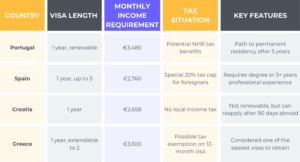
Comparing popular digital nomad visa programs
Here is a table to give you an idea of what you can expect when using visa programs abroad:
Bureaucratic procedures
Beyond securing your initial visa, prepare for ongoing bureaucratic procedures in your host country. Most destinations require you to register with local authorities shortly after arrival and may issue a separate residence permit.
Also, you will typically need to provide proof of secured accommodation for your stay and, in some cases, register with local tax authorities even if exempt from income tax.
Don’t forget that each nation maintains its own specific processes, so consulting official government resources or an immigration specialist for your target destination is crucial. It will help maintain legal compliance throughout your stay.
Taxes and financials
Perhaps the most complex aspect of the digital nomad lifestyle involves navigating international tax obligations. Ignorance of tax law never constitutes a valid defence with revenue authorities, so understanding your liabilities is essential.
Digital nomad taxes
- US citizens: The United States imposes citizenship-based taxation, meaning all US citizens must file federal tax returns regardless of where they live or earn income. If you earn more than the minimum filing requirement, you must file a US tax return. That’s even if you no longer live in the US.
- State taxes: Your state tax obligations depend on your “domicile state.” This is where you maintained permanent ties before leaving. States like California, New York, and Virginia are particularly aggressive about maintaining tax jurisdiction over former residents. Proving you’ve established domicile elsewhere requires concrete actions like securing a new driver’s license, voter registration, and professional relationships in another state.
- Foreign country taxes: Most countries use residence-based taxation, meaning they tax income earned by residents within their borders. The definition of “resident” varies, but typically triggers after spending 183 days in a country. Some countries like Panama and Croatia, specifically exempt digital nomad visa holders from local income tax to attract remote workers.
Tax mitigation strategies
Digital nomads have several legal options to minimise their tax burden:
- Foreign Earned Income Exclusion (FEIE): This allows qualifying Americans to exclude a certain amount of foreign-earned income from US taxation. To qualify, you must pass either the Physical Presence Test (330 full days outside the US in a 12-month period) or the Bona Fide Residence Test.
- Foreign tax credit: If you pay income taxes to a foreign country, you can typically claim these as a credit against your US tax liability, preventing double taxation on the same income.
- Foreign housing exclusion: This permits Americans living abroad to deduct certain housing expenses from their US taxes, though it has specific limitations and requirements.
Banking and financial management
Managing finances across borders requires a strategic approach to banking and payments. Digital nomads typically benefit from maintaining accounts in their home country while considering local accounts in their host country for daily expenses and avoiding foreign transaction fees.
Furthermore, the emergence of digital fintech solutions has revolutionised this space, with services like Wise and Revolut offering multi-currency accounts that provide far more favourable exchange rates and lower international transfer fees than traditional banks.
You’ll find that developing a smart currency strategy is also essential. In practice, it means maintaining balances in multiple currencies and timing larger transfers to capitalise on favourable rates.
For contractor payment management, use professional invoicing platforms that accommodate various currencies and payment methods, always stating your preferred currency and clear payment terms to clients.
Health insurance and social security
Comprehensive health coverage is non-negotiable for digital nomads. Domestic health insurance policies often provide limited or no coverage outside your home country. This leaves you vulnerable to potentially catastrophic medical costs.
Health insurance options
- International health insurance: Specialised policies designed for expatriates and frequent travellers that provide worldwide coverage (sometimes excluding the US due to high medical costs). These typically offer more extensive global coverage than travel insurance.
- Travel insurance with medical components: Suitable for shorter trips but often has limitations on pre-existing conditions and maximum coverage periods. These policies primarily cover emergencies rather than routine care.
- Local health insurance: Some countries require or allow digital nomads to enrol in their national healthcare system. For instance, Spain’s digital nomad visa may provide access to the public healthcare system once registered.
- Emergency evacuation coverage: Particularly important if you plan to spend time in remote areas with limited medical facilities. This coverage arranges and pays for transport to appropriate medical centres in emergencies.
Social security and retirement
For international digital nomads, maintaining social security and retirement benefits is achieved through social security coordination rules and bilateral agreements between countries.
These systems allow you to preserve and transfer acquired social security rights when moving between nations, thereby preventing the loss of your contributions. The key principles ensure you are only covered by one country’s legislation at a time. Furthermore, contributions from different countries are aggregated to qualify for benefits and you can often export your pension payments abroad.
It is vital to check the specific agreements between your home country and your host countries to understand your personal coverage and how your retirement savings are protected.
Legal structures and contracts
Establishing the right legal foundation for your freelance business protects your personal assets and simplifies tax compliance.
Choosing your business structure
The optimal legal structure depends on your income level, client base, and future plans:
- Sole proprietorship: The simplest structure with minimal setup requirements, but it offers no separation between personal and business assets. Overall, it’s suitable for those just beginning with lower liability risk, so you can start as a contractor without creating a company.
- Limited liability company (LLC): Provides personal asset protection against business liabilities. For instance, a US-based LLC can be established in business-friendly states like Wyoming or Delaware. For higher-earning nomads, this structure offers greater credibility with clients and enhanced legal protection.
- Foreign entities: In some cases, establishing a legal entity in a country with favourable tax treaties may be beneficial. However, this typically only becomes relevant for higher earners due to complexity and maintenance costs.
Contract essentials
Well-drafted contracts form the backbone of a sustainable freelance business:
- Scope of work: Clearly define deliverables, timelines, and revision policies to prevent scope creep.
- Payment terms: Specify currency, payment schedule, late fees, and accepted payment methods. Consider requiring deposits for new clients.
- Intellectual property rights: Explicitly state when and how ownership of the created work transfers to the client.
- Termination clauses: Outline conditions under which either party can end the agreement and any associated penalties.
- Governing law and jurisdiction: Specify which country’s laws govern the contract and where disputes would be resolved—a complex but crucial consideration for cross-border work.
Logistics, daily living, and risks
Beyond bureaucracy and taxes, successful nomadism requires mastering the practical aspects of mobile living.
Housing and workspace
Securing reliable housing and workspace is fundamental to the digital nomad lifestyle. Short-term rentals through platforms like Airbnb offer flexibility, while negotiating directly with local landlords can yield better rates for longer stays. Also, purpose-built co-living spaces provide turnkey solutions with built-in communities.
Beyond accommodation, internet reliability is non-negotiable. Therefore, always research speeds in specific neighbourhoods and have a backup plan, such as a mobile hotspot with a local SIM card.
Cost of living considerations
Popular digital nomad destinations offer significantly different costs and expenses:
- Southeast Asia (Thailand, Bali): Can comfortably live on $1,500-$2,500 per month, including nice accommodation, food, and co-working space.
- Eastern Europe (Croatia, Portugal): Moderate costs of $2,000-$3,500 monthly for a good quality of life.
- Western Europe (Spain, Italy): Higher expenses, typically $3,000-$4,500 monthly in major cities.
- Caribbean (Barbados, Costa Rica): Variable costs but often comparable to Western Europe, with imported goods carrying premium prices.
Risk mitigation
The nomadic lifestyle introduces unique risks that require proactive management:
- Legal compliance: Regularly audit your visa status, tax obligations, and business compliance across all jurisdictions where you spend significant time.
- Safety research: Understand local safety concerns, neighbourhoods to avoid, and common scams targeting foreigners. Register with your embassy when staying long-term.
- Cultural preparation: Learn basic local phrases and cultural norms to facilitate smoother integration and show respect for your host country.
- Data security: Use VPNs on public networks, enable two-factor authentication on all accounts, and maintain encrypted backups of essential work and documents.
- Contingency planning: Have a plan for medical emergencies, political instability, or natural disasters. This includes evacuation insurance and accessible emergency funds.
How Hightekers helps
Dealing with the complexities of international freelancing can be challenging, but Hightekers provides the employment and compliance solutions you need to work globally with confidence.
For freelancers who wish to relocate or work with international clients, we offer a unique model that allows you to enjoy the benefits of a permanent contract while maintaining your freelance lifestyle. Hightekers acts as your legal employer, managing payroll, taxes, and compliance in your host country, so you can focus fully on your projects and clients.
For employees who want to relocate to another country where their current employer has no legal entity, our Employer of Record (EOR) service makes international mobility simple. In this case, Hightekers becomes your legal employer, managing all local employment obligations on behalf of your company so you can continue working from your new location smoothly and compliantly.
Whichever situation applies to you, our comprehensive support—from international mobility and taxation to contract compliance—lets you work and expand internationally with complete peace of mind.
Discover how Hightekers can support international freelancers
Frequently Asked Questions
What are the typical digital nomad visa requirements?
Requirements vary by country but commonly include proof of remote employment or sufficient freelance income, valid health insurance, a clean criminal record, and application fees. Also, minimum income thresholds typically range from $2,000-$4,000 monthly.
What are the benefits of a digital nomad visa?
These visas provide legal permission to work remotely while residing in a country, avoiding immigration issues associated with working on tourist visas. Benefits often include longer stays than tourist visas, potential tax advantages, and sometimes a pathway to longer-term residency.
What is the biggest challenge digital nomads face?
Loneliness is frequently reported as the biggest struggle, followed by burnout and navigating different time zones. Additionally, the lack of a consistent community and the blurring of the line between work and leisure time present significant psychological challenges.


