 Belgique
 España
 France
 Germany
 India
India
 Italia
 Luxembourg
 Netherlands
 Polska
 Portugal
 Suisse
 United Kingdom
 United States
How Freelancers Can Stay Tax Compliant and Avoid Penalties


- Understanding tax compliance for freelancers
- Common tax mistakes freelancers should avoid
- How to track income and expenses efficiently
- Important tax deadlines and penalties
- Tax deductions and credits available to freelancers
- How international freelancers can stay compliant
- Final thoughts
- Frequently Asked Questions
Let’s be honest, tax compliance is rarely the reason someone chooses a freelance life. The allure lies in the freedom, the flexibility, the sheer thrill of building something that is entirely your own. But that very independence comes with the burden of managing your own taxes.
Unlike traditional employees, where tax is neatly sliced off a payslip before the money even arrives, you are responsible for managing taxes. Navigating these waters can feel daunting, but it is the non-negotiable price of admission for a life of professional autonomy.
This freelancer tax guide will help on your journey, designed to transform a source of anxiety into a manageable part of your business routine.
Understanding tax compliance for freelancers
So, what exactly is tax compliance when you’re your own boss? In essence, it is the formal obligation to:
- Declare your income accurately to the relevant tax authorities.
- Pay the correct amount of tax on that income by the legal deadlines.
- Maintain pristine records to support your filings.
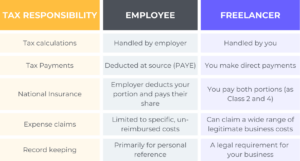
The fundamental shift from employee to freelancer is one of liability. Your clients pay you a gross fee. Then, it’s your sole responsibility to calculate, set aside, and pay the income tax and National Insurance contributions on that revenue.
This new role demands a proactive mindset. You are no longer reacting to a payslip, but you are forecasting your earnings, diligently tracking every business-related expense, and making estimated tax payments throughout the year.
Overall, the system operates on trust and is verified by the ever-present possibility of a tax audit for freelancers. That’s where authorities can request proof for every number you submit.
You’ll find that embracing this administrative duty is not just about avoiding penalties, but building a sustainable and legitimate business that can thrive for years to come. The table below highlights the core differences in tax responsibility.
Common tax mistakes freelancers should avoid
- Mixing personal and business finances: Failing to separate your business and personal bank accounts creates an administrative nightmare. It complicates tracking deductible expenses and proving business legitimacy during a tax audit for freelancers. Hence, open a dedicated business account immediately. This simple step helps with financial management and robust tax compliance.
- Missing key tax deadlines: Ignoring submission and payment deadlines is a guaranteed way to incur penalties. These fines are not trivial and accumulate quickly, adding financial stress. Also, use digital calendars with alerts for all key dates, including payments on account. Proactive deadline management is essential for avoiding unnecessary charges and interest.
- Underreporting your income: Overlooking income, whether from small cash jobs or international client payments, is a severe risk. Tax authorities use sophisticated data-matching systems to cross-reference bank records. The consequence is not just a bill for unpaid tax, but also substantial fines for inaccuracy, damaging your financial health and credibility.
- Failing to make payments on account: Many new freelancers are unaware of payments on account, which are advance tax payments towards your next year’s bill. Forgetting these mid-year payments results in a surprisingly large tax bill each January. Budget for these twice-yearly payments to avoid a significant and stressful financial shortfall.
- Claiming inaccurate or excessive deductions: Asserting personal costs, like non-business travel or clothing, as business expenses is a red flag for tax authorities. Conversely, not claiming all legitimate deductions leaves money on the table.
How to track income and expenses efficiently
The bedrock of seamless tax compliance for freelancers is a ruthless and organised system for tracking cash flow. This is not about complex accounting theory, but about creating habits that make your annual tax return a simple administrative task.
Start by separating your business and personal finances immediately by opening a dedicated business bank account. This single action automatically streamlines your bookkeeping, making it infinitely easier to see your true business position. Every payment you receive for your services is income. Every cost you incur wholly and exclusively for your business is an expense.
Tools and consistency
Next, choose your tools. For some, a well-organised spreadsheet, updated weekly, is sufficient. For others, dedicated cloud accounting software is a game-changer. These platforms can link to your bank account, automatically categorise transactions, and allow you to upload digital copies of receipts on your phone the moment you receive them.
This digital paper trail is invaluable, not just for your own peace of mind, but as your primary defence in the event of a tax audit for freelancers.
Make it a ritual. Set aside 30 minutes each Friday to update your records, send invoices, and file away receipts. This small, consistent investment of time eliminates the end-of-year panic and gives you a real-time, accurate picture of your profitability.
Important tax deadlines and penalties
In the world of tax, time is the difference between a clear conscience and a penalty notice. The specific deadlines can vary by country, but the principle is universal: know your dates and honour them.
For instance, in the United Kingdom, the tax year runs from 6th April to 5th April the following year. For the self-assessment tax return, the online filing deadline is the 31st of January following the end of the tax year, with the final payment for that year also due on the same date.
Furthermore, if your tax bill is over a certain threshold, you may be required to make payments on account. These are essentially advance payments for the next tax year, by the 31st of January and the 31st of July.
Penalties
Missing the deadlines above triggers an immediate and escalating penalty regime. A late filing might incur an initial £100 fixed penalty, which increases the longer the return remains outstanding. Furthermore, a late payment results in immediate interest charges on the outstanding amount, plus potential additional penalties based on how late the payment is.
These are not mere slaps on the wrist, but they are designed to compel compliance. Setting calendar reminders for these key dates is a basic yet critical strategy for protecting your hard-earned income.
Tax deductions and credits available to freelancers
This is the section where proactive tax compliance becomes financially rewarding. Deductions are legitimate business expenses that reduce your taxable profit, and therefore, your final tax bill. Understanding what you can claim is like finding hidden discounts on your tax liability.
Common allowable expenses include, but are not limited to:
- Home office costs: A proportional claim for rent, mortgage interest, council tax, and utilities based on the space you use exclusively for work.
- Office supplies: Stationery, printing costs, and postage.
- Technology: Computers, software subscriptions essential to your work, and a portion of your mobile phone and internet bills.
- Professional development: Courses, books, and conferences that enhance your current professional skills.
- Business travel: Train fares, petrol, parking, and hotel stays for business trips (not your regular commute).
- Professional services: Fees paid to an accountant, a lawyer, or a business consultant.
The golden rule is that the expense must be incurred for the purposes of your business. You must also retain proof—a receipt, an invoice, or a bank statement—for every single claim. Hence, a well-documented claim is a secure claim.
How international freelancers can stay compliant
For the globe-trotting freelancer, tax compliance takes on an additional layer of complexity. Your physical location and the source of your income create obligations that can span multiple jurisdictions.
The foundational principle here is tax residency. Most countries will tax you on your worldwide income if you are considered a tax resident there. The rules for establishing residency vary significantly, often based on the number of days you spend in the country.
Double taxation treaties
This is where double taxation treaties (DTTs) become your best friend. These are agreements between two countries designed to prevent the same income from being taxed twice. For example, if you are a tax resident of the UK but perform work for a client in Germany, the treaty will typically determine which country has the primary right to tax that income. The onus is on you to understand which treaty applies and how to claim its benefits, often by filing specific forms with your tax return.
Foreign income
Reporting foreign income is absolutely critical. Never assume that your home country’s tax authority cannot see a bank account you hold abroad. Schemes like the Common Reporting Standard (CRS) mean over 100 jurisdictions automatically share financial account information with each other.
The safest, and only legal course of action is to declare all of your global income to your country of tax residence. For complex international situations, investing in professional advice from a cross-border tax specialist is a good investment.
Final thoughts
Understanding the labyrinth of tax compliance as a freelancer demands diligence, organisation, and a proactive mindset. From tracking every penny to understanding international obligations, the responsibility rests solely on your shoulders.
While mastering this is empowering, the administrative weight can divert precious energy from your core work. If you value your independence but want to simplify the complexity of tax filings, client invoicing, and compliance, Hightekers offers a smarter alternative.
Through our employment model for freelancers, Hightekers acts as your legal employer — managing payroll, taxes, and compliance in your country of residence — while you continue working freely with your own clients. This way, you can enjoy all the benefits of a stable employment structure without sacrificing your autonomy.
Ready to make your freelance life easier?
Discover how Hightekers can simplify your tax and compliance journey
Frequently Asked Questions
What records do I need to keep for a potential tax audit?
You should keep all invoices you issue, receipts for business expenses, bank and credit card statements, and records of any grants or support received. Also, digital copies are perfectly acceptable. The general rule is to keep these records for at least five to six years after the relevant tax year ends.
What is the difference between a sole trader and a limited company?
A sole trader is a simple structure where you and your business are legally the same entity. A limited company is a separate legal entity from you, which can offer more tax efficiency and personal liability protection but involves more complex accounting and reporting.
Can I deduct the cost of a business coach or professional advice?
Yes, fees paid for professional advice that is directly related to your business are generally allowable business expenses. This includes an accountant, a lawyer, or a business coach who is helping you improve your commercial operations. Always ensure you receive a detailed invoice.


