 Belgique
 España
 France
 Germany
 India
India
 Italia
 Luxembourg
 Netherlands
 Polska
 Portugal
 Suisse
 United Kingdom
 United States
Everything You Need to Know About Maternity Leave in Spain


Understanding the intricacies of maternity leave in Spain is not just a legal obligation but a cornerstone of sound human resource management. The country offers some of the most generous leave entitlements in Europe. However, they are underpinned by a strict legal framework that demands compliance.
For international employers, navigating this landscape is crucial to avoiding significant penalties and fostering a supportive workplace. Likewise, employees should know about these laws to understand their rights.
This guide will walk you through the essential elements of maternity leave in Spain, from durations and payments to employer obligations and compliance strategies. It will provide the clarity needed to manage these processes effectively and lawfully when setting up a business.
Overview of maternity leave in Spain
In Spanish law, the concept of maternity leave is designed to protect the health of the mother and child while ensuring job security. This right is primarily governed by the Workers’ Statute (Estatuto de los Trabajadores) and is administered through the Spanish Social Security system. Also, it’s available to biological mothers and mothers through surrogacy, provided they are registered with and contributing to Social Security.
Recent reforms, particularly Royal Decree-Law 9/2025, which came into force on 31st July 2025, have been enacted to fully transpose the EU Directive on work-life balance into Spanish law.
These changes have refined and extended leave entitlements. A key feature of the Spanish system is its move towards gender neutrality. While maternity leave specifically pertains to the mother, the law provides an equivalent period of paternity leave in Spain for the other parent. That’s encouraging a more balanced sharing of childcare responsibilities from the outset.
Understanding this legal foundation is the first step for employers in upholding their employees maternity rights and ensuring compliance.
Duration and payment of maternity leave
The structure of maternity leave in Spain has recently been updated, offering more time and greater flexibility for new parents. For children born on or after 31st July 2025, the standard leave period has been increased.
The total leave entitlement is now 19 weeks of paid leave per parent. This is composed of two distinct parts:
1. A core block of 17 weeks of birth leave.
2. An additional 2 weeks of parental leave specifically for childcare.
Note that this leave is fully paid. The maternity benefits are funded by the Spanish Social Security system and not the employer. Employees receive 100% of their regular salary, calculated based on their regulatory base salary, up to a maximum contribution base (€4,909.50 per month in 2025).
Payment structure of maternity leave
The table below breaks down how the 19 weeks of leave are structured:
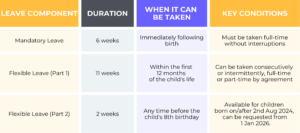
For single-parent families, leave has been significantly extended to 32 weeks. This comprises 28 weeks of core leave (with 6 weeks mandatory) plus 4 additional flexible weeks to be used before the child turns eight. It’s also important to note that for the biological mother, up to four of the 11 flexible weeks can be taken before the expected birth date.
Employer obligations during maternity leave
When an employee takes maternity leave, the employer has specific responsibilities. Fulfilling these duties is critical to maintaining legal compliance and safeguarding the company against disputes and penalties.
Your primary obligations include:
- Collecting and verifying documentation: You must request and keep on file the appropriate medical certificates confirming the pregnancy and the expected due date. Following the birth, a copy of the birth certificate is required to formalise the leave period.
- Managing payroll and social security: While Social Security covers the salary payments during leave, the employer is responsible for coordinating this process. This involves suspending the employee’s ordinary salary and ensuring the Social Security benefit is processed correctly. Also, contributions to the state system must be maintained during the leave period.
- Ensuring job protection: An employee on maternity leave is protected from dismissal. Any termination during this period is presumed to be discriminatory and unfair, requiring the employer to provide compelling evidence to the contrary. Furthermore, the employee’s contract is suspended, but their right to return to their same job, or an equivalent position, is guaranteed.
- Compliance with anti-discrimination laws: You must ensure that the employee does not suffer any detriment or discrimination due to their pregnancy or leave. This includes protecting their maternity rights related to promotion, training opportunities, and workplace treatment.
Returning to work after maternity leave
The transition back to work is a regulated process. Upon completion of their maternity leave in Spain, the employee has the right to return to their previous role or an equivalent position with the same salary and conditions. Denying this right can lead to serious legal consequences, including claims for unfair dismissal.
Employers should initiate a return-to-work discussion well before the leave ends. These conversations are an opportunity to plan a smooth reintegration. You can also discuss any potential flexible working arrangements the employee might be entitled to, such as reduced hours for childcare support in Spain.
Note that Spanish law allows parents to request schedule adjustments until their child reaches a certain age. While this may involve a proportional salary reduction, the request cannot be unreasonably denied. Managing this process with clarity and support is key to retaining valuable talent and maintaining a positive work environment.
Additional maternity and parental rights
Beyond the core maternity leave, Spanish law provides a suite of supplementary rights that form part of the broader family leave framework. Being aware of these ensures comprehensive compliance and support for your employees.
These include:
- Reduced working hours: Employees are entitled to reduce their working hours for childcare purposes until their child is 12 years old. Additionally, remuneration is adjusted proportionally.
- Unpaid leave: Parents can request an unpaid leave of absence for childcare support in Spain for up to three years. Note that the first year is calculated as effective service for seniority purposes. During this period, the job is not protected, but the employee has a preferential right to fill vacant posts in the company.
- Lactation leave: This separate entitlement allows for one hour of daily absence from work, which can be split into two 30-minute periods. This right can also be accumulated into full-time days. It typically adds up to about two to three extra weeks of leave, which can be transferred to the other parent.
- Leave for adoption or foster care: The same 19-week (or 32-week for single parents), fully paid leave entitlement applies in cases of adoption, guardianship, or foster care. This ensures equal support for all forms of parenthood.
- Robust protection against dismissal: An employee cannot be dismissed from the start of their pregnancy until after they return from maternity leave. That’s barring exceptional circumstances unrelated to the pregnancy or leave.
EOR support for maternity leave compliance
For international businesses without a local legal entity in Spain, managing these complex obligations can seem daunting. This is where our Employer of Record (EOR) becomes an invaluable partner. Our EOR serves as the official legal employer for your workforce in Spain, taking on the full administrative and legal burden of compliance.
An EOR ensures that your company adheres to all regulations concerning maternity leave in Spain by:
- Drafting compliant contracts: Creating employment contracts that explicitly outline all leave entitlements in line with Spanish law.
- Managing leave requests: Accurately processing leave applications, documentation, and communications with the employee.
- Coordinating payroll and social security: Ensuring the correct suspension of salary and the smooth payment of maternity benefits through Social Security, while handling all necessary declarations as part of Spanish payroll.
- Facilitating a smooth return-to-work: Supporting both the company and the employee through the reintegration process. That includes managing any requests for flexible working arrangements.
This model allows you to hire and support talent in Spain confidently, without the need to establish a local company. You’ll be secure in the knowledge that all aspects of maternity leave in Spain and other employment rights are being managed by our local experts.
Get in touch so we can help with your business expansion in Spain
Frequently asked questions
Who is eligible for maternity leave in Spain?
Eligibility extends to all biological mothers, including those through surrogacy, who are registered with and contributing to the Spanish Social Security system. This includes public sector workers, salaried employees, and the self-employed.
How much of the leave can be transferred to the other parent?
Under the current system, the leave is individual and non-transferable. Both the mother and the other parent are entitled to their own independent, equal periods of paid leave to encourage shared childcare.
Who funds the salary payments during maternity leave?
The salary is fully funded by the Spanish Social Security system and not the employer. Hence, employees receive 100% of their regulatory base salary, subject to a statutory cap. Furthermore, the employer’s role is administrative, ensuring the correct processing of the employee benefit.
What are the entitlements for single parents?
For single parents, paid leave doubles to 32 weeks for a birth, adoption, or foster care placement on or after 31st July 2025. This includes 28 weeks to be used in the first year and 4 additional weeks that can be used until the child turns eight.
How does the recent 2025 reform affect existing employees?
The reform increases the total paid leave to 19 weeks per parent. For children born on or after 2nd August 2024, parents are entitled to two additional paid weeks. These weeks can be requested from 1st January 2026, so employers should identify eligible employees and prepare for these requests.
What is the process for an employee to request maternity leave?
The employee must provide their employer with a medical certificate confirming the pregnancy and due date. After the birth, they must submit the family book or birth certificate. The employer then processes the leave with Social Security, which funds the payment.
Can maternity leave run concurrently with paid sick leave?
No, these are separate entitlements. If a pregnant employee is signed off on sick leave, this runs until the birth. Maternity leave in Spain then begins independently, starting the day after the birth. Overall, the two types of leave are distinct and do not overlap.
How is maternity leave calculated for part-time workers?
Part-time employees are entitled to the full 19-week duration of leave. However, the maternity benefits payment is calculated based on their part-time regulatory base salary, reflecting their actual working hours. Finally, all other rights and protections apply fully.


