 Belgique
 España
 France
 Germany
 India
India
 Italia
 Luxembourg
 Netherlands
 Polska
 Portugal
 Suisse
 United Kingdom
 United States
What Is the Average Salary in Italy Today?


Whether you’re considering a career move, planning a relocation, or simply benchmarking your position, knowing the average salary in Italy is the first step. This guide breaks down the numbers for 2025. We’ll explore how your profession, experience, and location within the country shape your earning potential.
Furthermore, we’ll look at the latest data on the average income in Italy, examine the average salary by profession, and provide the context you need to assess the salary in Italy.
Overview of average salaries in Italy
The average salary in Italy is often cited as around €3,600 per month, which translates to an annual gross figure of around €43,200. However, this single number can be misleading without context.
A more accurate picture comes from considering the median salary. That’s the point at which half of workers earn more and half earn less. Italy’s median monthly income is about €2,700, suggesting that the average can be skewed higher by top earners. Furthermore, Italy’s salary range is broad, with lower earners making around €930 per month and high earners reaching up to €16,300.
Two of the most critical factors influencing these income levels are education and professional experience. While the premium for higher education may be less pronounced for younger workers in Italy compared to other countries, it becomes more significant later in one’s career.
However, experience consistently commands a premium. The progression from entry-level to senior roles can substantially increase earnings. This is illustrated in the table below for selected professions:
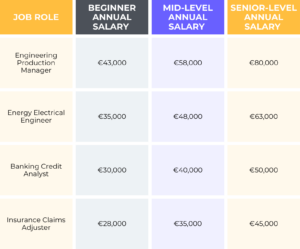
Note that employee wages are primarily determined by contrattazione collettiva nazionale (CCNL), or national collective bargaining agreements. These set minimum pay scales and conditions for different industries. This system covers most workers, though it can lead to complexities and variations.
Average salary in Italy by profession
Your chosen career path is perhaps the single greatest factor in your earning potential in Italy. The average salary by profession varies dramatically, reflecting:
- Global demand for specific skills
- The value of specialised education
- The structure of the Italian economy
High-skilled professions in sectors like medicine, law, and finance continue to top the charts. Furthermore, surgeons and doctors can command average monthly salaries of around €13,600, while judges and lawyers follow closely with averages around €11,400 and €9,230 respectively.
Bank managers and CEOs also feature regularly among the highest earners. These roles require significant qualifications and experience but offer financial rewards that are substantially above the national average.
For a broader view, the following list shows the typical pay scale across a range of common sectors, highlighting the diversity of opportunities:
- Journalism and Translation Services: €5,049
- Hotel and Tourism: €4,876
- Healthcare and Social Services: €2,927
- Teaching: €3,236
- Information Technology (IT): €2,728
- Childcare: €2,739
- Engineering: €2,529
- Accounting and Finance: €2,398
- Construction: €2,211
- Retail: €2,111
The difference between the public and private sectors is another key consideration. Data suggests that public sector workers in Italy earn slightly more on average than their private sector counterparts. The public sector is also noted for having a significantly smaller gender pay gap of around 4-5%. That’s compared to the private sector where the gap can be much wider
Salaries in Italy by region
If profession is the first major factor determining salary, geography is undoubtedly the second. Italy is famously characterised by a significant economic divide between the North and the South. That’s clearly reflected in income levels and the average salary in Italy by region.
The northern regions, home to the country’s industrial and financial heartlands, consistently offer higher wages. Lombardy, with its capital Milan, is the standout performer. It’s where workers have the highest mean gross salary in the country.
The northeastern regions, including Veneto and Emilia-Romagna, also boast strong economies and higher-than-average household incomes. This economic strength translates directly into higher employee wages across most sectors.
Central Italy, including Lazio (where Rome is located) and Tuscany, tends to offer salaries that are closer to the national average. However, they are still generally higher than in the South. The capital Rome, as a major administrative and cultural centre, provides a distinct job market with its own opportunities.
Southern Italy and the major islands of Sicily and Sardinia report the lowest average salaries. The average net annual household income in the South is around €29,451, compared to €41,224 in the Northeast. These differences are worth knowing when relocating to Italy.
Reasons for the average salary differences
This divide stems from long-standing socio-economic factors. The North has a more diversified economy with a strong focus on manufacturing, finance, and international trade. The South, while developing, has historically faced challenges related to infrastructure and investment.
For anyone considering a move to Italy, this regional variation means that a salary that affords a comfortable lifestyle in Sicily might be insufficient in Milan. These factors need to be considered when evaluating the ideal salary for the region.
Cost of living vs salary in Italy
Understanding the relationship between what you earn and what you spend is fundamental to assessing your quality of life. While the average salary in Italy provides a national benchmark, its true value can only be measured against the cost of living. This varies dramatically from the affluent north to the more affordable south.
This section will evaluate whether typical employee wages are sufficient to cover living costs. We’ll examine key expenses from housing to groceries and how they impact your disposable income.
The national average: A baseline comparison
The average net monthly salary in Italy is approximately €1,650 to €2,200 after tax. When compared to the average monthly living costs for a single person, which are estimated at around €888 to over €2,000 (excluding rent), a challenging financial picture emerges. That’s particularly true in urban centres.
However, supporting a family on a single average income would be difficult, as the estimated monthly costs for a family of four range from €3,000 to €4,500.
Breaking down the major cost components
To understand where your salary goes, it’s essential to look at the main components of the monthly budget.
- Housing costs: This is typically the largest expense. Rent for a one-bedroom apartment in a city centre can range from €700-€1,600 in Milan to around €350-€430 in southern cities like Lecce. In Rome, the average is about €1,000.
- Utilities and communications: Basic utilities (electricity, heating, water, garbage) for an apartment average €130-€200 per month. Furthermore, a standard internet package adds another €25-€35.
- Food and groceries: A single person’s monthly grocery bill is typically between €200 and €300. Also, shopping at local markets for fresh produce can help reduce this cost significantly.
- Transportation: Italy has excellent public transport, and a monthly pass costs €35-€50. However, car ownership is expensive due to some of the highest fuel prices in Europe, at around €1.78-€1.80 per litre.
Salary trends and economic outlook in Italy
The economic landscape is constantly evolving, and the trends shaping employee wages are crucial for a forward-looking perspective. As we move through 2025, several key trends are influencing the salary in Italy 2025 outlook. Here are the notable ones:
- Economic growth: Italy’s real GDP growth is projected to be 0.7% in 2025, strengthening to 0.9% in 2026. This growth is primarily supported by domestic demand and investment linked to the National Recovery and Resilience Plan (NRRP).
- Inflation and labour market: Inflation is forecast to remain low, at 1.8% in 2025. Furthermore, the unemployment rate is expected to fall to around 5.9%, indicating a tightening labour market.
- Wage trends: Nominal wages are projected to grow moderately. The OECD reports that average yearly wages are expected to reach €34,275 by the end of 2025.
Highest paying jobs in Italy in 2025
The medical and legal fields remain the most lucrative. Medical professionals, particularly surgeons and specialists, are at the pinnacle of earning potential. They have average monthly salaries reaching €13,600.
This reflects the extensive training and high level of responsibility inherent in the role. Similarly, judges and experienced lawyers command high salaries. In fact, they average €11,400 and €9,230 per month respectively. That’s tied to their expertise and the seniority of their positions.
The corporate world also offers a clear path to high earnings. Chief Executive Officers (CEOs) and Chief Financial Officers (CFOs) are compensated for their strategic leadership. Such positions have average monthly salaries of around €8,140 and €7,600.
Final thoughts
Trying to figure out Italy’s job market reveals a landscape of contrasts. Before finding a job, you’ll want to understand the average salary in Italy and regional disparities. While the economic outlook for 2025 shows modest growth and recovering wage trends, securing a position that matches your skills and financial expectations requires local expertise.
Whether you’re a professional relocating to Italy or a company hiring local talent, Employer of Record (EOR) service simplifies contracts, payroll, and compliance—so you can focus on growth.
Find out how we support talent and companies in Italy
Frequently asked questions
What is a good salary in Italy?
A good salary in Italy depends heavily on your location and lifestyle. A monthly net income of €1,500-€2,000 could be comfortable in a small southern town, covering living costs with some disposable income.
However, in Milan or Rome, a net salary of €2,500-€3,000 or more would be needed for a similar standard of living, due to significantly higher housing costs.
Does Italy have a national minimum wage?
No, Italy is one of the few EU countries without a statutory national minimum wage. Instead, minimum wages are set through sector-specific national collective bargaining agreements.
How much are taxes on salaries in Italy?
Italy has a progressive income tax system, meaning the rate increases as your income rises. Furthermore, deductions for taxes and social security contributions can be significant. It reduces your gross salary to your net take-home pay.


