 Belgique
 España
 France
 Germany
 India
India
 Italia
 Luxembourg
 Netherlands
 Polska
 Portugal
 Suisse
 United Kingdom
 United States
5 Proven Strategies to Boost Your Freelance Income in 2026


Many freelancers hit a frustrating ceiling. You’re consistently busy, meeting deadlines, and pleasing clients, yet your bank balance seems stuck in a loop. The traditional hustle—working more hours—has a hard limit. There are only so many billable days in a month.
But 2026 presents a different path, one defined not by grinding longer, but by working smarter. The global shift towards remote work jobs and the digitalisation of services have created unprecedented opportunities for freelancers to increase their freelance income without sacrificing their well-being.
This isn’t about working harder, but about re-engineering your freelance career for maximum impact and profitability. We’re moving beyond the gig economy and into the era of the intentional, scalable freelance enterprise.
Key takeaways
- Systematically increasing your rates is one of the most direct ways to boost your freelance income.
- Creating multiple income streams, from digital products to retainers, builds a more resilient and profitable freelance business growth plan.
- Specialising in high-value, in-demand niches allows you to command premium rates and stand out in a crowded market.
- Improving client retention is more cost-effective than constant new business development and provides a stable freelance income.
- Leveraging automation and smart outsourcing frees up your time to focus on high-impact work that increases your earnings.
Raise your rates the right way
Let’s be direct: if you haven’t increased your prices in the last 12 months, you’ve effectively taken a pay cut due to inflation. Raising your rates is the most straightforward lever to pull for increasing your freelance income. The hesitation is understandable:
- Fear of losing a good client
- Being perceived as greedy
- Pricing yourself out of the market
But confidence here is born from preparation and a clear understanding of your value.
First, timing is everything. The ideal moments to propose a rate increase are before renewing a long-term project, at the start of a new quarter, or when you have a significant new testimonial or portfolio piece to showcase. Don’t spring it on a client mid-project.
How to communicate the proposal
When you communicate the change, be professional and direct. Schedule a call or send a clear email. Frame it around the continued value you provide and the quality of your work. You could say, “As we look ahead to the next quarter, I’m updating my rates for all ongoing clients to reflect the consistent results I deliver. My new rate will come into effect from [specific date].”
The most powerful tool in your arsenal is proof. A compelling collection of testimonials and a portfolio of work that demonstrates tangible outcomes—increased sales, improved efficiency, higher engagement—makes your case for you.
It shifts the conversation from cost to investment. For international freelancers, remember that your value isn’t tied to your local cost of living, but to the global market value of your expertise. A client in London benefits from the same high-quality output whether you’re in Lisbon or Cape Town, and your rates should reflect that universal value.
Diversify your income streams
Relying solely on client work is a volatile strategy. A dry spell in projects means your freelance income drops to zero. The antidote is diversification—building multiple revenue channels that create a more stable and robust financial foundation. This is a core principle of sustainable freelance business growth.
Think of your income as a pyramid. The base is your core client work. The next level is recurring revenue, which provides predictable cash flow. This could be in the form of retainer agreements, where a client pays a monthly fee for a set number of hours or ongoing access to your skills. This model is golden for creating stability.
Then, explore creating your own products. This leverages the expertise you use in your client work and packages it for a wider audience. Consider:
- Digital products: An ebook, a premium video course, or a set of professionally designed templates related to your niche. Once created, these can be sold repeatedly with minimal ongoing effort, creating a semi-passive income stream.
- Complementary services: If you’re a web designer, could you offer website maintenance packages? If you’re a writer, could you offer SEO audit services? These add-ons provide more value to existing clients and increase your project value.
Diversification isn’t about becoming a jack-of-all-trades, but about strategically leveraging your core knowledge into multiple formats. This approach not only boosts your earnings but also enriches your freelance lifestyle by giving you more control and variety in your work.
Specialise in high-demand skills
The “generalist” freelancer often struggles to stand out and command top rates. The path to higher pay and more interesting work almost always involves specialisation. By focusing on a specific niche, you transform from a commodity into a sought-after expert.
Note that clients are willing to pay a premium for someone who speaks their language and understands their unique challenges intimately.
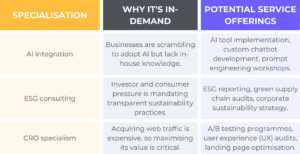
So, what are the best freelance skills for 2026? The current freelancing trends point towards the intersection of technology and strategic thinking. High-demand areas include:
- AI integration and prompt engineering: Businesses need professionals who can implement and optimise AI tools for content, design, and data analysis.
- Sustainability and ESG consulting: As companies face pressure to become more environmentally and socially responsible, expertise in this area is increasingly valuable.
- Cybersecurity auditing for SMEs: The shift to remote work has made even small businesses vulnerable, creating a huge demand for security expertise.
- Conversion rate optimisation (CRO): In a competitive digital landscape, the ability to turn website visitors into paying customers is a superpower.
Choosing a niche isn’t about limiting yourself. Instead, it’s about focusing your marketing efforts. To specialise, start by identifying where your interests, your existing skills, and market demand overlap.
Then, immerse yourself. Create content about that niche, network with professionals in that industry, and refine your service offerings to solve their specific problems. You become the obvious choice, and that is a powerful position to be in.
Here’s a table that summarises the niches mentioned above:
Improve client retention
The relentless pursuit of new clients is expensive and time-consuming. In contrast, nurturing existing relationships is the engine of efficient freelance business growth. A retained client means saved marketing time, a predictable income stream, and often, valuable referrals. Learning how to make more money as a freelancer is as much about keeping good clients as it is about finding them.
Increasing loyalty starts with exceptional communication. Therefore, be proactive and not reactive. Also, provide regular updates before the client has to ask. Anticipate their needs and offer insights that go beyond the immediate scope of work. Ideally, show them you’re a strategic partner, not just a task-completer.
Retainers and appreciation
Aim to formalise these relationships into retainer agreements. A retainer provides stability for you and priority access for the client. It’s a win-win. Frame it as a way to ensure they always have your expertise on tap, allowing for faster turnaround and more strategic, long-term planning.
Finally, never underestimate the power of a simple “thank you.” Small gestures of appreciation, like a personalised note or a small gift on a work anniversary, can significantly strengthen a business relationship.
The goal is to make your clients feel so valued and well-served that the thought of looking for another freelancer never crosses their mind. This loyal base becomes the foundation upon which you can confidently build the rest of your freelance career.
Automate and streamline your workflow
Time is the freelancer’s most precious and non-renewable resource. Every hour spent on administrative tasks, chasing invoices, or managing files is an hour not spent on high-value, income-generating work. The key to unlocking more capacity—and therefore more freelance income—is to systemise and automate the repetitive parts of your business.
Start by auditing your week. Identify the tasks that are repetitive, low-value, and essential. For most freelancers, this includes invoicing, scheduling meetings, social media promotion, and file backup. Then, find the tools to handle them.
- Finance: Use an app to track time, create invoices, and manage expenses.
- Scheduling: A tool allows clients to book meetings directly in your calendar, eliminating the back-and-forth emails.
- Marketing: Use a social media scheduler to plan and publish your content in batches.
- Communication & project management: Platforms like Trello or Asana keep projects on track and centralise client communication, reducing email clutter.
Once you’ve automated what you can, consider outsourcing the tasks that can’t be automated and don’t require your specific expertise. This could mean hiring:
- A virtual assistant for a few hours a week to handle admin
- A bookkeeper to manage your accounts
- A fellow freelancer to take on overflow work
This investment directly fuels freelance business growth by freeing you to focus on the work that only you can do—the strategic, creative, and high-level tasks that clients pay a premium for. Embracing this efficient, streamlined approach is a hallmark of a modern, successful freelance lifestyle.
How Hightekers can help
Dealing with the administrative side of freelancing—from complex tax obligations to client invoicing and local compliance—can divert your focus from where it truly belongs: growing your business.
This is where a streamlined approach makes all the difference. Through our unique employment model, Hightekers serves as your legal employer in your country of residence. We manage the entire backend operation, including reliable payroll, full tax handling, and ensuring complete legal compliance.
This allows you to concentrate fully on your professional work and income growth, free from administrative burdens.
Ready to get started?
Discover how Hightekers can help you work smarter and earn more
Frequently asked questions
What is the quickest way to increase my freelance income?
The most immediate impact often comes from raising your rates for new clients. For existing clients, you can introduce higher-priced packages with additional value, such as faster turnaround times or strategic consultations. It effectively increases your earnings without a direct rate negotiation.
How can I identify the best freelance skills to learn?
Focus on skills that align with emerging freelancing trends, such as AI implementation, data analysis, or sustainable business practices. Research industry reports and job postings for in-demand roles to see which competencies are consistently valued and likely to remain relevant for the next few years.
How do I transition a project-based client to a retainer?
Propose a retainer by highlighting the benefits for them: consistent availability, priority service, and a cost-effective model for ongoing needs. Also, suggest a trial period for a retainer package that addresses their recurring tasks, making it a low-risk, high-value decision for the client.


