 Belgique
 España
 France
 Germany
 India
India
 Italia
 Luxembourg
 Netherlands
 Polska
 Portugal
 Suisse
 United Kingdom
 United States
Permanent Contract in the Netherlands: What It Means for Employees


For any professional building a career in the Netherlands, few documents are as consequential as the employment contract. While temporary roles have their place, the permanent contract represents the gold standard for long-term job stability and integration into the Dutch workforce. For expats and international hires, understanding what this document means is crucial to securing your future.
This guide breaks down the Dutch permanent contract into clear, actionable insights. We will explore the robust rights it grants employees, the strict obligations it places on employers, and what you can expect from a long-term professional life in this dynamic country. We’ll also share how an Employer of Record can support employees and employers with permanent contracts.
What is a permanent contract in the Netherlands?
In simple terms, a permanent contract (known in Dutch as a contract for onbepaalde tijd) is an open-ended employment agreement with no specified end date. It forms the foundation of a continuous working relationship until it is terminated by the employee through resignation or by the employer following strict legal procedures.
The Dutch employment law system, primarily outlined in the Dutch Civil Code (Burgerlijk Wetboek), is designed to offer strong protections to employees. This protective nature is a defining feature of the professional landscape, making a permanent contract a significant milestone.
It is the most secure form of employment, distinguishing itself from temporary arrangements by offering unparalleled job security. Even a verbal agreement can be legally considered a permanent contract under certain conditions.
For example, if someone works for you every week for three months or at least 20 hours per month. However, a written Dutch employment contract is always recommended for clarity.
Who qualifies for a permanent contract?
There are two primary ways an employee becomes entitled to a permanent contract under Dutch law, governed by the “chain rule” or ketenregeling:
- After three consecutive contracts: If an employer offers an employee more than three consecutive fixed-term contracts.
- After a three-year period: If an employee works for the same employer on a series of temporary contracts for a period exceeding three years.
Once either of these conditions is met, the law automatically converts the employment status to permanent. The only way to “break the chain” of temporary contracts is if there is a gap of more than six months between contracts. This rule ensures that employers cannot keep employees on a string of temporary contracts indefinitely.
Rights and benefits for employees
Securing a permanent contract unlocks a comprehensive suite of rights and benefits designed to provide financial security and a healthy work-life balance.
Job security and protections against dismissal
The most significant right is robust job security. An employer cannot simply end a permanent contract. Termination requires legally recognised grounds. In most cases, it must be approved by an official body. The two main paths for termination are:
- UWV (Employee Insurance Agency): The employer must apply for permission to dismiss for economic reasons (redundancy) or long-term disability.
- The Subdistrict Court (Kantonrechter): The employer must seek court approval to dissolve the contract for personal reasons, like consistent underperformance or a seriously damaged working relationship.
This process is intentionally complex to prevent arbitrary dismissals. Furthermore, employees are protected from being fired while sick during the first two years of illness, as well as during pregnancy or maternity leave.
Financial security: Transition payment and benefits
A key financial benefit is the right to a transition payment (transitievergoeding). This severance pay is designed to support you as you transition to a new role. From the very first day of employment, you are entitled to this payment if your contract is terminated against your will (unless due to serious misconduct).
The amount is calculated as one-third of your gross monthly salary for each full year of service.
The comprehensive benefits package typically includes:
- Holiday allowance: A mandatory payment of at least 8% of your annual gross salary, usually paid in a lump sum each May.
- Pension: While everyone who retires in the Netherlands is entitled to a state pension, most permanent employees are also enrolled in a company pension scheme, to which both you and your employer contribute.
- Generous leave entitlements: Full-time employees are entitled to a minimum of 20 vacation days, though 25 is more common. You also benefit from fully paid maternity leave (16 weeks) and partially paid parental leave.
Other key protections
- Notice periods: If you choose to resign, the statutory notice period is typically one calendar month. For employers, the required notice period increases with your tenure, starting at one month and increasing after five years of service.
- Training and development: Your employer is obligated to provide and fund any training necessary for you to perform your job effectively. Any clause requiring you to repay costs for such mandatory training is not legally valid.
- Protection against non-competes: A non-compete clause is only valid in a permanent contract if the employer can demonstrate a compelling business interest, and it must be drafted precisely. In fixed-term contracts, such clauses are generally unenforceable.
Employer Obligations
When hiring on a permanent basis, Dutch law imposes significant responsibilities on employers to ensure fair and lawful treatment of staff.
Providing a written statement and adhering to the law
One of the first obligations is to provide a written statement of employment details within one week of the employee starting work. This document must include essential terms like job title, salary, working hours, and the duration of any trial period.
Furthermore, employers must strictly adhere to the Dutch Civil Code and other relevant regulations, such as the Working Conditions Act (Arbeidsomstandighedenwet), which mandates a safe physical and mental work environment.
Practical tips for avoiding legal disputes
- Document everything: Keep thorough records of performance reviews, feedback sessions, and any disciplinary actions.
- Explore redeployment: Before considering dismissal for redundancy, employers are legally obliged to see if there is a suitable alternative position within the organisation for the employee.
- Seek consent for major changes: Unilaterally changing core elements of the employment contract, such as primary work location or fundamental duties, is not permitted. For significant changes, the employer must seek the employee’s agreement.
Temporary vs permanent contracts
Understanding how a permanent contract differs from a temporary one is key to recognising its value. The table below highlights the core distinctions:
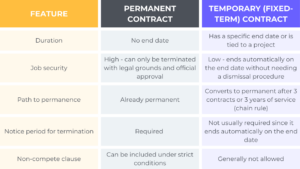
Converting a temporary contract into a permanent one
The conversion from a temporary to a permanent contract is not a matter of negotiation but of legal right once the conditions of the chain rule are met. This automatic conversion is a powerful employee protection.
If your temporary contract is not renewed because the chain rule has been triggered, you may still be entitled to a transition payment.
Future outlook for permanent contracts in the Netherlands
The Dutch labour market continues to value the stability offered by permanent contracts, and the legal framework consistently strengthens employee protections. Recent and upcoming legal developments signal a future where the rights of permanent employees are further clarified and reinforced.
Increased employer scrutiny
One significant trend is the courts increasing scrutiny of employer decisions. For instance, a recent Supreme Court ruling reinforced that the obligation to seek redeployment for an employee also applies to the cumulative ground for dismissal, a more complex dismissal route.
Furthermore, changes to workplace policies, such as working-from-home arrangements. They are increasingly being seen as subject to consultation with and consent from the works council, giving employees more collective say in their working conditions.
Importance of permanent contracts
For expats and international talent, the stability of a permanent contract is often a prerequisite for long-term settlement, such as obtaining a mortgage or securing a long-term visa.
Sectors with high demand for skilled international workers—like technology, engineering, life sciences, and finance—frequently use permanent contracts to attract and retain top talent.
For any professional committed to building a life in the Netherlands, the permanent contract remains the cornerstone of a secure and prosperous career.
How an EOR can help
Many international companies want to hire workers in the Netherlands but cannot issue a Dutch-compliant permanent contract because they lack a local legal entity. An Employer of Record is a solution that addresses these concerns.
Fortunately, an EOR:
- Acts as the legal employer in the Netherlands and can issue fully compliant permanent contracts
- Handles payroll, tax withholdings, social security contributions, and Dutch benefits such as paid leave and pension contributions
- Ensures all employment terms follow Dutch labour law and collective bargaining agreements (CAOs)
- Reduces legal and administrative risks related to termination procedures, record-keeping, and compliance
- Enables companies to hire long-term Dutch-based employees without setting up a Dutch entity
Final thoughts
The pathway to a permanent contract in the Netherlands unlocks unparalleled job stability and legal protections, forming the bedrock of a secure career. However, for international companies and global talent, the intricate web of Dutch labour law can be a significant hurdle.
This is where a trusted Employer of Record (EOR) like Hightekers becomes an indispensable partner. By acting as the legal employer for your team in the Netherlands, we assume all compliance risks, manage complex payroll, and ensure every permanent contract is perfectly aligned with local regulations.
This allows both businesses and employees to focus on growth and performance.
Contact Hightekers for contract compliance in the Netherlands
Frequently asked questions
What is the difference between a permanent and a temporary contract in the Netherlands?
A permanent contract has no end date and offers strong dismissal protections, requiring an employer to get official permission to terminate it.
In comparison, a temporary contract has a fixed end date and automatically expires on that date without the need for a dismissal procedure.
Can my employer easily fire me if I have a permanent contract?
No, Dutch law makes it deliberately difficult. Your employer must have a legally recognised ground (like redundancy, long-term illness, or consistent underperformance).
In most cases, obtain prior permission from the UWV agency or the subdistrict court before they can dismiss you.
What is a transition payment (transitievergoeding)?
It is a statutory severance pay. If your permanent contract is terminated by your employer (and it’s not your fault), you are entitled to a payment from your first day of employment.
Furthermore, it’s calculated as one-third of your gross monthly salary for each full year you worked for the employer.
How many holiday days am I entitled to with a permanent contract?
By law, you are entitled to a minimum of four times your weekly working hours. For a standard 40-hour week, this is 20 days. However, many collective labour agreements or company policies offer 25 or more days per year.


