 Belgique
 España
 France
 Germany
 India
India
 Italia
 Luxembourg
 Netherlands
 Polska
 Portugal
 Suisse
 United Kingdom
 United States
Understanding the Tax Code in Spain: A Complete Guide


For expats relocating to Spain, remote workers setting up a new life in the sun, and companies supporting a distributed team, understanding your Spanish Tax Code is the essential first step to a compliant experience.
This complete guide will walk you through what this code is, why your NIE or NIF number is so crucial, and how it affects everything from your payroll to your annual tax return. Furthermore, you’ll learn how to obtain yours, navigate residency rules, and ensure your financial life in Spain begins on solid ground.
What is a Spanish tax code?
In many countries, the term ‘tax code’ refers to a complex set of laws. In Spain, when people talk about your personal Tax Code, they are almost always referring to your unique tax identification number. This number is your fiscal fingerprint, used to track your tax obligations and is essential for nearly every financial and legal activity you will undertake.
For individuals, this takes one of two main forms:
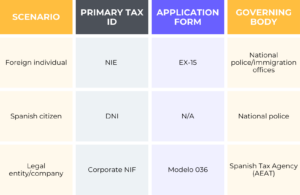
- NIE (Numero de Identificacion de Extranjero): This is the Tax Identification number for foreign nationals. If you are not a Spanish citizen, your NIE is your primary Tax Code for all purposes, from opening a bank account to filing your Spanish income tax return. Its format is a letter (X, Y, or Z), followed by seven numbers and a final letter (For example, X1234567A).
- DNI (Documento Nacional de Identidad): For Spanish citizens, the national ID number automatically serves as their tax number, known as the NIF (Numero de Identificacion Fiscal).
The umbrella term for the list of tax codes is NIF number. For expats, your NIE is your NIF, and you will use this number constantly. When you file your annual income tax return, the Agencia Tributaria—Spain’s State Tax Administration Agency—will use it to process your declaration.
If you work as a freelancer, it must appear on every invoice you issue. In short, without this number, you cannot formalise your financial life in Spain.
How to obtain your Spanish tax code
Securing your NIE is your first and most important administrative task. The process varies slightly depending on whether you are applying from outside Spain or from within the country, but the core requirements are similar.
The application is typically handled by the Spanish National Police. You can apply at a Spanish consulate in your home country before you move, or at an immigration office (Extranjeria) or designated police station if you are already in Spain. Be aware that getting an appointment can take time, especially in major cities, so it is wise to plan this well in advance.
Required documents and process
You will need to complete the official EX-15 application form and the Modelo 790 (Code 012) payment form. Along with these, prepare the following:
- A valid passport and a photocopy.
- Two recent passport-sized photos.
- Proof of your reason for applying, such as a job contract, proof of property purchase, or a letter of acceptance from a Spanish university.
- The paid Modelo 790 form, which proves you have settled the administrative fee (approximately €12).
Once submitted, the process usually takes a few weeks. Your NIE is a permanent number that does not expire, though the physical card for non-EU nationals (TIE) may need renewal.
Here’s a table summarising the process:
Understanding Spanish Tax Residency
Your tax residency status is the cornerstone of your obligations in Spain. It determines which of your income is taxable and how you will be taxed. The rules are clear, and understanding them is important.
You are considered a Spanish tax resident if you meet either of the following conditions:
- You spend 183 days or more in Spain during a calendar year. The days do not need to be consecutive, and even temporary presence counts unless you can prove your tax residency elsewhere.
- Your main economic interests are in Spain (such as the base of your business or professional activities), or your spouse and dependent children are resident in Spain.
A critical point for expats to note is that Spain does not recognise split-year tax residency. You are either a resident or a non-resident for the entire tax year.
Implications of Residency
- Tax residents: Are subject to Personal Income Tax (IRPF) on their worldwide income. This means you must declare all income earned both inside and outside Spain to the Agencia Tributaria. Additionally, Spain operates a progressive tax system, with rates ranging from 19% to 47% depending on your income and autonomous community.
- Non-residents: Are only taxed on income they earn within Spain, such as rental income from a Spanish property or income from a Spanish employer, typically at a flat rate of 24%.
How your Spanish tax code affects payroll and taxes
Once you have your NIE, it becomes the linchpin for all financial transactions, especially those related to your income. How it functions depends largely on the employment status.
For employees
If you are employed by a company, whether Spanish or a foreign company with a legal entity in Spain, your NIE is used to process your payroll. Your employer will use it to calculate and deduct the correct amount of Personal Income Tax (IRPF) and Social Security contributions from your salary.
These deductions are based on your anticipated annual income and personal circumstances. Furthermore, your Tax Code ensures that your tax payments are accurately recorded against your name throughout the year, which is crucial for your annual tax return.
For the Self-Employed (Autonomos)
Freelancers and remote workers who register as self-employed use their NIE as their official Tax Code for all business activities. You are required to:
- Include your NIE on all invoices you issue.
- File quarterly VAT (Value Added Tax) returns using Form 303, if applicable.
- Make quarterly payments on account of your income tax using Form 130.
- File an annual income tax return (Form 100) that consolidates your yearly income.
Freelancers can deduct legitimate business expenses, which can lower their overall taxable income. However, they are also responsible for fixed monthly Social Security contributions. These start at approximately €290 and provide access to healthcare and a state pension.
A note for digital nomads and remote workers
Spain’s Digital Nomad Visa offers a potential tax advantage. Successful applicants may benefit from the special tax regime (often called the “Beckham Law“), which allows them to pay a flat tax rate of 24% on their Spanish-source income up to €600,000. That’s instead of the standard progressive rates for a period of six years.
Updating or correcting your Spanish tax code
Your relationship with your NIE is for life since the number itself does not change. However, the information associated with it and your tax circumstances will need updating. Hence, the Agencia Tributaria must be informed of significant changes, such as a change of address, marital status, or a substantial shift in your income.
The primary way to interact with the Agencia Tributaria for updates or corrections is online using a digital certificate, which you can obtain once you have your NIE. For in-person assistance, you can schedule an appointment at your local tax office through the AEAT website.
If you discover an error on a tax return filed with your NIE, it is your responsibility to correct it. You can file a supplementary tax return to amend the mistake. For complex situations or if you receive a notification from the Tax Agency about a discrepancy, seeking professional help from a tax advisor or Employer of Record is recommended.
How an EOR can help
An Employer of Record is a compliant solution for companies that want to employ someone who becomes a Spanish tax resident but cannot legally hire in Spain on their own.
The benefits of an EOR include:
- Acts as the legal employer in Spain when a worker becomes a Spanish tax resident
- Ensures proper registration for NIF/NIE, social security (Seguridad Social), and Agencia Tributaria
- Manages fully compliant payroll, tax withholdings, social contributions, and Spanish payslips
- Provides Spain-compliant employment contracts aligned with statutory requirements and collective bargaining agreements
- Helps companies avoid risks like misclassification, illegal payroll, or permanent establishment
- Allows employees to relocate to Spain while staying fully compliant — without the company needing to set up a Spanish entity
Final thoughts
Dealing with the Spanish tax system, from securing your essential Tax Code to understanding residency and compliance, can feel daunting. The bureaucratic procedures and nuanced rules present real challenges for expats and international businesses. This is where expert guidance becomes invaluable.
Firms like Hightekers specialise in helping individuals and companies overcome these exact complexities. They provide practical support, from managing your NIE application and tax registration to ensuring your payroll and filings are fully compliant. This allows you to focus on enjoying your new life in Spain with complete peace of mind.
Contact Hightekers today to ensure Spanish tax compliance
Frequently asked questions
What is the difference between an NIE and a NIF?
The NIE is the identification number for foreigners, and it’s the general term for a tax identification number. For expats, your NIE serves as your NIF for all tax purposes. For Spanish citizens, their DNI is their NIF.
Do I need a Spanish Tax Code if I don’t plan to work but will live in Spain?
Yes. You will need an NIE to perform essential tasks such as opening a bank account, signing a long-term lease or buying property, setting up utilities, and accessing the healthcare system. It is fundamental to establishing your legal residence.
How long does it take to get an NIE number?
The processing time is typically around two to three weeks once you have submitted your complete application. However, securing an appointment to submit your documents can sometimes take weeks or even months in large cities, so you should start the process as early as possible.
Can I use my NIE for VAT purposes in Europe?
For intra-EU trade, businesses need a special VAT number. As a self-employed individual, you would obtain a VAT number (NIF-IVA), which is your NIE prefixed with ‘ES’ (For instance, ESX1234567A).
This allows you to issue and receive invoices exempt from VAT for services and goods traded within the EU.
What are the tax benefits for digital nomads in Spain?
Holders of the Digital Nomad Visa can often opt for a special tax regime, paying a flat 24% income tax on their Spanish-source earnings up to €600,000. That’s instead of the progressive rates that can go up to 47%, which can lead to substantial tax savings.


