 Belgique
 España
 France
 Germany
 India
India
 Italia
 Luxembourg
 Netherlands
 Polska
 Portugal
 Suisse
 United Kingdom
 United States
Sick Leave in Spain: Rules, Rights, and Employer Obligations in 2025


Understanding the intricacies of sick leave Spain regulations is crucial for any company employing talent in the country. Spain’s labour laws offer robust protections for employees, ensuring income and job security during periods of illness.
For international employers and expatriates, navigating this system—from calculating Spain sick pay to complying with Social Security obligations—can be complex. This guide breaks down everything you need to know about sick leave in Spain, outlining the framework, employee rights, and the specific responsibilities that fall on employers when expanding to Spain.
What is sick leave in Spain?
In Spain, sick leave, formally known as incapacidad temporal (Temporary Incapacity), is a fundamental right protected under the Workers’ Statute. It is designed to protect an employee’s job and provide a financial safety net when they are unable to work due to illness or injury, whether related to their job or not.
Furthermore, the system is underpinned by Spain’s Social Security framework. When an employee is on authorised sick leave, the cost of their absence is shared between the employer and the National Social Security Institute (INSS). This ensures that employees are not left without an income during a vulnerable time.
The right to sick leave in Spain applies to most employees, including those on temporary contracts. This ensures broad protection across the workforce. For self-employed workers, a different set of rules applies, where the Social Security system directly provides the benefits after a qualifying period.
The core purpose of this system is twofold:
1. To safeguard the health and wellbeing of the employee by allowing them time to recover without financial panic.
2. To provide a legally mandated process for employers to manage absences, maintaining stability and predictability within the workplace.
Employee rights during sick leave
The law strongly protects Spanish workers on sick leave, guaranteeing paid leave, job security, and a clear process for taking time off.
The right to paid leave and job protection
The most immediate concern for an employee is often financial. The Spanish system provides a graduated level of pay during a period of Temporary incapacity in Spain. The following table outlines the standard structure for common illnesses or non-work-related injuries:
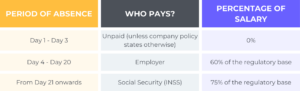
It is vital to understand that these percentages are not calculated against the employee’s full salary, but against a “regulatory base” (base reguladora). That’s a figure derived from their Social Security contribution base, which may be lower.
However, many collective bargaining agreements improve upon these minimums, sometimes topping up the payment to 100% of the employee’s regular salary.
Crucially, an employee’s job is protected during a legally authorised period of sick leave in Spain. Also, dismissal while on sick leave is generally considered discriminatory and is prohibited, providing significant peace of mind for the worker.
The maximum period for temporary incapacity is typically 365 days, which can be extended by an additional 180 days if recovery is expected within that time.
The right to take leave and the required process
Activating the rights to sick pay and job protection hinges on a clear, mandatory procedure. Both employees and employers must follow these steps precisely to ensure the absence is legally recognised and processed correctly.
Here’s the step-by-step process:
1. Obtain the medical certificate: The process begins the first day the employee is unable to work. They must visit a public health doctor or an approved mutual society to get a formal medical certificate (parte de baja medica). This document is the official proof of Temporary Incapacity Spain and is non-negotiable.
2. Notify the employer immediately: The employee must inform their employer of their incapacity on the first day of absence, following the company’s established communication protocol (for example, calling a line manager or HR).
3. Submit the certificate within 72 Hours: The employee must provide the medical certificate to the employer. That’s typically within three business days from the start of the leave. Also, many companies now accept digital copies via email.
4. Submit follow-up certificates: The initial certificate has a validity period. Before it expires, the employee must obtain and submit a new follow-up certificate (parte de confirmacion) from their doctor to extend the leave.
5. Provide the final discharge certificate: Upon recovery, the doctor issues a final discharge certificate (parte de alta). The employee must submit this to the employer immediately, confirming they are medically fit to return to work.
Employer obligations
When an employee goes on sick leave, the employer’s role shifts from direct management to one of administration and compliance. Fulfilling these duties is essential to avoid legal penalties and maintain a trustworthy relationship with your workforce.
Financial and administrative duties
The employer’s primary obligation is to manage the Spanish sick pay correctly. As outlined in the employee rights section, you are directly responsible for paying 60% of the employee’s regulatory base from the 4th to the 20th day of absence. From the 21st day onward, the Social Security system takes over the payments, but you have a key administrative role.
You must promptly report the sick leave to the Social Security authorities and coordinate with the INSS to ensure the employee receives their benefits without interruption. This includes providing necessary documentation and adjusting payroll accordingly.
Furthermore, you are obligated to keep detailed and accurate records of all sick leave absences, including the medical certificates and any payroll adjustments made. These records must be available for labour inspections.
Legal and compliance responsibilities
Beyond payments, your duty is to create a compliant and non-discriminatory environment. Hence, you cannot penalise an employee for taking legally authorised sick leave. This includes avoiding any negative impact on their:
- Performance reviews
- Bonus eligibility
- Promotion prospects
Recent legal developments, such as Law 15/2022, have reinforced that health status is a protected ground. Additionally, policies that indirectly discriminate against those who have taken medical leave can be challenged.
Upon the employee’s recovery, you must reintegrate them into their original job or an equivalent position. The law provides for a phased return-to-work process in some cases, which should be supported by a medical recommendation and agreed upon with the employee.
Overall, managing sick leave in Spain procedures correctly is not just about following the law—it’s about fostering a supportive company culture that values employee well-being.
How sick pay is calculated
Understanding the mechanics behind Spain’s sick pay is where many employers face confusion. The key is moving beyond the simple percentages and grasping the concept of the “regulatory base.” It’s the fundamental value used to calculate all Social Security benefits, including sick pay.
The regulatory base explained
Contrary to what some might assume, the 60% and 75% payments are not typically calculated against the employee’s full gross salary. Instead, they are based on the regulatory base. This figure is derived from the employee’s contribution base (base de cotizacion)—the amount of their salary that is subject to Social Security contributions. They have both monthly and daily values.
The exact calculation of the regulatory base for a common illness considers the employee’s contribution base from the previous month. The formula involves taking the employee’s monthly contribution base and dividing it by the number of days in that month to get a daily rate.
This daily rate is then used to determine the daily allowance the employee receives during their absence.
A practical calculation example
Imagine an employee with a monthly contribution base of €2,000 falls ill and is on sick leave for 25 days.
1.Establish the daily regulatory base: €2,000 / 30 days = €66.67 per day.
2. Calculate payment for days 4-20: The employer pays 60% of the daily base.
a. Daily allowance: 60% of €66.67 = €40.00.
b. Total for this period: 17 days * €40.00 = €680.00
3. Calculate payment for days 21-25: Social Security pays 75% of the daily base.
a. Daily allowance: 75% of €66.67 = €50.00.
b. Total for this period: 5 days * €50.00 = €250.00
4. Total sick pay received: The employee would receive €680.00 (from the employer) + €250.00 (from Social Security) = €930.00 for the 25-day period. The first three days are unpaid.
It is important to note that for a work-related illness in Spain or injury, the calculation differs, and the benefit is more generous. In fact, it’s often set at 75% of the regulatory base from the first day of absence.
Always confirm the specific details with the official Spanish Social Security website or a local payroll expert, as collective agreements can significantly alter these standard calculations.
How an EOR can help
Sick leave rights and employer obligations in Spain are highly regulated. Therefore, an Employer of Record (EOR) is a top solution for companies that want to employ someone in Spain but don’t have a local legal entity. They also need to comply fully with Spanish employment regulations.
Here’s how an EOR can help:
- Acts as the legal employer in Spain, ensuring full compliance with Spanish labour law.
- Handles statutory sick pay, payroll deductions, and Social Security contributions correctly.
- Manages all documentation and communication required during sick leave (INSS, mutual health authorities, medical certificates).
- Provides Spain-compliant employment contracts aligned with local legislation and collective bargaining agreements.
- Helps companies avoid legal issues such as underpayment, late sick-leave notifications, or mismanaged medical leave.
- Allows companies to legally employ Spanish-based workers — even remote ones — without setting up a local entity.
Final thoughts
Dealing with the complexities of sick leave in Spain, from calculating precise Spain sick pay to adhering to strict notification deadlines, presents a significant compliance challenge for international companies. The administrative burden and risk of legal missteps are substantial. This is where an Employer of Record (EOR) provider like Hightekers becomes an indispensable partner.
Hightekers manages the entire process for you, ensuring full compliance with Spanish labour law. We handle medical certificate validation, accurate benefit calculations, timely submissions to Social Security, and seamless payroll processing.
Contact Hightekers to comply with sick leave in Spain
Frequently asked questions
What is the maximum duration of sick leave in Spain?
An employee can generally receive sick pay for up to 365 days for a single medical condition. This period can be extended by an additional 180 days if the public health service determines that recovery is likely within that time.
After this maximum period, the case may be reviewed for a permanent disability pension.
What happens if an employee falls sick while on annual leave?
If an employee provides a valid medical certificate proving they were ill during their scheduled annual leave, those days of leave are not counted as vacation.
The holiday period is effectively paused and can be rescheduled for after the employee has recovered. This ensures employees can actually enjoy their rest and relaxation time.
How does a work-related injury change sick pay?
The rules are more favourable for a work-related illness or injury. In these cases, the employee is typically entitled to receive 75% of their regulatory base from the very first day of their absence.
This benefit is paid directly by the Social Security system, and the employer’s financial responsibility is different than for a common illness.


