 Belgique
 España
 France
 Germany
 India
India
 Italia
 Luxembourg
 Netherlands
 Polska
 Portugal
 Suisse
 United Kingdom
 United States
Self-Employment Tax in the UK: Rules, Rates and Compliance 2026


- Understanding how self-employment tax works in the UK
- Allowable expenses for self-employed individuals and how they reduce tax
- Key thresholds for self-employed workers: VAT, trading allowance, and income levels
- Managing self-employment finances: Compliance, record-keeping, and tax efficiency
- Final thoughts
- Frequently asked questions
For the self-employed professional in the UK, from the seasoned sole trader to the freelancer just setting up shop, overcoming the tax system is a fundamental part of business. Understanding your obligations is key to not just staying compliant, but also to building a thriving, financially sound enterprise.
This guide breaks down the self employment tax UK landscape for 2026. We’ll walk you through how the system works, what you need to pay, and how to manage your finances with confidence when working in the United Kingdom.
Understanding how self-employment tax works in the UK
When you work for yourself, your self-employment tax in the UK isn’t automatically deducted from your income like it is for employees. Instead, you are responsible for paying Income Tax and National Insurance Contributions (NICs) on your taxable profits directly to HM Revenue and Customs (HMRC). That’s through the Self Assessment tax UK system.
Note that your taxable profit is your total business income minus your allowable business expenses. It’s this profit, not your total income, that is subject to tax.
The amount of income tax you pay depends on which tax band your income falls into. For the 2025/26 tax year, the bands and rates for England and Northern Ireland are as follows:
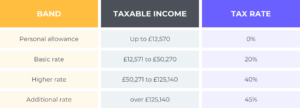
Remember, your Personal Allowance—the amount you can earn tax-free—is £12,570. However, this allowance reduces by £1 for every £2 your adjusted net income is over £100,000. This means you lose it entirely if your income is £125,140 or above.
As a self-employed individual, you’ll also pay Class 2 and Class 4 NICs. For the 2025/26 tax year, Class 4 NICs are charged at:
- 8% on profits between £12,570 and £50,270
- 2% on profits above £50,270
Becoming self-employed and meeting HMRC requirements
The moment you start trading as a sole trader, you have a legal responsibility to inform HMRC. You must register for Self Assessment if your total income from self-employment was more than £1,000 in a tax year.
The deadline for registration is 5th October in your business’s second tax year. For example, if you started trading in June 2025, you must register by 5th October 2026. You can do this online via HMRC’s website. Once registered, you will receive a Unique Taxpayer Reference (UTR), a 10-digit number essential for all your tax affairs.
After registration, you must file a Self Assessment tax return each year. This involves declaring your income and expenses for the tax year that runs from 6th April to 5th April. Key deadlines are etched in stone, and missing them leads to penalties:
- 31st October: Deadline for paper tax returns.
- 31st January: Deadline for online tax returns and for paying any tax you owe for the previous tax year.
Staying on top of these dates is one of the most critical aspects of your solo trader tax UK obligations.
Allowable expenses for self-employed individuals and how they reduce tax
One of the most effective ways to manage your self employment tax UK liability is by claiming all your allowable expenses self-employed UK claimants can. These are the costs incurred wholly and exclusively for your business. By deducting these from your gross income, you lower your taxable profit, and therefore the tax you pay.
Common allowable expenses include:
- Office costs: Stationery, phone bills, postage, and printer ink.
- Travel costs: Train fares, petrol, parking, tolls, and vehicle insurance for business trips.
- Premises costs: Rent for business premises, utility bills, and property insurance.
- Staff costs: Employee salaries, bonuses, and pension contributions.
- Legal and financial costs: Accountancy fees, bank charges, and insurance.
- Clothing: Uniforms or protective clothing needed for your work.
- Marketing and advertising: Website costs, business cards, and online adverts.
If you work from home, you can claim a proportion of your home running costs based on the number of rooms used for business and the time you spend working there. A simplified method is also available, allowing you to claim a flat rate based on the number of hours you work from home each month.
Keeping clear and accurate records of all these expenses is a requirement. Therefore, hold onto receipts, invoices, and bank statements as proof of your purchases.
Key thresholds for self-employed workers: VAT, trading allowance, and income levels
Several key financial thresholds can significantly alter your sole trader tax UK responsibilities. Being aware of them helps you plan for the future and avoid surprises.
- VAT registration: You must register for VAT if your business’s taxable turnover exceeds £90,000 in any 12-month period. Registration means you must charge VAT on your goods or services, submit quarterly VAT returns, and can reclaim VAT on your business purchases. You can also register voluntarily if it benefits your business.
- Trading allowance: If your total annual gross income from self-employment is £1,000 or less, you do not need to register for Self Assessment or declare this income. This is known as your trading allowance.
- National Insurance thresholds: As outlined earlier, you start paying Class 4 NICs once your profits exceed the £12,570 threshold. Additionally, the rate changes again at £50,270.
A major change coming into effect is Making Tax Digital for Income Tax (MTD for ITSA). This will require you to keep digital records and submit quarterly updates of your income and expenses using compatible software. This new system is being rolled out in phases:
- From April 2026 for those with a total qualifying income from self-employment and property over £50,000.
- From April 2027 for those with an income over £30,000.
- The government plans to extend this to those with an income over £20,000 from April 2028
Managing self-employment finances: Compliance, record-keeping, and tax efficiency
Staying in control of your finances is what separates a hobby from a sustainable business. Good habits formed early will save you time, money, and stress.
- Meticulous record-keeping: This is the foundation. Use a spreadsheet or accounting software to track every sale and purchase from day one. This makes filling out your tax return straightforward and ensures you claim every expense you’re entitled to.
- Separate business and personal finances: While not a legal requirement for sole traders, using a dedicated business bank account simplifies your record-keeping immensely. It provides a clear audit trail for your business transactions.
- Plan for your tax bill: Open a separate savings account and transfer a percentage of every payment you receive (around 25-30% is a good rule of thumb) to cover your upcoming Income Tax and NICs bill. This prevents a last-minute scramble in January.
- Understand your payments on account: If your tax bill is over £1,000, HMRC will usually require you to make payments on account. These are advance payments towards your next year’s tax bill, due in two instalments on 31st January and 31st July.
- Prepare for making tax digital: With digital reporting becoming mandatory, now is the time to explore HMRC-compatible software. Getting familiar with these tools early will make the transition smooth when it becomes a requirement for you.
Your Self Assessment tax UK responsibilities are a continuous part of your business life. However, by integrating these tasks into your regular routine, they become a manageable and predictable part of your operations.
How an EOR can help
Many companies prefer to work with UK-based talent but cannot manage the complexities of contractor compliance, IR35 risks, or local tax requirements. Likewise, some self-employed workers may prefer the stability of employee status when working with a foreign employer.
An Employer of Record can help by:
- Enabling companies to hire UK-based talent as fully compliant employees, avoiding the risks of misclassification
- Handling PAYE payroll, National Insurance, and all statutory UK employment requirements
- Providing an alternative for contractors who want the stability and protections of employment rather than self-employment
- Supporting international companies that operate in the UK without setting up a local entity.
Final thoughts
Successfully managing your self employment tax UK obligations is fundamental to building a sustainable business. It demands a clear understanding of liabilities, diligent record-keeping, and adherence to evolving compliance rules like Making Tax Digital. For the self-employed professional, this can be administratively heavy.
Hightekers, as an Employer of Record (EOR) service, provides a powerful solution. For international freelancers and contractors, we simplify UK market entry by handling tax, NI, and compliance through a local employment entity.
Contact Hightekers for tax compliance in the UK
Frequently asked questions
What is the deadline for registering as self-employed with HMRC?
You must register for Self Assessment by 5th October following the end of the tax year in which you became self-employed. For instance, if you started trading any time between 6th April 2024 and 5th April 2025, you must register by 5th October 2025.
Do I need to do a tax return if I earn less than £1,000?
No. If your total gross income from self-employment is £1,000 or less in a tax year, you do not need to register for Self Assessment or declare this income, thanks to the trading allowance. You can choose to register voluntarily if you wish to claim business expenses.
What is Changing with Making Tax Digital in 2026?
From April 2026, sole traders and landlords with a qualifying income over £50,000 will need to follow Making Tax Digital rules. This means keeping digital records and sending quarterly updates of income and expenses to HMRC using compatible software, rather than just filing one annual return.
What expenses can I claim for working from home?
You can claim a proportion of your home costs like heating, electricity, and internet. You can use a simplified expense method, claiming a flat rate based on your hours worked from home, or calculate the exact proportion of these costs used for your business.
Can I be both employed and self-employed at the same time?
Yes, it is common. You will pay tax on your employment income through your employer’s PAYE system. For your self-employed income, you must register for Self Assessment and declare this income separately. Your tax-free personal allowance will be used across both incomes.


