 Belgique
 España
 France
 Germany
 India
India
 Italia
 Luxembourg
 Netherlands
 Polska
 Portugal
 Suisse
 United Kingdom
 United States
Minimum Wage by Country: Key Insights for 2026


The concept of a minimum wage is straightforward—a legal floor for worker pay, designed to ensure a basic standard of living. Yet, as you glance from Luxembourg to Delhi, or from London to Manila, the reality is anything but simple.
For HR leaders and finance teams managing a global workforce, understanding these disparities is a fundamental pillar of compliance, ethics, and competitive strategy.
In 2026, the gap between the world’s highest and lowest mandated wages remains vast, reflecting deep-seated economic, social, and political differences. Continue reading to learn the key points and why hiring internationally with an Employer of Record is the smart move.
Key takeaways
- Global minimum wage disparity reflects deep economic and social policy differences between nations.
- Purchasing power, not just nominal wage, determines true worker living standards and costs.
- Complex regional regulations within countries create significant compliance challenges for businesses.
- Strategic global hiring requires expert navigation of local employment law and payroll standards.
- An Employer of Record like Hightekers ensures full legal compliance and simplifies international expansion.
The global discrepancy in minimum wages
An international minimum wage does not exist. Instead, the global labour market is a patchwork of national and regional standards, creating a staggering disparity in baseline salary standards.
At one end, workers in major European economies are protected by wage floors exceeding €2,000 per month. At the other, the lowest wage in the world can be found in developing economies, where daily rates may be equivalent to just a few dollars.
This divergence exists because a minimum wage is more than a number. You’ll find that it’s a tool of social policy, intricately tied to a nation’s:
- Cost of living
- Productivity
- Political will, and
- The strength of its collective bargaining institutions
Why it matters for businesses
The fundamental goal is to provide a baseline of economic security. However, the effectiveness of a statutory wage floor in achieving a “living wage” varies dramatically. For a business, this discrepancy presents both a challenge and an opportunity.
It impacts everything from where to locate a service centre to how to structure equitable compensation packages for distributed teams. Understanding this is the first step in building a responsible and sustainable international hiring strategy.
Countries with high and low minimum wages
About the countries with the highest minimum wage
Here are the countries with the highest minimum wages, with the key details:
- Luxembourg leads the EU with a gross monthly minimum wage of €2,704 as of January 2026, solidifying its position as the country with the highest minimum wage in the bloc. This high wage floor is designed to match the country’s elevated cost of living and maintain a stable standard of living for workers.
- In Western Europe, other high minimum wages include Ireland (€2,391), Germany (€2,343), the Netherlands (€2,295), and Belgium (€2,112). When adjusted for national purchasing power, these countries form the EU’s top tier for effective wage value. That’s along with France, Poland, and due to Spain’s high-paying jobs,
- Germany’s minimum wage rose to €13.90 per hour in January 2026, an 8.42% increase. This significant rise affects millions of workers. It translates to roughly €2,224 monthly for a full-time role and reflects a strong social policy focus on low-wage sectors.
- The Netherlands uses a strictly hourly system. For adults aged 21+, the rate is €14.71 from January 2026. This equals about €2,354 monthly for 160 hours of work. Unique youth rates scale up from age 15, ensuring younger workers are also protected.
- Outside the EU, the United Kingdom has announced its National Living Wage will rise to £12.71 per hour in April 2026. For a standard full-time week, this equates to approximately £2,200 monthly, making it competitive with leading European economies for workers aged 21 and over.
About countries with a low minimum wage
Let’s explore a few countries with a low minimum wage:
- In India, the national floor-level minimum wage is set at ₹178 per day (about $2.10), making it one of the lowest in Asia despite rapid economic growth. Rates vary significantly by state and sector, often complicating compliance for businesses.
- The Philippines mandates a daily minimum wage of PHP 695 (approx. $11.77). However, wage-setting is regional, leading to differences across the country’s many provinces, with rates in the capital region, Metro Manila, typically being higher.
- Nigeria’s national minimum wage remains low at ₦70,000 per month, which is roughly $40–$45 USD at current exchange rates. This highlights the severe gap in nominal income when measured against international benchmarks.
- In Pakistan, the monthly minimum wage ranges from PKR 37,000 to 40,000, equating to about $132–$143. This places it among the lower wage economies in South Asia, reflecting ongoing economic challenges.
- Madagascar has one of the world’s lowest hourly minimum wages, approximately $0.18. The monthly minimum ranges from $59 to $90, showcasing the extreme end of global wage disparities, particularly in some African nations.
Regional trends and comparisons
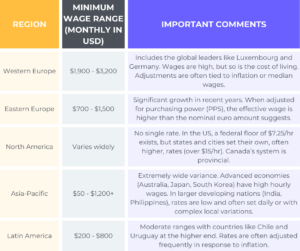
A regional breakdown reveals the patterns and nuances behind the raw data. The following table summarises key income benchmarks and regional salary differences for 2026.
Key insights for 2026
Purchasing power is the true benchmark for global comparison
Comparing raw, or nominal, wages in euros or dollars is misleading. A far more accurate method is to use Purchasing Power Standards (PPS), which account for the cost of living.
For example, while Luxembourg’s €2,704 monthly minimum wage is over four times Bulgaria’s €620 in nominal terms, the real gap in living standards is much narrower when measured in PPS.
This metric is essential for understanding real salary standards and making fair international labor market assessments. That’s because it reveals whether a wage provides a genuine living wage in its local context.
A persistent and growing gulf between high and low-wage economies
The fundamental global discrepancy remains stark. In 2026, the monthly minimum in Western European leaders like Luxembourg (€2,704) and Germany (€2,343) is magnitudes higher than in many Asian and African nations.
For instance, India’s national floor is approximately $1.96 per day, while Nigeria’s monthly minimum is about $40-$45. This chasm reflects deep-seated differences in economic development, productivity, and social policy.
For businesses, this represents vastly different baseline worker pay structures and operational costs in various regions.
Upward momentum continues across Europe, outpacing inflation
The trend of rising minimum wages in Europe persists. In 2026, 21 of the 22 EU countries with a statutory minimum wage increased their rates. The average hike was 5.9%, while slower than previous years, it still significantly outstripped the region’s average inflation rate.
Countries like Bulgaria, Hungary, and Lithuania saw some of the most substantial increases of over 11%. This consistent upward pressure is a critical employment law trend. You’ll find that it directly impacts payroll standards and labour costs for companies operating in the European market.
Payment structures and social models introduce critical complexity
Direct wage comparisons are further complicated by differing national payment structures. For instance, in Greece, Spain, and Portugal, the annual minimum wage is paid over 14 months, not 12.
Additionally, several developed nations like Denmark, Sweden, Italy, and Austria have no statutory minimum wage at all. Instead, they relied on strong sector-wide collective bargaining agreements to set salary standards. These variations mean the headline monthly or hourly figure is only part of the total compensation and compliance picture.
Notable national adjustments reflect diverse economic pressures
Beyond broad trends, specific national changes in 2026 highlight how minimum wages are used as targeted policy tools. For instance, Turkey implemented a dramatic increase of around 30% year-over-year to combat severe cost-of-living pressures.
The United Kingdom confirmed its National Living Wage will rise to £12.71 per hour in April 2026. Conversely, Saudi Arabia paused increases after previous hikes, shifting focus to broader labour-market reforms. These disparate approaches underscore that there is no universal international minimum wage policy.
How an EOR can help
While minimum wage is a basic labour standard meant to ensure a minimum quality of life, applying it correctly is complex. You’ll find that rates vary by country, region, city, industry and are often updated annually.
Fortunately, an Employer of Record can help since it:
- Acts as the legal employer in each country, keeping companies compliant with country- and region-specific wage laws, updates, and enforcement rules
- Accounts for local nuances such as hourly vs. monthly wages, age-based rates, or sector-specific minimums
- Reduces the risk of underpayment, fines, or reputational damage when hiring internationally
- Enables companies to hire globally without needing in-house expertise on constantly changing wage regulations
Final thoughts
Overcoming the global minimum wage landscape in 2026 demands more than just comparing numbers. It requires understanding complex local regulations, purchasing power, and relentless legislative changes. For companies hiring internationally, managing this compliance is a significant operational risk and burden.
This is where partnering with an Employer of Record like Hightekers becomes a strategic advantage. Hightekers simplifies global expansion by legally employing your international workforce on your behalf.
They assume full responsibility for ensuring 100% local compliance. That’s from administering the correct minimum wage by country and tax deductions to adhering to evolving employment law.
Contact Hightekers for minimum wage compliance
Frequently asked questions
How is the minimum wage enforced in different countries?
Enforcement varies by the strength of national labour regulations and inspection regimes. In the EU, member states have monitoring bodies and can impose significant fines.
In countries with less formal economies, enforcement can be sporadic. Companies are ultimately responsible for compliance, making reliable local payroll expertise essential.
Does a higher minimum wage always mean a better standard of living?
Not necessarily, since the critical metric is purchasing power. A high nominal wage in a city with an extremely high cost of housing and goods may provide less real security than a lower wage in a more affordable region. Always analyse local living costs alongside the legal minimum.
What is the difference between a minimum wage and a living wage?
A minimum wage is a legal mandate. Whereas, a living wage is an ethical benchmark calculated to cover the actual costs of basic needs like food, housing, and transport in a specific location.
It is often higher than the government-mandated minimum and is increasingly used by multinationals for ethical sourcing.
How do I handle minimum wage for remote workers in different countries?
This is a complex area of employment law. Typically, the worker’s physical location determines the applicable minimum wage, not the company’s headquarters.
You must comply with the local laws of the country where the work is performed, which requires robust international payroll systems.
With frequent changes, how can my company stay compliant?
Proactive monitoring is key. Designate responsibility for tracking international minimum wage adjustments in your operational countries.
Partner with global payroll providers or legal experts who have on-the-ground intelligence. Also, implement calendar reminders for announced changes, like the UK’s annual April increase or Germany’s January 2026 rise.
What is the highest minimum wage in the world?
Luxembourg holds the title for the highest minimum wage in the world, with a gross monthly rate of €2,704 as of January 2026.
In nominal terms, this significantly outpaces other high-wage countries like Ireland (€2,391) and Germany (€2,343). However, true purchasing power varies by location.


