 Belgique
 España
 France
 Germany
 India
India
 Italia
 Luxembourg
 Netherlands
 Polska
 Portugal
 Suisse
 United Kingdom
 United States
EOR for Startups: Expand Your Team Globally Without Hassle


For the ambitious startup founder, the world is your talent pool. Yet, the legal maze of international employment—local taxes in France, benefits in the Netherlands, termination laws in Germany—can halt global ambitions before they begin.
This is where the strategic power of an Employer of Record for startups becomes undeniable. It is the key to building a borderless team with agility and precision. We’ll share the key advantages of an EOR and why choosing Hightekers is the best way to get started.
Key takeaways
- An Employer of Record enables fast, compliant international hiring without a local entity.
- It transforms complex legal and financial risks into predictable, managed operations.
- Startups gain a strategic advantage by accessing global talent pools with agility.
- This model provides cost-effective global employment solutions, avoiding large capital outlays.
- Partnering with a specialist like Hightekers lets founders focus on growth, not global paperwork.
What is an Employer of Record (EOR)?
An Employer of Record is a specialised third-party organisation that legally employs workers on behalf of your startup. In this structured arrangement, the EOR becomes the official employer for legal, tax, and administrative purposes in the employee’s country, while your startup retains complete control over the employee’s day-to-day work, projects, and cultural integration.
This model creates a clear three-way relationship: your startup signs a service agreement with the EOR, the EOR signs a locally compliant employment contract with the worker, and the worker performs their services for you.
The EOR assumes critical legal and financial responsibilities, which typically include:
- Payroll management: Processing salaries, calculating and withholding correct income taxes, and making social security contributions.
- Benefits administration: Providing legally required benefits (such as health insurance, pension, or holiday pay) and often offering competitive local packages.
- Legal compliance: Ensuring all employment practices adhere to local labour laws, including contracts, working hours, and termination procedures.
- HR administration: Managing employment records, timesheets, and necessary documentation.
This setup is fundamentally different from using a Professional Employer Organisation (PEO), which requires your startup to already have a legal entity in the country. An EOR requires no such entity, making it a true gateway to new markets.
Why startups choose an EOR model
Choosing an EOR solution is a strategic decision for growth-focused startups. It directly addresses the most common constraints, which are limited capital, time, and in-house expertise. Meanwhile, you’ll unlock global potential.
Speed to market
Time is a startup’s most precious commodity. Setting up a legal entity abroad is a lengthy process, taking an average of three to twelve months and significant managerial focus. An EOR collapses this timeline.
Therefore, it allows you to onboard a new hire in a country like Spain or Poland in a matter of days, not months. This lets you seize market opportunities and secure top talent before competitors do.
Compliance and risk mitigation
Dealing with foreign labour laws can be a minefield. Missteps in employee classification, benefits, or tax withholding can lead to severe fines and legal disputes. Fortunately, an EOR acts as your shield, assuming legal liability and ensuring adherence to local regulations.
For example, they ensure your hire in the Netherlands receives their legally entitled 16 weeks of paid maternity leave, while your hire in Italy receives their correct trattamento di fine rapporto (severance pay).
Cost predictability and efficiency
Building international infrastructure is expensive. The average cost to set up a foreign legal entity ranges from $15,000 to $20,000, with annual maintenance costs around $40,000. An Employer of Record for startups converts these large, variable capital expenditures into a predictable operational fee.
You avoid the costs of local accountants, legal retainers, and HR staff, freeing capital for product development and growth initiatives.
Operational flexibility and scalability
Startups need to pivot and scale rapidly, so the EOR model offers unparalleled agility. You can test a new market with a small sales team in Sweden, and if strategies change, scale down or redirect resources without the burden of closing a legal entity.
It provides a scalable framework that grows seamlessly with your hiring needs across borders.
Access to global talent
Your perfect lead developer or marketing strategist may not be in your home city. An EOR obliterates geographical hiring barriers, allowing you to recruit the best person for the role, whether they are in Lisbon, Berlin, or Prague.
This expands your talent pool exponentially, giving you access to specialised skills and diverse perspectives that drive innovation.
How EOR works for startups step by step
The process of hiring through an EOR is designed for simplicity and speed, allowing founders to focus on people and not paperwork.
1. You find and select your candidate: Your startup leads the recruitment process to find the ideal candidate in your target country, just as you would locally.
2. You finalise terms and engage the EOR: You agree on the compensation package with the candidate. Then, you provide these details to your EOR partner and sign a service agreement with them.
3. The EOR legally onboards the employee: The EOR generates a locally compliant employment contract, registers the employee with tax and social security authorities, and sets them up on their payroll system. This step is where their legal expertise ensures full compliance.
4. Your startup manages the daily work: From day one, the employee integrates into your team. You provide equipment, manage their tasks and projects, and oversee their performance—maintaining full operational control.
5. The EOR manages payroll and compliance: Each pay cycle, you approve the payroll. The EOR calculates the gross-to-net salary, withholds all applicable taxes and contributions, and ensures the employee receives their net salary in their local currency, on time.
6. You receive a consolidated invoice: The EOR sends you a single, transparent invoice covering the employee’s gross salary, employer taxes, statutory costs, and their service fee. This simplifies your financial management and accounting.
When should startups use an EOR?
Identifying the right moment to leverage an EOR can accelerate your trajectory. Consider this model when:
- Testing a new market: Before committing six figures to establish a subsidiary in France, use an EOR to hire a small business development team on the ground. Validate demand and gain local insights with minimal risk and commitment.
- Lacking internal HR/Legal bandwidth: Most early-stage startups do not have in-house experts on German employment law or Portuguese tax codes. An EOR fills this critical expertise gap, acting as your de facto global HR department.
- Minimising legal and financial risks: If the thought of accidentally misclassifying an employee in Italy or miscalculating social tax in Belgium keeps you up at night, an EOR provides a safety net. They assume the liability for these complex matters.
- Focusing on core product development: When your team’s energy should be spent on coding, designing, and selling, outsourcing the immense administrative burden of global employment lets you maintain focus on what truly builds value.
Why EOR makes sense for startups in 2026
The business landscape in 2026 demands agility, smart resource allocation, and a global mindset from day one. The EOR model has evolved from a niche compliance tool to a foundational global hiring model for ambitious companies. With the global EOR market projected to reach $5.97 billion in 2026, adoption is surging as startups recognise its strategic value.
Modern Employer of Record services are increasingly powered by integrated technology platforms that use AI. They automate contract generation, monitor regulatory changes in real time, and provide seamless employee experiences.
This technological edge makes global team management more transparent and efficient than ever. For any startup looking to scale with speed, safeguard its operations, and compete for the world’s best talent, partnering with an EOR is a strategic imperative for sustainable growth.
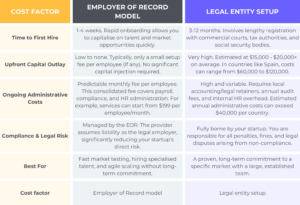
Cost analysis: EOR vs. legal entity setup
For a startup, the financial implications of global expansion are a primary concern. The following table contrasts the typical costs associated with using an Employer of Record versus establishing your own legal entity in a foreign country.
We’ll use illustrative examples from Europe.
Final thoughts
For startups, an Employer of Record is the strategic key to unlocking global growth without the burden of legal complexity. It transforms international hiring from a daunting operational challenge into a competitive advantage.
A specialised EOR solution like Hightekers makes this strategic leap seamless. They act as the legal employer for your global team, handling payroll, benefits, and full compliance across Europe and beyond. This allows you to focus purely on business growth.
As demonstrated with clients like Blueforge Partners, Hightekers provides:
- The speed to launch in new markets in days
- Significant cost savings versus setting up entities
- The agility to scale your international workforce on demand
With direct expertise in over 25 countries and support in more than 100, partnering with an experienced Employer of Record for startups is the best way to get started.
Contact Hightekers for support with your startup
Frequently asked questions
How much does an EOR for startups typically cost?
Costs are usually a transparent monthly fee per employee, often starting between $199 and $599. This fee generally covers payroll processing, tax filings, compliance, and core HR support.
Ideally, always request a detailed breakdown to understand the full scope, including any costs for statutory benefits or local insurance.
How quickly can I onboard a new employee in another country?
With a proficient EOR, the process from signed offer to first day can be very swift. In many European countries, compliant onboarding can be completed in as little as 48 hours to two weeks, compared to the months required for entity setup.
Do I lose control over my employees when using an EOR?
Not at all, since your startup maintains full day-to-day management control. You direct the employee’s work, set their objectives, and manage their projects.
The EOR handles only the legal, financial, and administrative responsibilities of employment in the background.
Can I use an EOR to hire contractors as well?
Yes, many leading EOR providers also offer integrated contractor management services. This is crucial for ensuring contractors are correctly classified under local laws (helping avoid misclassification risks) and for streamlining their invoicing and global payments.
What happens if we decide to set up our own entity later?
A good EOR partnership is designed to support your growth journey. Most providers will assist with a smooth transition of employees from their entity to yours when the time is right, ensuring business continuity and continued compliance throughout the process.


