 Belgique
 España
 France
 Germany
 India
India
 Italia
 Luxembourg
 Netherlands
 Polska
 Portugal
 Suisse
 United Kingdom
 United States
What You Should Know About Sick Leave Insurance in the Netherlands?


For any employer, the prospect of an employee’s long-term illness is a formidable one. It’s a human concern first, but quickly followed by a pressing financial question: who bears the cost of continued wages?
In many European countries, the state steps in early. In the UK, for instance, statutory sick pay (SSP) is a modest, fixed-rate payment from the employer for a limited 28 weeks. In Germany, statutory health insurance funds pay sickness benefit (Krankengeld) after six weeks of continued pay from the employer.
The Netherlands charts a different and a more demanding course. Here, the employer is the primary bearer of financial responsibility for up to two full years. This creates a unique landscape where commercial insurance for sick leave is not a peripheral benefit but a fundamental pillar of responsible business and Dutch payroll risk management.
This guide cuts through the complexity, explaining the system, its imperatives, and the smart solutions for international companies and their workforce.
Key takeaways
- Dutch employers carry full financial liability for two years of sick pay.
- Sick leave insurance is a crucial tool for employer financial risk management.
- Freelancers and self-employed individuals lack automatic statutory sick leave coverage in the Netherlands.
- The mandatory 104-week wage continuation insurance NL period is uniquely employer-centric.
- Using an EOR like Hightekers ensures compliance and manages complex Dutch employer sickness costs.
What is sick leave insurance in the Netherlands?
In the Netherlands, “sick leave insurance” refers almost exclusively to a commercial insurance product purchased by employers. It is not a state-provided benefit like the French indemnites journalieres or the Spanish prestacion por incapacidad temporal. Instead, it is a private risk-transfer tool known as verzuimverzekering (absenteeism insurance).
The core principle is simple but profound: by law, a Dutch employer must continue to pay a substantial portion of an employee’s salary during illness for a maximum of 104 weeks. This legal duty falls squarely on the company’s balance sheet.
Netherlands sick leave insurance exists to indemnify the employer for these mandatory wage payments. Hence, it transforms a potentially catastrophic variable cost into a predictable and managed overhead.
The employment contract
Crucially, employees do not take out this employment insurance for sick leave directly. Their protection is derived from their employment contract, which mandates continued pay.
The insurance is the employer’s financial backstop, ensuring they can meet this legal and social obligation without jeopardising operational stability. For an international company, this is a non-negotiable aspect of hiring in the Netherlands.
Statutory sick pay rules in the Netherlands
Understanding the statutory framework is essential to appreciate the value of insurance. The Dutch system is both generous and strict. Here are the main points that you should know about:
- Rate: The employer must pay at least 70% of the employee’s last-earned wage. This calculation includes regular salary and often holiday allowance (vakantiegeld) and fixed bonuses.
- Minimum floor (first year): During the first year of illness, the 70% payment cannot be lower than the statutory minimum wage for a full-time worker.
- Second year: In the second year, the 70% minimum remains. However, the guarantee of it being no lower than the minimum wage disappears.
- Duration: The obligation lasts for a maximum of 104 weeks (two years) from the first day of illness.
- Start of payments: There are no statutory “waiting days.” Payments are due from the very first day of reported illness.
- After two years: Upon reaching the 104-week limit, the employer’s wage payment obligation ends. The employee may then transition to a disability benefit (WIA uitkering) from the national insurance scheme. At this point, the employer may also have grounds to dismiss the employee due to long-term incapacity.
What does sick leave insurance cover in the Netherlands?
A comprehensive policy is designed to mirror and manage the employer’s legal liabilities. Its coverage typically extends to several key areas:
Continuation of salary during illness
This is the fundamental coverage, because the insurer reimburses the employer for the wages paid to the sick employee. This typically covers the legally mandated 70% of the employee’s salary. However, it can extend to 100% if stipulated in the individual employment contract or applicable collective labour agreement (CAO).
The policy ensures the employee receives a steady income while the company’s cash flow is protected from the direct impact of prolonged absence. It fulfils the core promise of employment insurance for sick leave.
Coverage of the employer’s associated costs
A robust policy goes beyond gross salary. It also covers the employer’s continuing share of statutory social security contributions. For example, pension premiums and unemployment insurance payments are accrued during the employee’s sick leave.
This is crucial for complete Dutch payroll risk management, preventing a hidden financial drain. Without this coverage, employers would still be liable for these high ancillary costs on top of the sick pay itself.
Payments for long-term sick leave
The Dutch two-year liability period is uniquely demanding. Sick leave insurance is specifically structured to cover this extended duration, which can represent a cost equivalent to 1.4 times an annual salary.
This long-term coverage provides stability for both parties. That’s because the employee has security, and the employer avoids a potentially devastating financial blow that could cripple smaller businesses. It’s unlike in systems where state support intervenes after a matter of weeks.
Support for reintegration and return to work
Dutch law requires active employer efforts to reintegrate sick staff. Also, insurance policies often directly fund or provide access to essential reintegration services. This includes occupational health assessments, case managers, and vocational training. That’s to facilitate a return to the original role or a suitable alternative role.
This proactive approach, supported by the insurer, aims to reduce long-term absenteeism and is a key component of a responsible sick pay insurance explained model.
Management of the insurance waiting period
Policies include a deductible waiting period—often 4, 6, or 13 weeks—during which the employer covers the costs. Choosing a longer waiting period lowers the insurance premium but increases the company’s retained risk.
This flexibility allows businesses to tailor their sick leave coverage Netherlands to their financial resilience. The insurance coverage activates after this period, creating a shared responsibility model for short-term absence.
How sick leave insurance works for different types of workers
The application of sick day insurance varies significantly depending on the worker’s legal status, creating a critical consideration for hiring strategies.
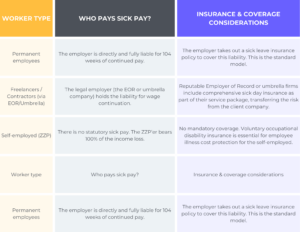
How an EOR can help
For global companies, using an established Employer of Record service in the Netherlands is often the most efficient and compliant path. A quality EOR embeds the required sick leave coverage in the Netherlands into its offering. This ensures full legal compliance and financial risk management without the administrative burden falling on the international client.
Here’s how an Employer of Record can help:
- An EOR acts as the legal employer and assumes sick pay obligations.
- The EOR manages payroll, compliance, and sick leave processes.
- Sick leave insurance helps protect the EOR (and indirectly the client company) from high long-term costs.
- For global companies without a Dutch entity, using an EOR is the safest and simplest way to comply with Dutch sick leave rules.
Final thoughts
The Dutch approach to sick leave is a hallmark of its advanced social market economy, offering robust employee illness cost protection while placing a corresponding duty on employers. For businesses, this is not an area for ambiguity. Proactively managing this risk through commercial insurance for sick leave is a sign of a mature, sustainable, and responsible operation.
It transforms a potential financial shock into a calculated and insured operational cost. For international companies entering the Dutch market, partnering with an EOR service like Hightekers is the simplest approach. We’ll manage your employee sick leave, so you can focus on core business objectives.
Contact Hightekers for sick leave support in the Netherlands
Frequently asked questions
Is sick leave insurance mandatory for employers in the Netherlands?
No, the insurance itself is not legally mandatory. However, the obligation to continue paying wages for up to two years is mandatory.
Most employers take out insurance to mitigate this significant financial risk, making it a practical necessity.
How does Dutch sick pay compare to other European countries?
The Dutch system is notably employer-centric. Unlike in Belgium or the UK where state benefits kick in relatively quickly, the Dutch employer bears the cost for much longer.
This makes private insurance more critical for Dutch employer sickness costs.
Can an employee be dismissed while on sick leave?
It is very difficult and generally prohibited to dismiss an employee specifically for being ill. Dismissal may only be pursued after the two-year wage continuation period has ended.
And even then, it requires careful procedural steps and often permission from the UWV (Employee Insurance Agency).
What happens if a freelancer gets sick?
A self-employed professional (ZZP) has no automatic income protection. Without a voluntary disability insurance policy, they receive no sick pay. This is a key difference from the extensive protections for employees.
What is the role of an EOR in managing sick leave risk?
An Employer of Record becomes the legal employer in the Netherlands. As such, it assumes the full 104-week wage liability and secures the necessary wage continuation insurance NL. This shields the international client company from the direct financial and administrative burdens of the Dutch system.


