

Working as a freelancer gives you the freedom you’ve always wanted. But beyond wonderful clients and fulfilling work, you still have to deal with the challenges of running a business. This is where things get real.
Usually, freelancers take one of two options. Either they start a company and run everything themselves (a limited company), or they partner with another company that does this for them (an umbrella company).
The option you choose is a big deal because it affects your income, taxes, how your business operates and long-term goals. In this article, we help you examine these two choices and decide which one is right for you.
Quick Overview
Freelancers work with an umbrella company because it’s a legal entity that can administer the financial and employment aspects of contracting work, without taking management control. Alternatively, freelancers can set up their own limited company, giving them full control over all aspects of running the business. They are also responsible for the company’s compliance and legal governance.
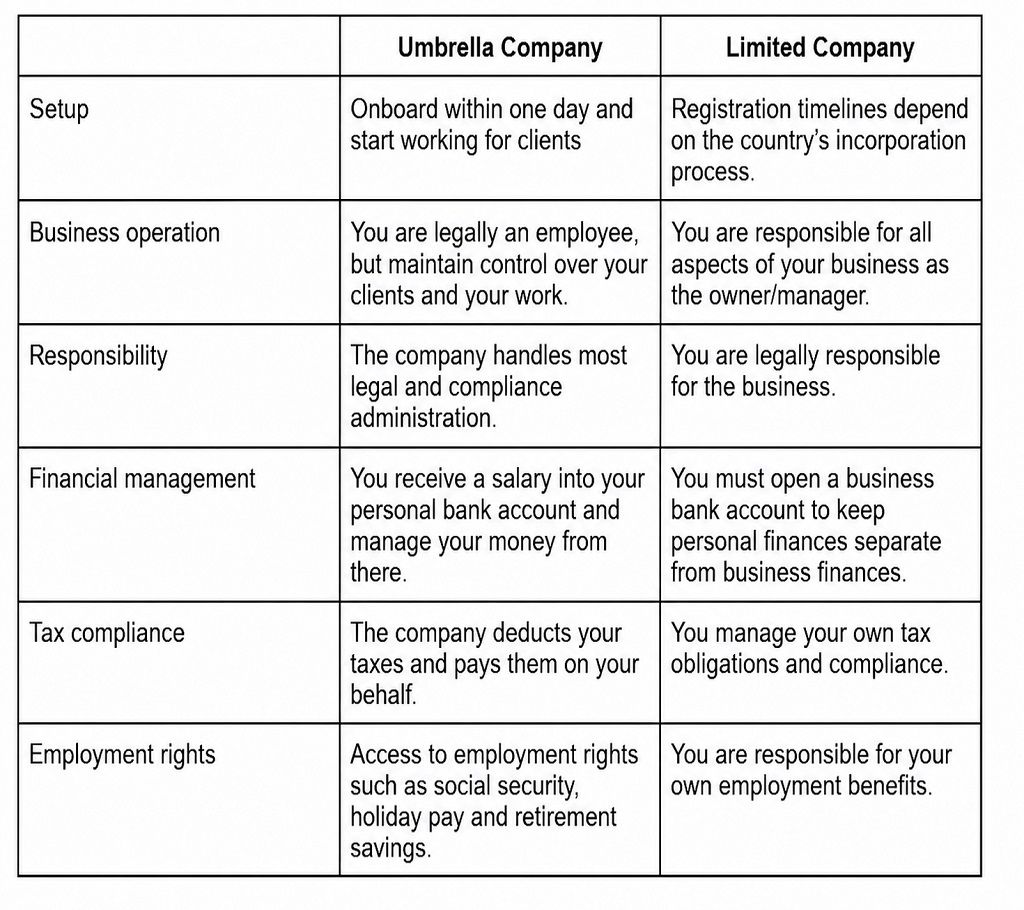
Snapshot: Umbrella company vs limited company for freelancers
When should you choose a limited company?
You should choose a limited company as a contractor or freelancer when you want to own the business and have complete control over it. Rather than becoming an employee of another company, you register a legal entity and are responsible for its legal and compliance obligations.
You want to retain management control
Owning a company requires that you have knowledge about your country’s tax system, accounting framework and general business practices. You will be required to record all financial transactions and complete a corporate tax return (if applicable). You will also need to submit compliance reports (or annual accounts) as required by your country’s local laws and business regulations.
You want to grow a business, not just a career
A limited company allows you to grow a lasting business rather than simply providing services as a contractor. If you so choose, you can reinvest profits, hire others, develop new services and partner with other businesses.
You will receive more tax benefits as a company
Countries around the world have vastly different tax incentives and structures. In some countries, freelancers and contractors pay less tax than employees. In other countries, corporation tax is lower if you qualify for certain incentives. Depending on your business, allowable expenses may give you a tax advantage, allowing you to reduce your taxable income. If tax efficiency is at the top of your business objectives, then a limited company is the way to go.
When should you choose an umbrella company?
Not everyone who wants to work for themselves loves the idea of running a business. If you want the freedom of choosing your own clients, but also want the predictability of a stable income, then an umbrella company is your answer.
You want to get started quickly
The majority of umbrella companies can onboard contractors within days. This is especially valuable when you’ve secured a top client in another country, or have a client that wants to start a project immediately, and can’t wait for you to register a company.
The umbrella company already has the business processes in place to onboard your client, send invoices and collect payment. This means you don’t have to learn about multiple processes and financial practices before you can work.
You want a stable income and benefits while freelancing
An umbrella company is the best of both worlds for contractors because the business structure allows you to be an employee, but work as a freelancer. You sign an employment contract with the company, and they take care of the things you don’t want to stress about, like taxes and fluctuating income. If you find the right company, they may even offer benefits like pension contributions and professional indemnity insurance.
There are a number of companies providing these umbrella services, and you’ll need to do your homework. Some work mostly with IT contractors, like Hightekers, while others work with finance professionals or private healthcare workers.
You want a built-in support system
Partnering with an umbrella company isn’t just about receiving a salary and benefits. It's also about getting administrative support. Many contractors feel frustrated and overwhelmed with how much time goes into sending invoices, collecting payments, doing accounting and paying taxes. Mostly, they wish they could make it go away so they can do more for their clients.
If that’s you, then the support of an umbrella company can really free up your time and energy. Their business structure is designed to handle the headaches for you. This is one area where the services of an umbrella or management company become invaluable.
Why freelancers choose Hightekers
Not all umbrella-style solutions offer the same level of support. While traditional umbrella companies typically focus on payroll and compliance, Hightekers is designed to help freelancers build a more sustainable and rewarding career.
In addition to handling contracts, invoicing, payroll, and compliance, Hightekers helps freelancers increase their take-home income, access employee-level benefits, and remain fully independent while keeping their existing clients. Members also benefit from dedicated support throughout their freelance journey, allowing them to spend less time on administration and more time delivering value to their clients.
If you're looking for more than basic administrative support, Hightekers offers a flexible solution that combines the freedom of freelancing with the security and simplicity many independent professionals are looking for.
Conclusion
As a freelancer or contractor, the decision between a limited company and an umbrella company isn’t just semantics. It fundamentally shapes how you work and how you reach your goals.
An umbrella company provides two advantages that traditional employers can't: enabling you to establish income stability while selecting your own clients and work. In contrast, a limited company is a different setup that gives you full control but also requires you to assume all the risks.
Ultimately, the right choice depends on your priorities.
Get the best of both freelancing and employment. Start here with Hightekers.
Frequently Asked Questions
1. How does an umbrella company differ from a limited company?
The main difference between an umbrella company and a private limited company is who has legal ownership of the business. An umbrella company is a legal entity set up by someone else, and you become an employee of that company while working as a contractor or freelancer. A limited company structure is a legal entity registered by you and managed by you. You take full responsibility for the finances, taxes, accounting and compliance.
2. Do I need to register a separate legal entity to work as an IT contractor?
In most countries, contractors must register as either a sole trader or a personal limited company to work for clients and pay income taxes. However, there is also an alternative to this traditional system. An umbrella company is a legal entity that employs you as its own employee. This is a simple, quick process that lets you start working almost immediately. They take responsibility for the finance and compliance administration, while you manage your clients and the projects you take on.
3. What are the advantages of an umbrella company for freelancers?
An umbrella company is an alternative for freelancers to set up their own legal business. The company becomes the employer and manages payroll, taxes, benefits and administration. You maintain control over finding clients and what work you do. In essence, the umbrella company provides you with a steady income and benefits while you work like a self-employed person. This frees up your time to concentrate on getting clients instead of managing a business.
4. What are the advantages of a limited company for freelancers?
A limited company is fully owned and managed by a self-employed person as the company director. This means there is complete control over clients, rates, processes and the type of work done. As the business owner, you decide how to take advantage of tax planning opportunities, business expenses and profits. You also benefit from limited liability. This is how your personal assets are protected from the business debts and liabilities.