 Belgique
 España
 France
 Germany
 India
India
 Italia
 Luxembourg
 Netherlands
 Polska
 Portugal
 Suisse
 United Kingdom
 United States
Top Best Paid Jobs in Italy 2026


For those drawn to Italy by its unrivalled culture and quality of life, the question of building a prosperous career is a vital one. Today, the Italian job market offers both traditional pathways to success and exciting new opportunities in its rapidly modernising economy.
This guide cuts through the noise to provide a clear picture of where the highest salaries are found. That’s from the corporate powerhouses of Milan to the tech startups of Turin. We will explore the best paid jobs in Italy, examining everything from the average income in Italy to the specific qualifications that can unlock your earning potential.
Overview of salaries in Italy
Before pinpointing the most lucrative roles, it is essential to understand the broader salary landscape. The average salary in Italy provides a helpful baseline, but the real story is in the details. That’s the regional disparities, the impact of experience, and the premium placed on certain skills.
In 2025, the average gross annual salary in Italy is around €43,900, which translates to about €3,660 per month. However, this single figure can be misleading. The median income, often a more accurate reflection of what a typical worker earns, sits at around €32,400 per year. This difference suggests a significant gap between high earners and the general workforce.
Several key factors influence where an individual’s salary will fall within this range:
- Regional variations: Italy’s economy is famously characterised by a North-South divide. Northern regions, home to industrial and financial centres, offer significantly higher wages. Lombardy, with Milan at its heart, has the highest mean gross salary in the country. In contrast, regions in the South, such as Campania and Basilicata, report the lowest average wages. For instance, the average net annual household income in the Northwest is €39,240, while in the South, it drops to €29,451.
- Experience and education: As in most countries, experience commands a premium. An entry-level professional in engineering might start on a salary of around €35,000, while a senior-level counterpart in the same field can earn €63,000 or more. Similarly, higher education leads to better pay. For example, a master’s degree can boost earning potential in fields like software engineering.
It is also important to note that Italy is one of the few EU countries without a national minimum wage. Instead, minimum wages are set by sector-specific collective bargaining agreements (CCNL), which typically result in a minimum hourly rate of around €7 to €9.
Best paid jobs in Italy by industry
The hunt for the highest paying jobs in Italy leads to a diverse set of industries. That’s from well-established pillars of the economy to emerging digital frontiers. The following table provides a snapshot of some of the most lucrative professions, followed by a deeper dive into the key sectors. This will give you an idea of what jobs are worth pursuing when expanding to Italy.
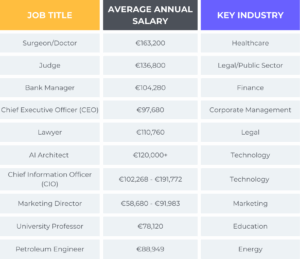
Note: These figures are not only useful for job seekers but also for international employers. Foreign companies can use Italy’s salary benchmarks to plan competitive compensation packages and understand labour costs when hiring local talent.
Technology and IT
Italy’s tech sector is booming, with the ICT market projected to reach €91.7 billion in 2025. This growth fuels demand for specialised talent and creates some of the country’s most impressive salary packages.
- AI architect: As businesses rush to integrate artificial intelligence, the architects who design these systems are in peak demand. With salaries for top performers exceeding €120,000 annually, this role combines expertise in machine learning, neural networks, and data management.
- Cybersecurity expert: With cyber attacks on Italian companies increasing sharply, the need for digital defenders has never been greater. Overall, the cybersecurity market is projected to grow nearly 10% annually. It means experienced professionals can command salaries of €60,000 to €74,000, with senior roles like Chief Information Security Officer (CISO) reaching up to €150,000.
- Cloud professional: With 61% of Italian firms having adopted cloud computing, skills in platforms like AWS and Azure are highly valued. The market is expected to reach USD 26.34 billion by 2029. This ensures continued opportunities for cloud architects and engineers.
Healthcare and medicine
The medical profession remains one of the most reliably high-paying career paths globally, and Italy is no exception. Surgeons and specialists top the national salary charts. It reflects the extensive training and expertise required. The healthcare sector is also experiencing growth driven by an ageing population, sustaining demand for skilled medical professionals.
Law and finance
Established professions in law and finance continue to offer substantial rewards. Lawyers and bank managers feature prominently on lists of top paying jobs in Italy. These roles often require deep regulatory knowledge and are concentrated in financial hubs like Milan. It’s where major banks and legal firms are headquartered.
Engineering and Manufacturing
Italy’s strong industrial backbone provides excellent opportunities for engineers. That’s particularly true in automotive, aerospace, and mechanical engineering. Furthermore, you’ll find that specialised roles in petroleum engineering can offer average salaries nearing €89,000.
Meanwhile, the tech-driven evolution of traditional manufacturing in cities like Turin is increasing demand for robotics and automation engineers. They can earn average salaries of €73,625.
Best paid jobs in Italy for foreigners
For foreigners, including non-EU citizens, the Italian job market has specific challenges and opportunities. While fluency in Italian is a significant advantage and often a requirement for client-facing roles, there are clear pathways to securing one of the best paid jobs in Italy.
The most accessible opportunities for English speakers often lie with international companies or in fields where English is the primary language of business. Also, major tech hubs in Milan, Rome, and Turin are often more open to hiring international talent. That’s especially true for roles with skill shortages.
High-demand roles for expats:
- Tech professionals: The significant growth in Italy’s tech sector, coupled with a domestic skills gap, makes it a promising field for expats. Roles such as software engineer, machine learning engineer, and IT consultant are in high demand. The key is possessing proven technical skills that are transferable globally.
- Engineering specialists: Similar to the tech sector, engineering fields like aerospace, petroleum, and robotics have a need for highly skilled professionals. They can work in a foreigner’s favour if they have the right expertise.
- Corporate executives: Multinational companies operating in Italy often recruit internationally for senior management positions. It includes positions like country manager or marketing director. These roles typically require a proven track record and often involve working in an English-speaking corporate environment.
- English teaching and university roles: For native English speakers, teaching English can be an entry point. While salaries for language teachers are generally modest, positions at international schools or universities can be more lucrative. For instance, university professors can earn an average of €78,120 annually.
Practical steps for foreign job seekers:
- Visa requirements & work permit: Non-EU citizens must secure a job offer before applying for a work visa. The process is governed by an annual quota system called the Decreto Flussi. In practice, your future employer will typically initiate the process by applying for a work authorisation document (Nulla Osta) on your behalf. You may also need to secure a work permit before starting the job.
- Networking is key: Many jobs in Italy are filled through personal and professional networks. Furthermore, platforms like LinkedIn are essential, and attending industry events or connecting with expat groups can provide invaluable leads.
- Leverage the expat community: Tapping into existing communities of international professionals can offer support, advice, and job tips that are not widely advertised.
Future outlook for high paying jobs in Italy
Looking beyond 2025, the trends shaping Italy’s economy point towards sustained growth in specific high-value industries. For job seekers and career-changers, aligning with these trends is the key to long-term earning potential.
Overall, the technology sector is poised to remain the primary engine of high-salary job creation. The demand for tech roles is estimated to grow by 27%, far outpacing the average for other industries.
Fields like artificial intelligence, cloud computing, and data analysis are not just standalone careers. They are becoming essential skills that boost earnings across all sectors. The Italian government’s National Strategy for Artificial Intelligence 2024-2026 further underscores the commitment to developing this field. Hence, it ensures a pipeline of opportunity for years to come.
Another area of significant growth is green energy engineering. As Italy and the wider EU work towards ambitious carbon reduction targets, the shift to renewable energy sources is accelerating. The renewables sector across Europe is expected to need a 5.2% increase in new employees before 2030. This will create a new class of high-paying jobs in Italy.
Furthermore, there is an ongoing digital transformation of traditional industries. That includes everything from manufacturing to luxury goods. It will continue to blur the lines between sectors. This creates hybrid roles that command high salaries, such as a digital marketing director for a fashion house or an automation engineer in the automotive sector.
Are you wondering what are the highest paying jobs in Italy moving forward? They will increasingly be those that combine specialised technical knowledge with an ability to drive innovation.
Summary of main insights
The pursuit of the best paid jobs in Italy reveals an evolving economy that is full of opportunity. While traditional professions in medicine, law, and finance continue to offer high earnings, the most exciting growth is in the technology sector. That includes jobs like AI architect and cybersecurity.
Ready to unlock your high-earning potential in Italy? If the prospect of navigating visa sponsorships, complex local contracts, and Italian tax law seems daunting, there is a simpler way. Partnering with an Employer of Record (EOR) service can simplify your entire relocation process.
An EOR acts as your legal employer in Italy, handling all compliance, payroll, and administrative burdens on your behalf. This allows you to focus on what you do best, which is excelling in your new role.
Finally, our Employer of Record service helps companies hire talent in Italy compliantly, while providing access to local HR support.
Contact us to hire compliantly in Italy
Frequently asked questions
What is a good salary to live comfortably in Italy?
A good salary for a comfortable life in Italy depends heavily on location. In major northern cities like Milan or Rome, a monthly net income of €2,500-€3,000 is advisable for a professional single person to cover rent, expenses, and leisure.
In the South, a lower salary can provide a similar standard of living due to reduced costs. Comfort also depends on lifestyle, but this range allows for a good quality of life outside the city centre.
Is it difficult for an English speaker to get a high-paying job in Italy?
It can be challenging but is certainly achievable. Fluency in Italian is a major advantage and often essential for senior roles managing local teams. However, high-paying jobs in multinational companies, tech startups, or specialised fields are more accessible to English speakers.
Success often depends on having a niche skill set that is in high demand and difficult to find locally.
What benefits can I expect with a high-paying job in Italy?
Italian labour law and collective agreements provide strong employee benefits. Beyond a competitive salary, you can typically expect a tredicesima (13th month) and sometimes a quattordicesima (14th month) salary as bonus payments.
Other standard benefits include at least four weeks of paid annual leave, paid public holidays, contributions to the national health and pension systems, and generous paid maternity and paternity leave.
How does the Italian income tax system work?
Italy has a progressive personal income tax (Imposta sul Reddito delle Persone Fisiche, or IRPEF). Hence, tax rates increase as your income rises, starting at 23% for the lowest bracket and rising to 43% for the highest portion of income.
Your employer usually handles tax deductions directly from your salary through the pay-as-you-earn system. Therefore, you receive your net pay without needing to file for standard employment.


