 Belgique
 España
 France
 Germany
 India
India
 Italia
 Luxembourg
 Netherlands
 Polska
 Portugal
 Suisse
 United Kingdom
 United States
Employment Law in Italy: How to Hire Legally


Expanding your team into Italy offers exciting opportunities, and navigating its employment law landscape is crucial for success. That’s because missteps in hiring and compliance can lead to significant financial penalties and legal challenges.
This guide is essential for any company planning to hire talent in Italy, providing a clear roadmap through the legal framework. You will learn how to choose the correct employment contracts, understand your ongoing employer obligations, and implement a compliant hiring process from start to finish. It will ensure that your expansion to Italy is smooth and compliant.
Overview of employment law in Italy
The Italian employment system is a multi-layered structure, drawing its authority from a combination of national statutes, European Union directives, and sector-specific collective bargaining agreements. At its core is the Italian Constitution, which guarantees fundamental worker rights. It includes fair remuneration proportionate to the quantity and quality of work, and the right to form trade unions.
Workers Statute
The cornerstone of this system is the Workers Statute (Law no. 300/1970), which provides extensive protections for worker freedom, dignity, and trade union activity within the workplace. Furthermore, companies with more than 15 employees fall within the full scope of this statute, triggering enhanced protections.
National Collective Bargaining Agreements
A pivotal feature of the Italian system is the powerful role of National Collective Bargaining Agreements (CCNL). These agreements are negotiated between trade unions and employer associations for specific industries. They set binding standards on:
- Wages
- Working hours
- Benefits
- Other employment conditions that often surpass the minimums set by national law
Compliance with the applicable CCNL is not optional, since it’s a mandatory requirement for employers operating in that sector.
Other legal frameworks
Recent years have seen significant reforms, notably the 2015 Jobs Act. This introduced greater flexibility for new permanent hires, particularly regarding dismissal protections. Furthermore, the government continues to adapt the legal framework through new provisions, such as the “Collegato Lavoro” that came into force in January 2025, bringing updates to rules on staff leasing and fixed-term contracts.
The overarching trend, supported by Italy’s National Recovery and Resilience Plan (PNRR), is towards integrating ESG (Environmental, Social, and Governance) standards, promoting corporate welfare, and encouraging fair and sustainable work practices.
Key legal requirements for employers
Before your first employee signs a contract, you must be aware of several non-negotiable legal duties. The principle of “primacy of reality” means that the actual conduct of the work relationship takes precedence over how a contract is labelled. This makes correct classification vital.
Here is a summary of the core legal requirements for any employer in Italy:
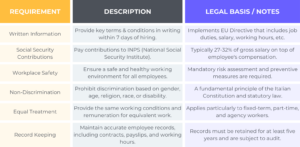
Beyond the table, a critical obligation is the payment of the “trattamento di fine rapporto” (TFR), a severance indemnity that accrues throughout an employee’s career. Employers must set aside an amount equal to 7% of the employee’s annual gross salary each year, which is paid out upon termination of employment.
Types of employment contracts
Choosing the correct contract type is the first practical step in compliant hiring. Italian labour law provides for several forms of employment relationships, each with distinct rules.
Open-ended contracts
This permanent contract is the standard form of employment in Italy and provides the highest level of job security for the employee. It has no fixed end date and can only be terminated with a justified reason or for a just cause.
The 2015 Jobs Act established that for employees hired on open-ended contracts from March 7th, 2015 onwards, unfair dismissal typically results in compensation rather than reinstatement. However, except in cases of discriminatory or void dismissals.
Fixed-term contracts
These contracts are for a specific duration and can only be used under certain conditions. As a general rule, a fixed-term contract cannot exceed 12 months without a justified reason, such as those established by collective agreements or for replacing other employees. The maximum duration is 24 months, and that’s including extensions.
Crucially, a company’s fixed-term employees cannot exceed 20% of its total permanent workforce as of January 1st of each year. Using a fixed-term contract without a valid reason or in breach of the legal limits can lead to the contract being automatically converted into a permanent one.
Part-time contracts
Part-time work involves fewer than the standard 40-hour work week. The contract must be in writing and must precisely specify the work schedule. Any variation to the schedule that constitutes “additional work” compared to what was originally agreed must be compensated with an overtime premium.
Other contract types
- Apprenticeship contracts: Aimed at workers aged 15-29, these contracts combine work and training and are designed to facilitate entry into the labour market.
- Temporary agency contracts: In this tripartite relationship, the employee is formally hired by a staffing agency but performs their duties for a user company. Also, agency workers are entitled to the same working conditions as the user company’s direct employees performing the same tasks.
Hiring process in Italy
A legally sound hiring process sets the stage for a compliant employment relationship. It begins with understanding the restrictions on contract types, as detailed above. When recruiting, job advertisements must avoid any discriminatory language and focus on objective skills and professional requirements.
Once a candidate is selected, the employer is legally required to provide them with specific written information within seven days of the employment commencing. This document, mandated by the Transparency Decree, must include:
- The identities of the employer and employee
- The place of work
- The job title, level, and category
- The date of commencement
- The duration (for fixed-term contracts)
- The initial remuneration and payment schedule
- The length of the probationary period
- Working hours
Certain other information, such as the procedure for termination, holiday entitlements, and applicable collective agreement, can be provided within one month.
Hiring foreign employees
For hiring talent in Italy, the process differs significantly based on nationality. EU/EFTA citizens have the right to work in Italy without restriction. For non-EU nationals, the process is generally quota-based, requiring the employer to secure a work permit and the employee to obtain a visa.
However, short-term work exemptions exist for nationals of some countries, like the US and Canada. Since April 2024, Italy has also implemented a Digital Nomads Visa for highly skilled non-EU remote workers, providing a new avenue for bringing international talent into the country.
Finally, the employment contract must be registered with the local employment centre.
Employer obligations and compliance
Your responsibilities as an employer extend far beyond the hiring stage. Ongoing compliance requires diligent management of several key areas.
Working time and overtime
The standard full-time workweek in Italy is 40 hours, with a legal maximum of 48 hours on average (including overtime) over a four-month period. Any work beyond 40 hours per week is considered overtime.
Its use must be limited, and it typically requires employee consent, with an annual cap of 250 hours unless otherwise regulated by a collective agreement. Furthermore, overtime must be paid at a premium rate, usually between 15% and 50% above the normal hourly rate, as defined by the applicable CCNL.
Leave entitlements
Employees are entitled to a minimum of four weeks of paid annual leave, though many CCNLs provide for more. Italy also observes 12 national public holidays. For sick leave, employees are protected for up to 180 days per year.
The National Institute for Social Security (INPS) provides a portion of the salary, and the CCNL or the employer often tops this up. Then, maternity leave is generously provided at five months on 80% of salary, while paternity leave is 10 working days at full pay.
Payroll, tax, and social security
Managing payroll in Italy involves strict adherence to rules on:
- 13th (and sometimes 14th) month’s salary
- Accurate calculation of the TFR severance fund
- Correct deductions for income tax (IRPEF) and social security
As mentioned, employers are responsible for paying significant social security contributions to INPS, which can range from 27% to 32% of the employee’s gross salary. These contributions fund pensions, unemployment benefits, and other social safety nets. Employers must also pay workplace injury insurance to INAIL, with rates varying by the risk level associated with the job.
Termination procedures
Dismissing an employee must always be supported by a justified reason, which falls into two categories:
- Disciplinary that’s related to the employee’s conduct.
- Objective which is related to the company’s operational needs.
Additionally, the procedure must be followed meticulously, including providing written notice and, in the case of collective redundancies (five or more dismissals within 120 days), engaging in a mandatory consultation process with trade unions.
The consequences for unfair dismissal depend on the hiring date and the nature of the unfairness, ranging from compensation to reinstatement.
How an Employer of Record can help
An Employer of Record is a helpful solution to the complexities of employment law in Italy. The strict employer obligations, contract rules, and compliance requirements can be simplified with an EOR.
Here are the notable benefits:
- Acting as the legal employer on behalf of the company
- Managing payroll, social contributions, and tax deductions
- Ensuring all employment contracts are compliant with Italian law and collective bargaining agreements (CCNLs)
- Handling registration, onboarding, health & safety requirements, and ongoing compliance
- Reducing legal and administrative risks when hiring local or foreign workers
- Enabling fast hiring without needing to set up a local entity in Italy
Employers in Italy will benefit from a specialised partner like Hightekers. We manage the entire process for you, ensuring seamless hiring, payroll, and full adherence to all regulations. With our support, you can confidently build your Italian team, secure in the knowledge that your legal responsibilities are met.
This allows you to focus on integrating your new talent and driving your business forward.
Contact Hightekers for Italian Employment Law compliance
Frequently asked questions
What are the penalties for misclassifying an employee as a contractor?
Misclassification can lead to a court re-qualifying the relationship as one of employment. The employer becomes liable for all unpaid social security contributions, taxes, and employee benefits, plus substantial administrative fines.
Is there a national minimum wage in Italy?
No. Italy is one of the few EU countries without a statutory minimum wage. Minimum pay is instead determined by the applicable National Collective Bargaining Agreements for each sector.
Can we use a probationary period when hiring?
Yes, probationary periods are common. For non-managerial roles, they typically last 45-60 days, while for executives, they can be up to six months. You’ll find that specific durations are often set by the relevant CCNL.
What is the Collegato Lavoro?
It is a recent legislative package linked to the 2025 Budget Law. It introduced changes to staff leasing rules, fixed-term contracts, and smart working, effective from January 2025.
What are the rules for remote work?
Remote work is formally regulated. The Collegato Lavoro introduced a mandatory five-day notice period for communications related to the commencement, modification, or termination of a remote working arrangement


