 Belgique
 España
 France
 Germany
 India
India
 Italia
 Luxembourg
 Netherlands
 Polska
 Portugal
 Suisse
 United Kingdom
 United States
How Freelance Bookkeeping Works in the Netherlands?


- Key takeaways
- Why accurate bookkeeping is your legal and business foundation
- What documents should a freelancer keep and store?
- Key elements of freelance accounting
- Navigating tax obligations: VAT and income tax
- The 2026 landscape: Upcoming changes for the self-employed
- DIY vs. professional help: Choosing your bookkeeping path
- Final thoughts
- Frequently asked questions
For the self-employed professional in the Netherlands, meticulous bookkeeping for freelancers is the foundation of a legitimate and sustainable business. Regardless of your field, turnover, or whether you are a native or an expat, Dutch law mandates that every freelancer maintain clear and accurate financial records.
This obligation is designed to ensure transparency with the Dutch Tax and Customs Administration (Belastingdienst) and to form the basis for your VAT and income tax declarations. With significant legislative changes on the horizon for 2026, including stricter rules on self-employed status and a ban on large cash payments, understanding and organising your finances has never been more critical.
This guide will explain the process, providing you with the clarity and confidence to manage your financial affairs professionally, avoid penalties, and focus on what you do best.
Key takeaways
- Freelance bookkeeping is a strict legal requirement for all self-employed professionals in the Netherlands.
- Maintain all financial documents for seven years to comply with Dutch record-keeping rules.
- Upcoming 2026 changes will bring stricter enforcement of freelance tax obligations and new rules.
- Accurate accounting for freelancer operations provides crucial business insights beyond just tax compliance.
- Using professional bookkeeping services for freelancers can save time, ensure accuracy, and reduce audit risk.
Why accurate bookkeeping is your legal and business foundation
In the Netherlands, every freelancer is legally required to keep financial records. This requirement applies universally, whether you run a bustling creative agency or a solo consultancy. The primary purpose is compliance with tax legislation to avoid fines and ensure you meet all fiscal obligations.
Accurate accounting enables a freelancer to achieve several key objectives:
- Pay taxes and VAT on time: Proper records ensure you calculate your liabilities correctly and meet strict filing deadlines.
- Monitor income and expenses: It provides a real-time snapshot of your business’s health, highlighting profitability and cash flow.
- Confirm financial transactions during an audit: The Belastingdienst can request to review your records up to seven years back. Well-organised documentation is your best defence.
Beyond compliance, robust bookkeeping for freelancers is a strategic tool. It offers invaluable insights into your most profitable services, tracks deductible expenses to minimise your tax burden, and provides the data needed to make informed decisions about investing in your business’s growth.
What documents should a freelancer keep and store?
Your financial administration is built on a paper trail (digital or physical) that evidences every business transaction. Maintaining these documents systematically is not optional, but a legal requirement for a minimum period.
Core Documents to Retain:
- Sales and purchase invoices: Every invoice you send to clients and receive from suppliers must be stored. Ensure your own invoices contain all mandatory details, including your VAT number (BTW-ID), a unique invoice number, and a clear breakdown of VAT charged.
- Bank statements: All business-related bank account statements serve as a primary record of cash flow.
- Contracts and agreements: Signed contracts with clients, suppliers, and for business assets (like office leases) define the terms of your engagements.
- Payment confirmations: Records of payments made and received, such as bank transfer confirmations.
- Tax returns and assessments: Copies of all submitted VAT (btw-aangifte) and income tax (aangifte inkomstenbelasting) returns, plus any subsequent assessments from the tax office.
- Official correspondence: Any letters or digital messages from the Belastingdienst or the Chamber of Commerce (KVK).
Key elements of freelance accounting
Understanding what goes into your accounts transforms bookkeeping from a confusing task into a logical process. For a freelancer, your accounts should accurately reflect several core elements.
Income and expenses: This is the profit and loss core. Track all revenue from client invoices and all business-related costs. That’s from software subscriptions and home office costs to professional development. Meticulous expense tracking is key to reducing your taxable profit.
Assets and liabilities: This covers what you own (assets like a laptop, camera, or company car) and what you owe (liabilities like a business loan). This is crucial for understanding your net business worth.
VAT accrued and paid: A central component of accounting for freelancer operations in the Netherlands. You must account for VAT you charge clients (output VAT) and VAT you pay on purchases (input VAT). The difference is what you owe to or can reclaim from the tax authority.
Bank transactions and cash: All business movements in your bank account must be recorded and reconciled against your invoices and receipts. Note that from 2026, a ban on cash payments over €3,000 will come into effect. This further emphasises the shift to traceable digital transactions.
Invoices: As both a record of income and a VAT document, your invoicing system is a critical part of your accounting workflow.
Employee pay slips (if applicable): If you hire any staff, their salary records become part of your administration.
Each element interlocks to create a transparent, comprehensive picture of your financial activity, which is vital for compliance and insightful business analysis.
Navigating tax obligations: VAT and income tax
The two primary tax pillars for Dutch freelancers are Value Added Tax (VAT/BTW) and Income Tax. Navigating these correctly is the most practical outcome of good bookkeeping.
VAT
As a freelancer, you are generally considered an entrepreneur for VAT purposes. This means you must:
- Charge VAT on your invoices to clients (typically at the standard 21% rate, though 9% and 0% rates apply in specific sectors).
- File quarterly VAT returns, declaring the VAT you’ve collected and deducting the VAT you’ve paid on business expenses.
- Pay the net amount to the Belastingdienst.
A key scheme for smaller operations is the Kleineondernemersregeling (KOR), or Small Businesses Scheme. If your annual turnover is under €20,000, you can apply for this exemption, freeing you from charging and filing for VAT. However, you also lose the right to reclaim VAT on your purchases.
Income tax
Your annual income tax is calculated on your business profit (income minus allowable expenses). The Netherlands uses a progressive tax system. For the 2026 tax year, the rates are 37.48% on income up to €76,817 and 49.50% on the portion above that.
As a self-employed professional, you may be eligible for valuable deductions like the zelfstandigenaftrek (self-employed deduction) and the startersaftrek (starter’s deduction), which directly reduce your taxable profit.
The 2026 landscape: Upcoming changes for the self-employed
Proactive freelancers should be aware of significant legislative changes taking effect from the 1st of January 2026. These changes underscore the importance of having your administrative and contractual affairs in order.
- Stricter rules on self-employed status: The government is intensifying its focus on false self-employment. The moratorium on enforcement will end, meaning the tax authority will actively investigate and penalise companies that misclassify employees as freelancers. New proposed legislation could presume an employment relationship exists for freelancers earning below a certain hourly threshold.
- Reduction of the self-employed deduction: The zelfstandigenaftrek, a key tax deduction, will be further reduced in 2026. This makes comprehensive accounting for freelancer expenses even more vital to lower your taxable income through other means.
- Ban on large cash payments: A new law will prohibit cash transactions exceeding €3,000, aligning with broader EU efforts against money laundering. This will require adjustments for any business that handles substantial cash payments.
DIY vs. professional help: Choosing your bookkeeping path
While you are not legally required to hire a bookkeeper, you are required to maintain a compliant administration. The choice between managing it yourself and seeking professional help depends on your time, expertise, and business complexity.
The following table outlines the key considerations:
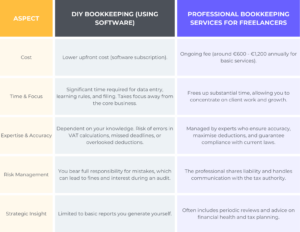
For many, especially those with growing or complex operations, the time saved and risk mitigation offered by bookkeeping services for freelancers far outweigh the cost. A good bookkeeper or accountant acts as a strategic partner, not just an administrative assistant.
Final thoughts
Mastering your financial administration is a definitive step in professionalising your freelance business in the Netherlands. While the framework may seem intricate, leveraging modern tools or expert support can transform it from a source of stress into a pillar of your success.
Given the increasing complexity of regulations, including the pivotal changes in 2026, one of the most strategic investments a freelancer can make is to delegate these responsibilities to a qualified bookkeeper or accountant.
This delegation allows you to devote your energy to developing your business. You’ll be secure in the knowledge that your compliance is handled accurately and that deadlines are met. For freelancers who prefer a simpler and more secure setup, delegating bookkeeping and tax administration to a trusted provider like Hightekers is a smart and increasingly common choice.
Hightekers supports freelancers with structured and fully compliant bookkeeping, built specifically around Dutch freelance regulations.
By managing financial records, tax reporting, and required documentation, Hightekers helps reduce administrative complexity and the risk of errors.
This approach gives freelancers peace of mind, saves valuable time, and ensures their business remains compliant as regulations evolve.
Contact Hightekers for freelancing support in the Netherlands
Frequently asked questions
Do I need to hire a bookkeeper as a freelancer in the Netherlands?
No, it is not a legal requirement to hire a bookkeeper. However, you are legally required to maintain a complete and accurate financial administration yourself.
Many freelancers choose to hire a professional to save time, ensure compliance, and optimise their tax position.
How long must I keep my invoices and financial records?
You are obligated by Dutch law to retain all business records, including invoices, receipts, and bank statements, for a minimum of seven years from the end of the relevant fiscal year.
For documents pertaining to real estate, the retention period is ten years.
What are the most common tax deductions for freelancers?
Key deductions include:
-
- business expenses (office costs, travel, equipment)
- self-employed deduction (zelfstandigenaftrek)
- starter’s deduction (startersaftrek)
- SME profit exemption (MKB-winstvrijstelling)
Eligibility often depends on working a minimum number of hours for your business.
What should I look for when choosing a bookkeeper or accountant?
Seek a professional or firm with specific experience working with freelancers and sole proprietorships in the Netherlands.
They should be familiar with relevant deductions, VAT schemes like the KOR, and the upcoming 2026 legislative changes. Furthermore, clear communication and a transparent fee structure are also essential.


