 Belgique
 España
 France
 Germany
 India
India
 Italia
 Luxembourg
 Netherlands
 Polska
 Portugal
 Suisse
 United Kingdom
 United States
Understanding the Tax Code in the Netherlands: A Complete Guide for 2026


Moving to the Netherlands conjures images of cycling along canals and world-class art. But for a truly smooth transition, you need to master a less glamorous Dutch tax code.
For international residents, remote workers, and the companies that employ them, understanding this system is the key to unlocking a legally compliant and financially sound life.
This guide will explain the Dutch tax code for you, focusing on the cornerstone of your fiscal identity, which is your Citizen Service Number or BSN.
What is a Dutch tax code?
In many countries, you might be issued a specific number for tax purposes alone. In the Netherlands, the system is more integrated. Your tax code in the Netherlands is not a separate entity. Instead, it’s intrinsically linked to your Burgerservicenummer (BSN), which translates to Citizen Service Number.
Think of your BSN as your lifelong personal identifier for all interactions with the Dutch government. It is used for healthcare, education, and, crucially, for all tax matters. The Belastingdienst, the Dutch Tax and Customs Administration, uses this number to track your income, wealth, and obligations.
You will use your BSN Netherlands number constantly. It is essential for:
- Starting a job: Your employer requires it to process your salary, calculate income tax, and social security contributions correctly.
- Filing tax returns: It is your unique identifier in all communications and digital filings with the Belastingdienst.
- Opening a bank account: Most Dutch banks will ask for your BSN.
- Accessing healthcare: To register with a GP and use the Dutch health insurance system.
- Renting a home: For formal rental agreements and applying for certain housing allowances.
Without a BSN, you cannot legally work, get paid, or access public services. It is the first and most critical administrative step for any new resident.
How to obtain your Dutch tax code
Getting your BSN is your primary mission upon arrival. The process differs slightly depending on whether you are classified as a resident or a non-resident.
For residents (staying longer than 4 months)
If you plan to live in the Netherlands for more than four months, you are required to register at the personal records database (BRP) at your local municipality, known as the gemeente.
1. Schedule an appointment: Contact the gemeente of the city you are moving to. Appointments are mandatory and can often be booked online.
2. Gather your documents: You will typically need a valid passport or identity card (a driver’s licence is often not accepted), your birth certificate, and proof of your address in the Netherlands, such as a rental contract.
3. Attend your appointment: During the registration, you will be added to the BRP and will receive your BSN on the spot or by post shortly after.
For non-residents (staying less than 4 months)
If you are a remote employee or a director of a Dutch company but will not reside in the country for more than four months, you do not register in the BRP. Instead, you register in the Non-Resident Records Database (RNI).
- You must do this in person at one of 19 designated municipalities offering RNI services.
- If you are a non-EU/EEA citizen, your options are more limited, typically to specific RNI desks in cities like Breda or Venlo.
- You will need a valid passport, and upon registration, you will be issued your BSN.
Avoiding common mistakes
Here are a few tips to consider so you don’t make the same mistakes as others:
- Book early: Gemeente appointments can have long waiting times in major cities. Schedule as soon as you have proof of address.
- Document preparation: Ensure all foreign documents are officially legalised and, if necessary, translated by a certified translator.
- Non-resident path: Do not attempt to register as a resident if you are staying for less than four months, as this is incorrect and can cause legal complications.
Understanding Dutch tax residency
Your tax residency status is a critical distinction that determines how you are taxed. The Dutch system looks at your personal and economic ties to the country.
You are generally considered a tax resident if:
- You have a home in the Netherlands where you live with your family.
- Your centre of vital interests (your personal, social, and economic life) is in the Netherlands.
- You spend more than 183 days in the Netherlands within a tax year.
Implications of residency status
Here’s a table summarising the noteworthy outcomes of your residency status:
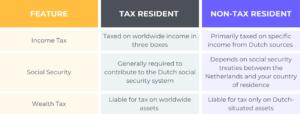
The Netherlands has an extensive network of tax treaties with other countries to prevent you from being taxed twice on the same income. These treaties help determine which country has the primary right to tax your income. That’s especially true for remote workers with an employer based abroad.
How your Dutch tax code affects payroll and taxes
Once you have your BSN, your employer or your client will use it to ensure your income and taxes are processed correctly. The Dutch income tax system for residents is divided into three main “boxes.”
The three-box system
- Box 1 – Income from work and homeownership: This includes your salary, benefits, and income from a business. It is taxed at progressive rates up to 49.5% in 2026. It also includes a notional calculation for the value of owning your own home.
- Box 2 – Income from Substantial Interest: If you own a significant interest (typically 5% or more) in a company, the dividends and capital gains from that interest are taxed at a flat rate of 33% in 2026.
- Box 3 – Income from savings and investments: This box taxes a notional (assumed) return on your net assets (savings and investments minus debts), not your actual capital gains. For 2026, the government has confirmed changes: the tax-free allowance will be reduced from €57,684 to €51,396, and the notional rate of return for assets other than savings and debts will increase to 7.78%.
Payroll withholding and social security
When you are on a Dutch payroll, your employer will use your BSN to apply the correct tax tables and withhold income tax and social security contributions at source. This withheld amount is your preliminary tax payment. At the end of the tax year (which runs from 1 January to 31 December), you file an income tax return to settle any underpayment or overpayment.
Social security contributions, which cover state pension, healthcare, and unemployment benefits, are also calculated based on your income. Also, they are shared between you and your employer.
Remote workers and international employers
This is a common and complex area. If you live in the Netherlands but work for a foreign company without a local entity, your employer is likely obligated to comply with Dutch payroll tax and social security laws.
To manage this complexity without establishing a legal entity, many companies use a professional employer organisation (PEO) or an Employer of Record service. These entities act as your legal employer in the Netherlands. They also handle your payroll, tax withholding, and compliance using your BSN.
Updating or correcting your Dutch tax code
Life changes, and your tax situation must reflect that. It is your responsibility to inform the authorities of relevant changes.
When to update your information
You must inform the Belastingdienst if you:
- Change your residential address.
- Get married, enter a registered partnership, or divorce.
- Have a child.
- Start or stop a business.
- Move abroad or start working for a foreign employer.
A change of address is first registered with your gemeente, which then shares this information with the Belastingdienst. For other life events, you may need to proactively inform the tax authority through a letter or a message in your online portal.
Correcting errors
If you discover an error in the information the Belastingdienst has on file for you—for instance, an incorrect marital status or a mistake in a pre-filled tax return—you must correct it promptly.
The primary channel is the Belastingdienst website. You’ll need to log in with your DigiD (your digital identity for government services) to check your data and submit corrections. For complex issues, you can call or write to them. However, it’s advisable to keep records of all your communications.
How an EOR can help
An Employer of Record is a compliant hiring solution for companies that want to keep an employee who becomes a Dutch tax resident but cannot legally employ them in the Netherlands.
In fact, an EOR is a practical support tool because it:
- Acts as the legal employer in the Netherlands when the worker becomes a Dutch tax resident
- Handles BSN registration support and ensures the worker is set up correctly with the Belastingdienst and Dutch social security
- Manages fully compliant Dutch payroll, income tax withholdings, social contributions, and payslips
- Provides Dutch-compliant employment contracts aligned with local labour laws and collective agreements
- Helps companies avoid issues like permanent establishment risk, worker misclassification, or unlawful payroll
- Allows employees to live and work in the Netherlands while the original employer avoids the cost and complexity of setting up a Dutch entity
Final thoughts
The Dutch tax code is centred on your essential BSN, which is a fundamental step for any expat or remote worker. While the system is logical, its details regarding residency, payroll, and international employment can present significant administrative hurdles.
This is where specialised services like Hightekers provide invaluable assistance. As an Employer of Record (EOR), Hightekers can legally employ you on behalf of your foreign company, managing all Dutch payroll, tax withholdings, and social security contributions using your tax code.
Likewise, employers can remain fully compliant while focusing on their business.
Contact Hightekers for tax compliance in the Netherlands
Frequently asked questions
I am a remote worker for a foreign company. Do I need a Dutch BSN?
Yes, if you are living in the Netherlands, you are obligated to register and obtain a BSN. You will need it to open a bank account, get health insurance, and for your tax obligations.
Also, your foreign employer may need to use a payroll service in the Netherlands to handle your salary and tax withholdings legally.
What is the difference between a BSN and a tax code?
In the Dutch context, they are one and the same. The BSN (Burgerservicenummer) is your general citizen service number that is used for all government services, including taxation.
Unlike some countries that issue a separate number just for tax, the Netherlands uses the BSN as your primary tax identification number.
How long does it take to get a BSN after arriving?
If you are registering as a resident at the gemeente, you will often receive your BSN during your appointment or within a few days by post. For non-residents registering via the RNI, the number is typically provided immediately upon registration.
The main variable is the waiting time for the appointment itself, which can be several weeks in busy cities.
Can I start work in the Netherlands without a BSN?
While you can begin the process of employment, you cannot receive a salary on a Dutch payroll without a BSN. Employers are legally required to collect this number.
You can start work provisionally, but you must obtain your BSN as an absolute priority to get paid and remain compliant.


