 Belgique
 España
 France
 Germany
 India
India
 Italia
 Luxembourg
 Netherlands
 Polska
 Portugal
 Suisse
 United Kingdom
 United States
UK Visa Application Status in 2026: Tracking Guide


Waiting for a decision on your UK visa application can feel like an eternity. Knowing how to effectively track your UK visa application status provides invaluable peace of mind during what can be a stressful process.
This guide provides comprehensive information on monitoring your application through official channels, understanding processing timelines, and resolving common issues. Whether you’re expanding your business to the UK or coming as a freelancer, we’ll help you get the visa.
What is UK visa application status?
Your UK visa application status is the current stage of your application within the UK Visas and Immigration (UKVI) decision-making process. It represents a digital record of your identity and immigration status. Furthermore, it replaces physical documents like biometric residence permits (BRPs) and stickers in passports.
The application process typically moves through several stages:
- Submission and payment acknowledgement
- Biometric enrolment appointment
- Processing and consideration
- Additional information requests
- Decision notification
Monitoring your visa status check for UK applications is crucial because it helps plan your next steps and identify potential issues early. You can also ensure you haven’t missed any communication requests and manage expectations during waiting periods.
The UK government is increasingly moving toward digital immigration statuses, known as eVisas. These are online records of your immigration status and conditions. This shift means that checking your status online will become even more important going forward.
How to check your UK visa application status online
Knowing how to check progress of visa application in the UK is essential for staying informed. The method varies depending on whether you applied from inside or outside the UK, but always requires specific information ready before you begin.
Before checking your status, ensure you have your application reference number (GWF number or similar), passport number, date of birth, and the email address used on your application.
Applications made outside the UK
If you applied from outside the UK, you have several options to track a UK visa application:
- VFS global website: If you submitted your application through a VFS centre, visit their website, select your location, click “Track your application.” Then enter your reference number and last name.
- TLScontact website: For applications through TLScontact, sign into your account on the GOV.UK website and navigate to ‘Provide Documents and Biometrics.’ Now click ‘Continue’ to be redirected to TLScontact. Finally, select ‘Track’ to view real-time status.
- UKVI paid email service: You can email UKVI through their paid enquiry service (£2.74 per enquiry) on the UKVI website. This service typically receives replies within 2 working days.
- Telephone Enquiries: You can call UKVI at +44 (0)300 790 6268 (option 1) or +44 (0)203 875 4669. This service costs 69p per minute plus standard network charges, and is available 24/7 Monday to Friday.
Applications made inside the UK
For in-country applications, the process is different:
- UKVCAS limitations: The UK Visa and Citizenship Application Services (UKVCAS) website does not provide application status updates.
- Telephone enquiries: Contact UKVI at 0300 790 6268 (select option 2) Monday to Thursday 9am-4:45pm and Friday 9am-4:30pm.
- Email enquiries: For citizenship applications specifically, email nationalityenquiries@homeoffice.gov.uk.
Understanding UK visa application processing times
UK visa processing times vary significantly depending on your visa type, application location, and individual circumstances. Understanding these timelines helps manage expectations and reduce anxiety during the waiting period.
The following table outlines the standard processing times for common visa categories. It is important to note that these are guidelines provided by the UK Home Office and are not guaranteed timelines.
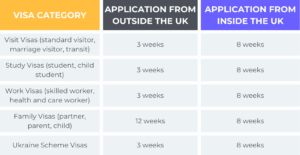
Factors affecting processing times
Are you frustrated that your UK visa application is taking too long? Here are the factors that might cause delays:
- Application completeness and accuracy: Incomplete forms or incorrect information require caseworkers to seek clarification, thereby halting progress until resolved. Submitting a perfectly prepared application from the outset is crucial for avoiding preventable delays in the decision-making process.
- Need for additional evidence or documentation: If UK Visas and Immigration decides they need more proof, they will issue a request. The processing timeline is effectively paused until you provide this information. In practice, this can extend the overall waiting period considerably.
- Verification of supporting documents: The Home Office must verify the authenticity of documents like bank statements or qualifications with the issuing authorities. The speed of these external checks is beyond their control and can prolong the assessment phase.
- Personal circumstances and history: Complex personal backgrounds require a more detailed and thorough assessment by caseworkers. This includes a criminal record or previous immigration violations. The necessary scrutiny naturally takes more time than a straightforward application.
- Application volumes and seasonal peaks: Processing centres experience high demand during certain seasons, which leads to backlogs. This increased workload can extend standard processing times across the board.
- Requirement to attend an interview: While not common for all visa types, an interview might be required. Scheduling it and awaiting the outcome adds extra steps to the process. This will inevitably increase the total time until a final decision.
Common issues when checking visa status
Despite efforts to speed up the process, applicants often encounter challenges when trying to check their UK visa application status. Understanding these common issues can help you overcome them more effectively.
Technical glitches and system errors
Many applicants face persistent technical problems with the official online tracking portals. That’s because websites may experience unexpected downtime, display error messages, or fail to load entirely. It is not uncommon for the system to fail to recognise a valid application reference number. That’s true even when entered correctly.
Furthermore, login issues can also occur despite using the right credentials. These technical hiccups are often temporary, but they can cause significant anxiety. If you encounter this, wait a few hours and try again using a different internet browser or device. Clearing your browser’s cache and cookies can also resolve many of these common technical issues
Delayed or missing status updates
A major source of frustration is the lack of real-time progress updates. The online status may remain stagnant for weeks, showing a message like “Application Received” long after your biometrics appointment.
This does not necessarily indicate a problem, since the system is often not designed to provide step-by-step updates. Furthermore, the status may only change once a final decision has been made.
The delay between a decision being reached and the status updating online can also be a cause for concern. Hence, applicants should be prepared for a lack of intermediate notifications and understand that the system is primarily a high-level tracker.
Vague or ambiguous status messages
Interpreting the meaning of status updates can be confusing and often leads to misinterpretation. Phrases such as “Under Consideration” or “Being Processed” are intentionally broad. They do not indicate what stage the application is in or how much longer it might take.
Additionally, the term “Processed Application” is particularly ambiguous as it reveals nothing about the outcome—whether it is an approval or a refusal. This lack of clarity can leave applicants guessing. It is important not to read too much into the messages, as they are standard terms and not indicative of the application’s result.
Difficulties with third-party service providers
For applications made outside the UK, tracking is often handled through commercial partners like VFS Global or TLScontact. This can add a layer of complexity, as communication may need to be channelled through these intermediaries.
Their websites may have different interfaces and updating schedules than the core UKVI system. Also, there can sometimes be a disconnect between what the partner agency’s portal shows and the actual status within the UK Home Office.
Furthermore, getting a clear response from these partners regarding specific delays can be challenging. They often act as processing agents rather than decision-makers. This can limit the detailed information they can provide.
Lack of communication on delays
Perhaps the most common issue is the absence of proactive communication when an application exceeds standard processing times. The system typically does not automatically notify you if your application is stuck in a queue or requires additional internal checks.
This silence can be particularly worrying. Applicants are left to wonder if the delay is normal or if something has gone wrong. This is when the UKVI paid enquiry service becomes essential. The responsibility falls on the applicant to seek out an update once the published processing time has passed, as automatic notifications are not standard practice for routine delays.
Tips for staying updated on your UK visa application
Proactive management of your application can reduce stress and help you stay informed throughout the UK visa processing period. Here are practical strategies for maintaining visibility on your application progress.
Prepare meticulously from the beginning
The foundation for smooth tracking is laid during the application stage itself. Therefore, keeping impeccable records prevents frantic searches for information later when you need to check your status or contact UKVI. Organisation is your greatest ally in overcoming the waiting period efficiently.
Here are some practical tips:
- Securely save all reference numbers (GWF, IHS, and application ID).
- Use a single, reliable email address and monitor its spam folder regularly.
- Create a dedicated folder for digital and physical copies of all submitted documents.
- Note the exact dates of submission, biometric enrolment, and any correspondence.
Establish a sensible monitoring routine
While it’s tempting to check the portal constantly, a disciplined approach is more effective. That’s because excessive checking can increase anxiety without providing new information. Instead, set a realistic schedule for yourself to stay informed without becoming overwhelmed by the process.
Here’s what you can do:
- Check your online status once a week, rather than daily.
- Set a calendar reminder for when your application approaches the standard processing time.
- Follow official UKVI social media channels or websites for announcements about system-wide issues.
- Avoid relying on unofficial forums for status updates, as they can provide misleading comparisons.
Communicate effectively with UKVI when necessary
If you need to seek an update, being prepared will help you get a clear response. Whether contacting UKVI by email or phone, having your details organised shows you are serious and helps the officer access your case quickly.
Here are the top best practices:
- Have your application reference number and passport details on hand before calling or emailing.
- For enquiries, be concise and polite, stating your application date and question clearly.
- Keep a record of all communications, including the date and the name of any official you speak with.
- Use the paid enquiry service for specific questions after standard processing times have elapsed.
Know what to do if you experience a significant delay
If your application has exceeded the published processing time, it is reasonable to seek clarification. A structured approach is more likely to yield a helpful response than making multiple frantic enquiries through different channels.
Follow these steps:
- First, verify there are no general delays for your visa type on the official GOV.UK website.
- Escalate your enquiry through the UKVI paid service if you receive a generic response.
- If you are in the UK, you can contact your local MP for assistance with significant delays.
- For complex cases or persistent unexplained delays, consider seeking advice from a qualified immigration adviser.
Last words
Understanding the UK visa application process requires patience and organisation. You can regularly check your UK visa application status through official channels and set realistic expectations about processing times. Also, it helps to know how to address common issues to reduce stress during the process.
Need to streamline the entire process? Partnering with an Employer of Record (EOR) service can help. An EOR acts as the official employer for your role in the UK, often handling the complex visa sponsorship and application process on your behalf. This expertise can help ensure your application is complete and compliant from the start. It reduces the risk of delays and simplifies your path to working in the UK.
Explore how an Employer of Record in the UK can facilitate your move today
Frequently asked questions
How can I check my UK visa status with just my passport number?
While you typically need your application reference number (GWF) to check your status, some portals may allow queries with your passport number. However, the UKVI official enquiry service usually requires your reference number.
If you’ve lost this information, contact UKVI directly with your personal details and passport information to request status updates. Make sure to always keep your reference number secure, as it significantly simplifies tracking.
What does it mean if my visa status hasn’t changed for several weeks?
A static status for several weeks typically indicates your application is progressing normally. UK visa status portals often lack real-time updates. Hence, they may not change until a decision is ready.
Unless your application has exceeded the standard processing time for your visa category, this is usually not cause for concern. Check published processing times for your visa type to assess whether your wait is unusual.
Can I travel while waiting for a UK visa decision?
If you applied from outside the UK, you cannot travel to the UK while awaiting a decision. However, if you applied from inside the UK, you can generally remain until a decision is made. That’s provided you applied before your previous visa expired.
However, leaving the UK while awaiting a decision may withdraw your application. Always check specific rules for your situation before making travel plans during pending applications.
How long after biometrics should I expect a visa decision?
The timing varies typically by visa type and application location. For outside UK applications, decisions typically come within 3-12 weeks after biometrics, depending on the visa category. For inside UK applications, the process typically takes 8 weeks for most categories.
Priority services can reduce this to 1-5 working days after biometric enrolment. These are guidelines rather than guarantees, and individual cases may vary.
What should I do if my application has exceeded the maximum processing time?
If your application has exceeded the maximum processing time for your visa category, first use the UKVI paid enquiry service for an update. If this doesn’t yield satisfactory information, consider formal complaint procedures or contacting your MP if you’re in the UK.
For serious delays without explanation, you may want to seek professional immigration advice. Keep records of all communications regarding your delayed application.


