 Belgique
 España
 France
 Germany
 India
India
 Italia
 Luxembourg
 Netherlands
 Polska
 Portugal
 Suisse
 United Kingdom
 United States
A Complete Guide to VAT in the Netherlands for Expats


Understanding the VAT system in the Netherlands can feel like a daunting task, especially when you’re trying to settle into a new life. Whether you’re an expat freelancer, a professional, or an employee, understanding your VAT obligations is crucial for staying on the right side of the Dutch tax authorities.
This guide breaks down everything you need to know about VAT in the Netherlands, from the basic rates to complex compliance rules, all tailored for the international community.
Basics of VAT in the Netherlands
Value Added Tax, or VAT, is a consumption tax applied to most goods and services in the Netherlands. It’s known locally as Belasting over de toegevoegde waarde (BTW). Unlike income tax, which is levied on what you earn, VAT is a tax on what you spend.
Therefore, businesses act as tax collectors on behalf of the government, charging VAT on their sales and remitting it to the tax authorities.
For businesses, the VAT system functions as a pass-through mechanism. You charge VAT to your customers on your sales (output tax) and pay VAT to your suppliers on your purchases (input tax). The difference between what you collect and what you pay is what you remit to the tax office. If you’ve paid more VAT than you’ve collected, you may be eligible for a refund.
For tourists from outside the EU, the Dutch VAT rate can often be reclaimed on purchases made during their visit through the tax-free shopping scheme. This provides a big saving on luxury goods and souvenirs.
How VAT works in the Netherlands
The Dutch VAT system operates on the destination principle, meaning VAT is generally charged in the country where the customer is located. This is particularly important for businesses serving clients across EU borders. Note that the mechanism relies on businesses diligently tracking their input and output VAT.
When your business is VAT-registered, you must charge the appropriate Dutch VAT rate on your taxable supplies. Simultaneously, you can generally reclaim the VAT you pay on business-related expenses.
This creates a chain where the tax burden ultimately falls on the final consumer, while businesses mainly facilitate its collection. Special schemes exist to simplify this process. That’s particularly true for small businesses and those trading internationally.
The Dutch Tax and Customs Administration (Belastingdienst) oversees VAT compliance and enforcement. They determine:
- registration requirements
- collect returns
- conduct audits
The system is designed to be largely self-assessed, placing responsibility on business owners to correctly calculate, charge, and remit their VAT liabilities.
VAT Rates in the Netherlands
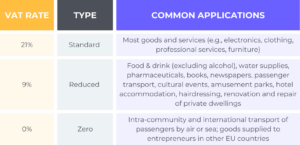
The Netherlands employs three main VAT rates: the standard rate and two reduced rates. Understanding which rate applies to your products or services is fundamental to proper VAT compliance.
This table summarises the main VAT rates and their common applications:
Exemptions and special schemes
Some sectors and activities are fully exempt from VAT. This means no VAT is charged on supplies, but the business generally cannot reclaim VAT on related expenses. Key exemptions include:
- Healthcare services provided by doctors, dentists, psychologists, and other professionals listed in the Individual Health Care Professions Act (BIG).
- Education provided by legally regulated institutions, as well as general, vocational, and arts education.
- Childcare provided by registered centres and childminders.
- Certain financial services and insurance.
- Services of sports clubs (for non-profit organisations).
Furthermore, special arrangements exist for specific industries:
- Small businesses scheme: If your annual turnover is less than €20,000, you may apply for this scheme, allowing you to not charge VAT to your customers. However, you also cannot reclaim VAT on your business expenses.
- Margin schemes: For second-hand goods, art, and collectables, VAT can be paid on the profit margin rather than the full selling price.
- Travel agency scheme: For tour operators, a special margin scheme applies to travel services.
Upcoming VAT rate changes
It’s important to be aware of future adjustments to the VAT in the Netherlands landscape. The Dutch government has announced that starting 1st January 2026, the VAT rate on short-stay accommodations (including hotels, B&Bs, and holiday homes) will increase from the current 9% to the standard rate of 21%. Furthermore, camping accommodations will remain at 9%.
VAT registration in the Netherlands
Knowing when and how to register for VAT is a critical step for any entrepreneur or business in the Netherlands.
Who must register?
You must register for VAT if:
- You are an entrepreneur (including freelancers, self-employed professionals, and companies) and your annual turnover exceeds €20,000.
- You are a non-resident business supplying goods or services in the Netherlands (the threshold is effectively zero for foreign businesses).
- You acquire goods from other EU member states worth more than €10,000 per year.
- You intend to claim a Dutch VAT refund through the non-Union OSS scheme.
Even if your turnover is below the threshold, voluntary registration can be beneficial as it allows you to reclaim VAT on your business costs.
The registration process
After registering your business with the Netherlands Chamber of Commerce (KVK), the Dutch Tax Administration will automatically assess your status. If you are considered an entrepreneur for VAT purposes, you will receive two numbers:
- A VAT identification number (btw-id), which you must display on all your invoices.
- A VAT tax number (omzetbelastingnummer), used for administrative purposes.
The process can be completed online through the Dutch Tax and Customs Administration website. For non-resident businesses, the process is similar, and you may need to appoint a fiscal representative.
VAT compliance and filing
Once registered, maintaining strict VAT compliance is an ongoing responsibility. This involves invoicing, record-keeping, and filing periodic returns.
Invoicing requirements
Every VAT-registered business must issue valid invoices for its taxable supplies. A compliant invoice must include:
- Your business name, address, and VAT identification number.
- The customer’s name and address.
- A unique, sequential invoice number and the date of issue.
- A clear description of the goods or services supplied.
- The quantity and unit price.
- The applicable VAT rate and the total VAT amount are shown separately.
- The total amount payable.
Invoices can be issued electronically, provided the authenticity and integrity of the content are guaranteed and the recipient agrees.
Filing your VAT return
You are required to file your VAT return (btw-aangifte) digitally. The tax authorities will inform you of your filing frequency. That’s typically quarterly, though monthly or annual filing may also apply. Also, the deadline for filing and payment is generally the end of the month following the reporting period.
The return requires you to declare:
- Total turnover (including VAT charged).
- Total VAT you have charged on your sales (output tax).
- Total VAT you have paid on your business purchases (input tax).
- The resulting VAT payable or refundable.
Penalties for non-compliance
Failure to adhere to the rules can result in significant penalties. These include:
- Late submission: A fine of up to €131 for not filing your return on time.
- Late payment: Interest on overdue amounts, plus a potential penalty of up to €5,278 for careless errors.
- Incorrect returns: Penalties ranging from 25% to 100% of the underpaid VAT for gross negligence or fraud.
The tax authorities may also consider serious non-compliance a criminal offence, which could lead to higher fines or imprisonment.
VAT refunds and special cases
VAT refunds for foreign businesses
Businesses established outside the Netherlands but within the EU can often use the reverse-charge mechanism for B2B supplies. This means the Dutch client accounts for the VAT. For B2C supplies or if VAT is due, the One Stop Shop (OSS) system simplifies the process. The OSS allows businesses to declare and pay VAT for all their EU sales in a single quarterly return in their home country.
For businesses based outside the EU, a similar Non-Union OSS scheme is available. Alternatively, they can register for VAT directly in the Netherlands or use the OSS portal in a member state of their choice to account for VAT across the EU.
Tax-free shopping for tourists
Visitors from outside the EU can shop tax-free in the Netherlands. As a retailer, you can facilitate this by:
- Verifying the customer’s non-EU residency by checking their passport (you may copy it, but must obscure the photo and BSN number).
- Issuing a special invoice detailing the goods and the customer’s passport number.
- The customer must then have the goods and invoice validated by customs upon leaving the EU. Then, they send the validated document back to you for the VAT refund.
Special rules for digital and virtual services
The rules for digital services have been expanded. From 2025, the scope of VAT will extend beyond pre-recorded digital content to include interactive, real-time virtual services. This includes online coaching, live-streamed events, paid webcam interactions, and other remote services in the artistic, scientific, or educational fields.
For these services, the place of taxation is the customer’s location. If your customer is a private individual in another EU country, you must charge the VAT rate of that member state. The OSS scheme is the most practical way to manage these obligations without registering in multiple countries.
Summary
Grasping the intricacies of VAT in the Netherlands is not just about legal compliance. It’s about making informed financial decisions for your business or personal finances. From the standard 21% rate to the various exemptions and the crucial small business scheme, the Dutch VAT system is detailed but manageable.
Remember that the rules for digital services are evolving, and staying informed of these changes is key to maintaining good VAT compliance. Given the complexity and potential financial impact, consulting with our Employer of Record service is often a wise investment.
Get support with VAT compliance in the Netherlands
Frequently asked questions
What is the VAT registration threshold in the Netherlands?
The VAT registration threshold for resident businesses is an annual turnover of €20,000. If your turnover exceeds this amount, you are required to register for VAT. Different rules apply to non-resident businesses and those involved in distance selling within the EU.
Can I reclaim VAT as a tourist in the Netherlands?
Yes, if you live outside the EU, you can reclaim VAT on goods you purchase and take home with you. You must ask the retailer for a tax-free shopping form when you buy the items and have it validated by Dutch customs when you leave the EU. The retailer will then process the refund for you.
How does VAT work for services I provide to clients abroad?
The rules depend on your client’s location and status. For business clients (B2B) within the EU, the reverse-charge mechanism usually applies, meaning your client pays the VAT in their country.
For private clients (B2C) in the EU, you typically must charge Dutch VAT. However, for digital services, you must charge the VAT rate of your client’s country, often using the OSS scheme.


