
France ended 2025 with more than 3 million registered micro-entrepreneurs, according to URSSAF, the agency that collects social contributions. But while signing up takes an afternoon online, figuring out what you’ll owe in taxes takes a bit longer.
Let’s take a freelance UX designer in Lyon as an example. She’s single, invoices €60,000 over a year with no other income and few business costs. After every office with a claim on that money has been paid, she’s left with roughly €40,000. The other €20,000 goes to two different places at different times in the year under the rules she chose in a few clicks while signing up.
Which part of that €20,000 is income tax? Why does some of it leave her account in a month with no clients at all? And why does she get a separate bill in December, from a tax she’s never heard of?
In this article we’ll go over those questions and a few others like:
- How the two French tax regimes for freelancers work, and which one suits you
- Who takes the biggest slice of your income (hint: the office you think about least)
- How income tax, VAT and the local business tax fit around it
- What changed in 2026
Key takeaways
- Self-employed freelancers in France pay social contributions to URSSAF and income tax to the tax office separately. For most service freelancers, the social contributions are by far the bigger bill.
- Micro-entrepreneurs are taxed on turnover minus a flat allowance (34% for most liberal professions) and can’t also deduct real expenses, so the standard regime pays off only when business costs are higher.
- VAT has its own threshold of €37,500 for services, far below the micro-entreprise limit
- The CFE local business tax is waived in your first year, so the first bill usually lands in your second December.
In 2026, the micro-entreprise limit for services rose to €83,600, while the ACRE discount for new businesses dropped from 50% to 25% for registrations from July 1.
Micro-entreprise or the standard regime
Before any rate applies, you choose how your income gets measured.
The micro-entreprise regime, still widely called “auto-entrepreneur”, taxes you on turnover. You report your sales, URSSAF applies a fixed percentage, and the tax office takes a flat allowance off the top to cover your expenses. There’s no balance sheet to prepare, so an accountant is optional, though some micro-entrepreneurs still use one.
The standard regime (régime réel) taxes you on profit. You keep books as usual, deduct the expenses you can prove, and pay tax and contributions on what’s left. Freelancers in liberal professions, such as developers, designers and translators, who choose the standard regime report their yearly profit on form 2035.
So which is better? It depends on the costs, but one micro-rule applies to both: the flat allowance replaces your expenses, so you either get one or the other. You can’t have your cake and eat it too.
If you mostly sell your time, the allowance is a good deal. A laptop, a few subscriptions and a coworking desk rarely add up to a third of your earnings. Lots of travel, subcontractors or pricey equipment are a different story where the standard regime can come out ahead, even after paying the accountant.
The 2026 micro-entreprise figures:
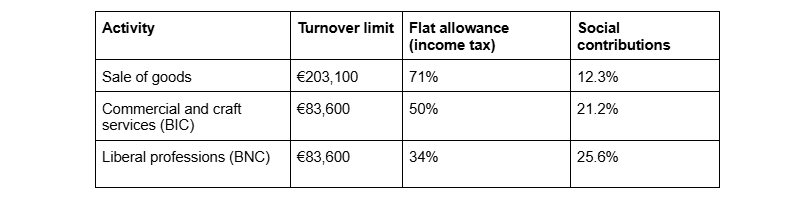
If you go over the limit two years in a row, you’ll be moved to the standard regime automatically.
Social contributions take the lion’s share
Income tax gets all the attention, but it's the smaller of the two bills.
URSSAF charges a fixed fee for everything under micro-entrepreneur bills. In 2026 that’s 25.6% for most liberal professions, according to the French government’s guide to micro-entrepreneur social contributions. The money pays for health cover, your state pension and family allowances.
Back to our example from the intro, the designer’s €60,000 year would look something like this:
- Social contributions: €15,360, plus a small training levy of €120
- Income tax: around €4,980
- What she keeps: around €39,500, before her own business costs
URSSAF takes three times what the tax office does, and for a single person with no other income, social contributions are the bigger bill at every turnover level the micro regime allows. This is why the rule of thumb of setting aside 30 to 35% of every invoice makes sense. In her case, it’s 34%.
Some things make this slightly easier to live with. You declare monthly or quarterly, so the money leaves soon after it arrives. Also, a month with no turnover means no contributions at all. The downside is that a slow year earns you very little toward your pension.
On the standard regime, contributions are calculated on profit, paid as provisional installments and corrected as soon as your income is known, with a minimum due even in a barely profitable year.
Income tax and when you pay it
Income tax uses the same progressive scale as every other French tax resident. On 2025 income, taxed in 2026, the official income tax scale charges 0% up to €11,600 per household share, then 11%, 30% and 41% on successive slices, and 45% above €181,917.
Micro-entrepreneurs start from turnover minus the flat allowance, so the designer’s €60,000 becomes €39,600 of taxable income. Her top bracket is 30%, yet her average rate is about 12.6%.
That amount joins the rest of your household’s income on the yearly return, filed each spring on forms 2042 and 2042-C-PRO. You don’t pay it all in one go a year later, though. The tax office takes monthly or quarterly installments from your account based on your last return, then sorts out the difference when you file the next one.
French tax residents are taxed on their worldwide income, non-residents are taxed only on income from French sources.
The versement libératoire: too good to be true?
Micro-entrepreneurs get one extra option. The versement libératoire allows you to pay income tax as a fixed percentage of turnover, collected by URSSAF with your contributions: 2.2% for liberal professions, 1.7% for commercial services and 1% for sales.
That would mean €1,320 of income tax for the designer instead of €4,980. It’s probably off the table for her, though. The option is only open to households whose reference taxable income from two years earlier stayed under a set limit, which is €29,579 for a single person, with higher limits for couples and families.
Conversely, a freelancer whose household would owe little or nothing under the normal scale still pays the percentage on every invoice.
VAT has its own, much lower threshold
The designer’s €60,000 year has one more twist. She’s well under the €83,600 micro limit, but she passed the VAT threshold months ago.
VAT has its own thresholds, although much lower. Below €37,500 of annual turnover for services, or €85,000 for sales, you don’t charge it, and every invoice has to state this with the line “TVA non-applicable, article 293 B du CGI.” If you cross that base threshold, VAT starts on January 1st of the following year. Crossing the higher threshold of €41,250 during the year, it starts the very day you cross it, according to the government’s guide to the VAT exemption.
From then on, she adds 20% to her invoices, files VAT returns, and passes the money on. Business clients barely notice since most can reclaim it, but the price for a private client went up by a fifth.
What changed in 2026
The good news first: on January 1st, the micro-entreprise limit for services went up from €77,700 to €83,600, and it's fixed until 2028.
The less welcome news: ACRE, which reduces social contributions during a new business’s first months, was scaled back. Businesses created from July 1st, 2026, get 25% instead of 50%. That’s €576 a month in contributions instead of €384, for roughly the first nine to twelve months if your turnover is €3,000 a month. A business registered in June 2026 keeps the old discount.
The CFE, a local business tax with a late first bill
The cotisation foncière des entreprises (CFE) is a local business tax that every registered business pays, micro-entrepreneurs included, even if you work from your kitchen table. Your commune sets the rate, so the amount depends on where your business is registered.
The first bill takes its time. According to the government’s guide to the CFE for micro-entrepreneurs, you’re exempt in the year you start, and the tax base is cut in half the year after. You are also exempt from any fees in a year where your turnover two years earlier was €5,000 or less. You do still have to file a first declaration (form 1447-C-SD) by December 31 of the year you start.
When the bill arrives, it’s generally due by December 15, often more than a year after you registered.
A freelancer’s tax year at a glance
Put together, a freelancer’s tax year in France looks like this:
- Every month or quarter: declare your turnover to URSSAF and pay contributions and the versement libératoire if you chose it
- Every month or quarter: income tax installments leave your account automatically
- Spring: file the annual return. The deadlines depend on the “département”
- Mid-December: pay the CFE
- If you charge VAT: file VAT returns on the schedule that applies to you.
How Hightekers can help
What we talked about throughout this article is the self-employment route, and plenty of people make it work. In fact, 1.66 million entrepreneurs declared turnover in the last quarter of 2025. It also leaves you to handle every deadline yourself, from the monthly or quarterly declarations to the yearly return.
With an employment contract from Hightekers, you keep your own clients and rates, but you don’t run a business. Hightekers invoices the client and handles VAT, payroll, and compliance. Contributions and income tax come straight off your payslip, and since there's no business to register, there's no business tax return or CFE bill to manage.
You also build pension rights and keep access to unemployment benefits between projects.
Want to see what that looks like on your own income? Request your personalized simulation. We will run a personalized simulation based on your day rate and show you exactly what ends up in your account.
FAQ
How much tax does a freelancer pay in France?
For a single micro-entrepreneur in a liberal profession, social contributions and income tax together come to roughly a third of turnover at mid-range incomes, about €20,500 on €60,000. Your activity, regime and household all change the result.
What is the micro-entreprise turnover limit in 2026?
€83,600 for services and liberal professions, and €203,100 for the sale of goods. Going over the limit two years in a row moves you to the standard regime.
Do freelancers in France have to charge VAT?
Only above the VAT threshold, which for services is €37,500 of annual turnover, with a tolerance threshold of €41,250. Below it, every invoice must include the line “TVA non applicable, article 293 B du CGI”.
Can micro-entrepreneurs deduct business expenses?
No. They get a flat allowance instead: 34% of turnover for liberal professions, 50% for commercial services and 71% for sales. If your costs are higher, you can opt for the standard regime and deduct them.