 Belgique
 España
 France
 Germany
 India
India
 Italia
 Luxembourg
 Netherlands
 Polska
 Portugal
 Suisse
 United Kingdom
 United States
When to Consult an Employee Rights Lawyer in Italy


Imagine being dismissed from your job without a clear reason, or discovering your fixed-term contract has been unlawfully extended multiple times. For many employees in Italy, these scenarios are a reality, yet few know their legal rights or when to seek professional help.
Likewise, businesses expanding to Italy need to understand the best route forward to employee compliance. Understanding when to consult an employee rights lawyer is crucial. This guide explains key legal protections, scenarios requiring legal assistance, and how to find specialised support.
Overview of consulting lawyers in Italy
Italy’s employment law framework is strong, grounded in constitutional principles that guarantee dignified work conditions, fair pay, and protection against unjust dismissal. However, the system is multi-layered, incorporating:
- National legislation
- Collective bargaining agreements
- Frequent court rulings that reshape interpretations
For employees—especially expats and international staff—this legal landscape can be daunting. An employment lawyer in Italy specialises in translating these complexities into actionable advice, helping you understand your position and assert your rights effectively.
Early legal consultation can prevent minor issues from escalating into significant disputes, providing peace of mind and strategic clarity.
Understanding employee rights in Italy
Italian employment law is detailed, with rights derived from the Constitution, the Civil Code, and collective agreements. Below are foundational protections every employee should know.
Contracts and wages
Employment contracts must outline essential terms, including job duties, compensation, and working hours. While indefinite-term contracts are the standard, fixed-term contracts are permitted under specific conditions. For example, for seasonal work or replacing absent employees.
Note that a written contract is mandatory for fixed-term roles. Otherwise, the law may deem the position permanent. Also, there is no national minimum wage, but instead minimum pay scales are set by National Collective Bargaining Agreements (NCBAs) for each sector.
Remuneration must be “proportionate to the quantity and quality of work” and sufficient for a “free and dignified existence,” as stated in the Italian Constitution. Then, employees typically receive a thirteenth (and sometimes fourteenth) month’s salary as additional annual payments.
Working hours and leave entitlements
The standard workweek is 40 hours, though collective agreements may set lower averages. Overtime is limited to 250 hours annually without a collective agreement and must be compensated at a premium rate or with time off.
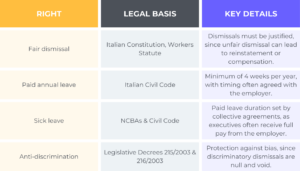
Additionally, employees are entitled to at least four weeks of paid annual leave and public holidays. Sick leave allowances vary by NCBA, with employers and the National Social Security Institute (INPS) often sharing salary payments.
Note that recent legislation also introduced special leave, such as 10 hours of paid leave for employees with serious illnesses or parents of children with chronic conditions.
Workplace safety and discrimination
Employers must provide safe working environments, complying with national health and safety regulations. Also, anti-discrimination laws protect employees from bias based on gender, race, religion, or other protected characteristics.
Furthermore, dismissals motivated by discrimination are automatically void, and reinstatement is required. New laws also promote inclusivity, such as extended sick leave for executives with disabilities. Then there’s paid leave for medical appointments for employees or their children with oncological or chronic conditions.
Here’s a table summarising key employee rights in Italian law:
Situations that require legal assistance
Certain workplace issues demand immediate legal advice to protect the rights and financial interests of workers in Italy.
Contract disputes and misclassification
Disputes may arise over contract terms, such as misclassification as self-employed when you function as an employee. Fixed-term contracts are especially prone to abuse. For instance, if your contract was repeatedly extended beyond 24 months without justification, it could convert automatically into a permanent contract under the “Collegato Lavoro” rules.
A labour law attorney can review your situation to ensure compliance and seek remedies like formal recognition of permanent status or compensation for unpaid benefits.
Unfair dismissal
Here’s what you need to know about unfair dismissals in Italy:
- Valid motive: A dismissal is considered unfair if your employer fails to provide a justified disciplinary or objective economic reason for the termination. The law requires a valid motive, and without one, the dismissal is legally deemed invalid. This allows you to challenge it formally through the courts.
- Possible outcomes: Challenging an unfair dismissal can lead to two primary outcomes, which are reinstatement to your former position or significant financial compensation. Recent constitutional court decisions have removed previous compensation caps, enabling awards of up to 18 months of salary, especially for smaller companies.
- Importance of legal steps: A dismissal is also procedurally unfair if the employer neglects legal steps, such as providing a written justification or failing to follow the specific process outlined in collective agreements. Even with a potentially valid reason, these procedural failures can render the entire dismissal unlawful.
- Discrimination: Dismissals motivated by discrimination based on gender, religion, race, disability, or political beliefs are automatically null and void. The law mandates your reinstatement to the workplace in these cases, alongside compensation for damages suffered during the period of unlawful unemployment.
- Employee rights lawyer: In collective redundancy situations, dismissals can be unfair if the employer applies selection criteria incorrectly or fails to follow required consultation procedures with trade unions. An employee rights lawyer can scrutinise the process to identify these critical flaws.
Discrimination and Harassment
If you face discrimination—such as being passed over for promotion due to gender or subjected to harassment—legal action can include nullifying discriminatory acts, seeking damages, or securing reinstatement.
The courts have expanded protections, such as granting paternity leave to intentional mothers in same-sex couples to ensure equal treatment. Overall, a lawyer can help gather evidence, file complaints with relevant bodies, and represent you in court.
Unpaid wages and benefits
Employers who withhold salaries, overtime pay, or Italian benefits (like holiday pay) violate core rights. A lawyer can demand payment through formal notices and, if needed, litigation.
Recent cases show courts ordering payment of accrued wages with penalties, reinforcing the principle that compensation must ensure a dignified living.
How an employee rights lawyer can help
An employment law lawyer provides tailored support across various stages of a dispute, whether it’s for freelancers in Italy or employers. Here’s a summary of their biggest advantages:
- Case evaluation & strategy: They analyse your situation against Italian law and collective agreements. A lawyer identifies the strength of your case, advises on the best course of action, and develops a strategic plan to achieve your goals. That’s whether through negotiation or litigation.
- Document scrutiny & evidence gathering: Lawyers meticulously review your employment contract, company policies, and all relevant correspondence. Furthermore, they identify contractual violations, procedural errors, and help gather crucial evidence to build a compelling case for mediation or in court.
- Negotiation & settlement advocacy: Your lawyer can engage your employer in direct negotiations to secure a favourable settlement without court. Also, they leverage their expertise to advocate for a fair financial package or reinstatement, often resolving disputes more efficiently.
- Court representation & litigation: If a settlement isn’t possible, they will formally represent you in the labour court. This includes preparing legal petitions, presenting arguments, examining witnesses, and fighting for your rights before a judge.
- Rights clarification & preventive advice: They provide clear explanations of your legal entitlements regarding wages, working hours, and safety. This proactive advice helps you understand and assert your rights, potentially preventing disputes from arising in the first place.
Choosing the right lawyer
Specialisation and experience
Choose a professional who specialises exclusively in employment law, as their practice will reflect current precedents and procedures. For example, reputable boutiques may focus solely on labour law. This offers depth in handling:
- Dismissals
- Restructuring
- Discrimination cases
Look for practitioners recognised by legal directories like Chambers Europe or Best Lawyers.
Credentials and track record
Verify their admissions to the Italian Bar and involvement in significant cases. Lawyers with decades of experience are cited for expertise in litigation and cross-border employment matters. Take the time to review their published work or case history to assess their authority.
Fee structures and consultations
Many lawyers offer initial consultations to evaluate your case. Discuss fees upfront—some work on fixed fees for specific services, while others charge hourly or on a success basis. Transparency about costs helps you make informed decisions.
Assessing language skills and cultural fit
For international employees, a lawyer’s language ability and cultural fluency are paramount. Your chosen advisor should be proficient in your native language to prevent costly misunderstandings of complex legal nuances.
Furthermore, an understanding of cross-cultural business practices ensures clearer communication and a more effective strategy. This compatibility builds trust and facilitates a stronger working relationship. Hence, it makes the often-stressful legal process feel more manageable and transparent from the initial consultation to the case’s resolution.
How an EOR can help
Many employment issues mentioned in the article often arise from incorrect or non-compliant employment setups. Fortunately, an EOR can help prevent many of the problems that lead workers to seek legal advice. That’s especially true for expats or employees working for companies that do not have a legal entity in Italy.
Here is a summary of the benefits an EOR provides:
- Ensures employees in Italy receive legally compliant contracts, correct salary payments, and full statutory protections.
- Reduces risks of unfair dismissal, misclassification, or payroll errors.
- Helps international companies employ staff in Italy without violating local labour laws.
- Provides clarity and stability for expats who might otherwise face contract irregularities.
Final thoughts
Italian labour law provides strong employee safeguards, but its intricacies require specialised knowledge to navigate successfully. From unfair dismissal to contract disputes, an employee rights lawyer offers the expertise to defend your interests.
For expats, employees, and international employers facing these challenges is even simpler with the help of Hightekers. They specialise in Italian employment law, offering clear guidance and robust representation.
Furthermore, they can help with other aspects of working or hiring in Italy, such as contract management, benefits, and payroll.
Reach out to Hightekers for support on employee rights in Italy
Frequently asked questions
What are the most common types of unfair dismissal in Italy?
Unfair dismissals often involve terminations without a justified disciplinary or economic reason. Others include discriminatory dismissals or those violating procedural rules, such as improper notice or flawed selection in collective redundancies.
How much does it cost to hire an employment lawyer in Italy?
Costs vary by case complexity and lawyer experience, and many offer initial consultations. Fees may be hourly, fixed, or contingency-based. Ideally, you will discuss this upfront to understand financial commitments.
What is the time limit for challenging a dismissal in Italy?
Employees typically have 180 days from the dismissal date to file a judicial challenge. Strict deadlines apply, so consult a lawyer promptly to avoid losing your rights.
Can I be fired while on sick leave in Italy?
Dismissal during sick leave is generally prohibited if the illness is certified and within the protected period outlined in your collective agreement. Such dismissals are often deemed unfair.
Are there legal protections against workplace harassment in Italy?
Yes, Italian law prohibits moral and sexual harassment. Employees can report incidents to internal channels or pursue legal action, which may result in damages or disciplinary action against perpetrators.


