

If you're a UK contractor or freelancer working through a limited company, understanding whether your contract falls inside or outside IR35 is essential. Your IR35 status affects how you're taxed, your take-home pay, and whether HMRC considers you genuinely self-employed or an employee for tax purposes.
Although the terms sound straightforward, IR35 assessments are based on your actual working relationship with the client, not simply what your contract says. Understanding the difference can help you make informed decisions before accepting a new engagement.
Key takeaway
- Inside IR35 means HMRC considers your engagement similar to employment for tax purposes, so Income Tax and National Insurance are generally deducted through PAYE.
- Outside IR35 means you're operating as a genuine independent business. You're responsible for managing your own taxes and typically have greater flexibility over how your income is structured.
Every contract is assessed individually, meaning you can be inside IR35 for one engagement and outside IR35 for another.
What is IR35?
IR35, also known as the Intermediaries Legislation or the off-payroll working rules, was introduced by HM Revenue & Customs (HMRC) in 2000 to tackle disguised employment. It applies to contractors who provide services through an intermediary, such as a Personal Service Company (PSC), but who may be working in a way that's similar to an employee.
The purpose of IR35 is to ensure that contractors who work like employees pay broadly the same Income Tax and National Insurance contributions as permanent employees. Rather than focusing on your job title or company structure, HMRC assesses your actual working relationship with the client to determine whether the engagement falls inside or outside IR35.
Who is responsible for making that determination depends on the type of client. Public sector organisations and medium or large private sector businesses are generally responsible for deciding a contractor's IR35 status, while contractors working for small private sector clients usually remain responsible for assessing their own status.
Understanding the difference between Inside IR35 and Outside IR35
The distinction between being inside IR35 and outside IR35 is fundamental to how contractors manage their businesses and their overall tax strategy. Understanding this difference is essential for compliance and financial planning.
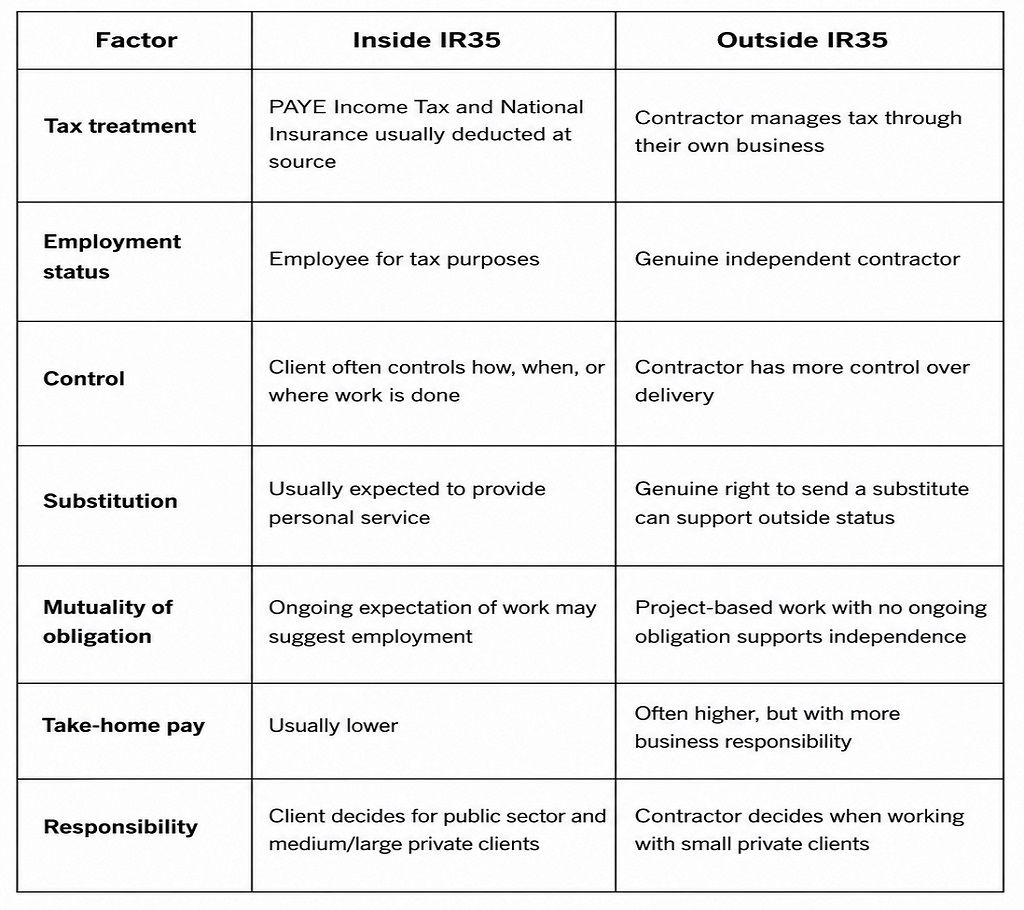
Inside IR35
If a contract is deemed to be inside IR35, it means that for tax purposes, the contractor is considered an employee of the client company. Therefore, income from that contract is subject to payroll taxes, namely PAYE (Pay As You Earn) and National Insurance contributions, just as it would be for an ordinary employee. This classification generally leads to a higher tax liability compared to being outside IR35. Contractors inside IR35 lose some of the tax advantages typically available to self-employed individuals, such as being able to claim broader expenses.
Outside IR35
A contract that falls outside IR35 allows the contractor to be recognised as an independent business entity. This status affords more flexibility in how income is drawn from the company, typically through a combination of salary and dividends, which can be tax-efficient. Being outside IR35 also enables contractors to retain control over their working arrangements and business decisions, reflecting true business ownership rather than employee status.
The correct classification hinges on several factors determined by HMRC criteria, including the level of supervision, direction, and control over how the work is completed; whether the contractor has the right to send a substitute in their place; and the nature of the contractual terms themselves. Misclassification can lead to significant tax and penalty liabilities, making it crucial for both contractors and the companies they work with to carefully assess each contract.
How HMRC assesses whether a contract is inside or outside IR35

HMRC does not decide IR35 status based on one factor. It looks at the overall working relationship and whether the contractor appears to be operating as an independent business or working like an employee.
The main factors are:
Control
Who decides how, when, and where the work is done? If the client closely manages the contractor like an employee, the engagement is more likely to fall inside IR35.
Substitution
Can the contractor send a suitably qualified substitute to complete the work? A genuine and practical right of substitution can support an outside IR35 position.
Mutuality of obligation
Is the client expected to keep offering work, and is the contractor expected to accept it? Ongoing obligations can make the relationship look more like employment.
Financial risk
Does the contractor carry business risk, such as correcting defective work at their own cost or working to a fixed project fee?
Business on own account
Does the contractor operate like a genuine business, with multiple clients, business insurance, their own equipment, and responsibility for delivering defined outcomes?
Understanding your IR35 status is only part of the challenge. Many contractors also need to manage contracts, invoicing, payroll, and ongoing compliance, all while focusing on client work.
How Hightekers helps freelancers to overcome any issue with IR35

Hightekers helps freelancers comprehend the complexities of IR35 legislation through a unique model. By offering freelancers permanent contracts, Hightekers positions itself not just as a support system but as an employer, thereby simplifying the IR35 compliance process.
This approach allows freelancers to focus on their client work rather than managing administrative processes. By providing a structured employment solution, Hightekers helps freelancers manage their tax obligations while remaining compliant with applicable employment and tax regulations.
Support for IR35 administration
Hightekers provides practical support throughout the contracting process, including employment onboarding, payroll administration, contract management, and ongoing account management. Your dedicated account manager is available to answer questions about the employment process and help coordinate administrative matters as your contracts evolve.
Where specialist tax or legal advice is required, such as determining IR35 status in complex situations, freelancers should consult a qualified tax or legal advisor.
Proactive contract reviews
Hightekers overcomes the concerns surrounding IR35 by employing freelancers directly. This approach ensures that freelancers are no longer just independent contractors but are part of an organizational structure that inherently complies with IR35.
Through Hightekers' employment model, the typical complexities and risks of contract evaluations for IR35 are managed by the company, allowing freelancers to focus fully on their professional assignments without the worry of IR35 classification.
These reviews look at factors such as control, substitution, and mutuality of obligation, which are crucial in determining IR35 status. With Hightekers' support, freelancers can negotiate contracts that not only protect them from IR35 but also align with their professional goals and requirements.
Administrative support and simplified tax handling
For freelancers juggling multiple clients and projects, managing administrative tasks and tax obligations can be overwhelming. Hightekers simplify these processes by handling administrative duties and providing guidance on tax-efficient practices.
By offering a centralized platform for managing invoices, payments, and tax submissions, Hightekers ensures that freelancers maintain proper records and comply with HMRC requirements. This structured approach is vital in demonstrating the independence necessary to remain outside IR35.
By integrating these services, Hightekers not only helps contractors understand the complexities of IR35 but also enhances their overall business operations, making it easier to thrive in a competitive and regulated environment.
FAQS
How can you check your IR35 status before signing a new contract?
Review both your written contract and your expected working practices before accepting the engagement.
Your IR35 status depends on more than the contract terms alone. HMRC considers key factors such as control, substitution, and mutuality of obligation, as well as how the work is carried out in practice. If you're unsure, use HMRC's Check Employment Status for Tax (CEST) tool as a starting point and seek specialist advice before signing a new contract, particularly if you're providing services through your own limited company.
Can you have one contract inside IR35 and another outside IR35?
Yes. Every engagement is assessed individually.
Many contractors work on multiple engagements at the same time, and each contract must be assessed separately. One client may determine that you're inside IR35, while another engagement falls outside IR35 because the working arrangements are different. This is why you should review every new contract rather than assuming your previous IR35 status still applies.
What happens if HMRC decides your contract was incorrectly classified?
If HMRC decides a contract should have been inside IR35, additional tax may be payable.
Depending on who was responsible for the IR35 determination, HMRC may recover unpaid tax, National Insurance contributions, interest, and potentially a penalty if reasonable care wasn't taken. The financial impact can be significant, which is why it's important to assess every engagement carefully and keep evidence that supports your IR35 status.
Does having a limited company mean you're automatically outside IR35?
No. Operating through a limited company or Personal Service Company (PSC) does not automatically mean you're outside IR35. HMRC looks at the reality of your working relationship, including factors such as control, substitution, mutuality of obligation, and financial risk. Even if your contract is between two businesses, you can still be considered inside IR35 if your day-to-day working practices resemble employment.