
If you're working as a ZZP (Zelfstandige Zonder Personeel) in the Netherlands, protecting your income is just as important as finding your next client. Unlike employees, freelancers are generally responsible for arranging their own financial safety net against risks such as illness, disability, liability claims, and business losses.
While only some insurance is legally required, choosing the right cover can help safeguard both your income and your business. This guide explains which ZZP insurance is mandatory, which policies are recommended, how they work, and how to choose the right protection for your situation.
Key takeaways
- For most ZZP'ers, basic Dutch health insurance is the only legally required insurance.
- Disability insurance (AOV) is one of the most important policies because it can replace your
- income if illness or injury prevents you from working.
- The right insurance depends on your profession, clients, and business risks, so your coverage should be tailored to your situation.
Why self employed insurance matters in the Netherlands?
In the Dutch system, the social safety net is largely designed around employment. Statutory benefits for long-term illness and disability are for employees, not the self-employed.
As a freelancer, the state provides no automatic income replacement if you cannot work. This gap leaves you personally liable for all business risks, from a damaged laptop to a professional oversight that costs a client money.
The goal of ZZP insurance
ZZP insurance refers to the range of insurance policies available to self-employed professionals in the Netherlands. While basic Dutch health insurance (zorgverzekering) is legally required, many ZZP'ers also choose additional cover, such as disability insurance (AOV), business liability insurance (AVB), and professional liability insurance (BAV), depending on their profession and level of risk.
They transform unpredictable, potentially devastating costs into manageable, fixed premiums. Essentially, freelance insurance is what stands between your business and financial ruin, allowing you to work with confidence and security.
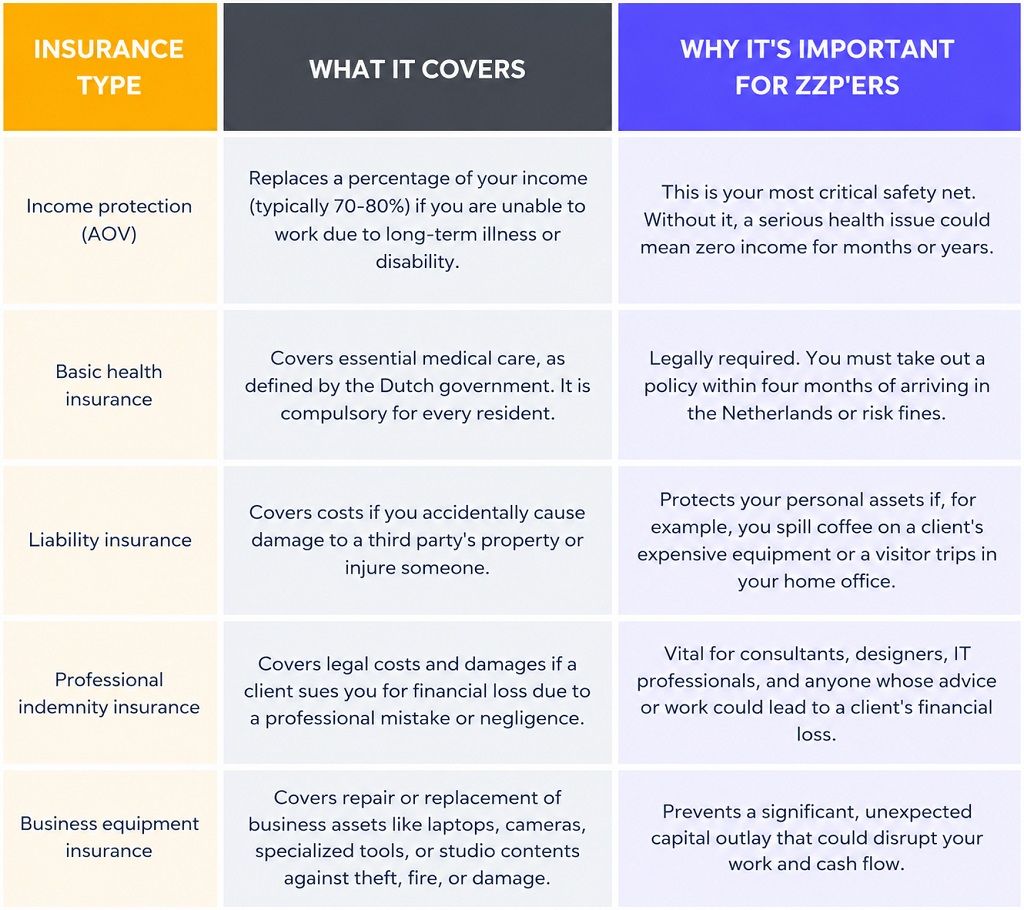
Key types of insurance for freelance professionals
Dealing with the world of insurance can seem complex, but breaking it down into core types simplifies the process. Here are the essential covers every Dutch freelancer should consider:
When self employed insurance becomes essential
 While it's wise to consider insurance from day one, certain milestones and situations make it non-negotiable:
The moment you officially launch your business
Once you've registered your business with the Dutch Chamber of Commerce (KvK), you're responsible for managing the financial risks that come with running your own freelance business.
Establishing self employed insurance from the outset—particularly public liability and professional indemnity—is a foundational business practice. It protects your enterprise from claims that could cripple it financially before it even gains momentum. Think of it as essential operational infrastructure, as important as a business bank account or a quality laptop.
When scaling up or taking on major projects
Landing a larger client or a substantial project is cause for celebration, but it also amplifies your risk profile. The financial stakes are higher, and the potential impact of a professional error or dispute grows significantly.
This is the time to review and upgrade your freelance insurance. Your professional indemnity coverage limits may need increasing, and you must ensure your income protection reflects your higher earnings. It's a strategic move to safeguard your business's growth trajectory against unforeseen setbacks.
If a single client constitutes a large portion of your income
Many freelancers, especially early on, rely heavily on one or two main clients. This concentration creates a significant vulnerability. If that relationship ends unexpectedly, your income evaporates.
While not a direct insurance product, this scenario underscores the critical importance of robust income protection (AOV). If an illness or disability prevents you from servicing that key client or seeking new work, this insurance becomes your sole financial lifeline. You'll find that it provides stability during a precarious period.
During vulnerable gaps between contracts
The freelance economy is often project-based, leading to natural breaks between contracts. These are periods of inherent financial vulnerability. If you were to fall ill during such a gap, you would have no sick pay and no current client invoice to fall back on.
However, a solid disability insurance policy is designed for this exact situation, providing a continuous safety net regardless of your contract status. It ensures you are protected even when you are actively marketing your services for the next opportunity.
When venturing into fields with higher liability risks
Your specific profession dictates your risk exposure. For instance, a freelance copywriter faces different liabilities than an independent construction consultant or a self-employed physiotherapist.
If your work involves physical sites, handling expensive goods, or giving advice that could lead to significant client financial loss, your need for tailored insurance for freelance professionals escalates immediately.
High-risk fields demand comprehensive liability and professional indemnity covers from the very first day of operation. That's to protect against large career-threatening claims.
A guide to selecting insurance for freelance work

Once you've identified the types of insurance your business may need, the next step is comparing policies. Price is important, but it shouldn't be the only factor when making your decision.
When evaluating insurance providers, consider the following:
-
Coverage limits: Make sure the policy provides enough financial protection for your income, business activities, or potential liability.
-
Waiting periods: For disability insurance (AOV), check how long you'll need to wait before benefits begin, as this can affect both your premium and financial planning.
-
Exclusions: Review what's not covered, including any exclusions relating to pre-existing medical conditions, specific professions, or business activities.
-
Premiums and deductibles: Compare the overall value of each policy rather than simply choosing the lowest monthly premium.
-
Policy flexibility: As your business grows, your insurance needs may change. Check whether you can increase, reduce, or adjust your cover over time.
-
Independent advice: If you're unsure which policy best suits your circumstances, consider speaking with an independent insurance advisor who understands the Dutch insurance market.
Final thoughts
Building a successful freelance career in the Netherlands is as much about managing risk as it is about talent and hustle. While the Dutch system offers great freedom, it places the onus of protection squarely on your shoulders. Treating insurance for freelance professionals as a strategic business investment is a mark of professionalism.
Remember, basic health insurance is a legal requirement, but layering on income protection, liability, and professional indemnity cover transforms you from vulnerable to secure. It's the smart step that safeguards your independence, letting you focus on what you do best.
How Hightekers can help
Taking out private insurance isn't the only way freelancers in the Netherlands can improve their financial security. Depending on your circumstances, working through a management company like Hightekers may provide an alternative way to access employee-style protections while maintaining your independence.
Here's how we can support you:
- Through Hightekers, freelancers can work via an employment contract while continuing to manage their own clients and assignments.
- This approach provides greater financial stability by giving you access to employee benefits and income protection that many self-employed professionals would otherwise need to arrange independently.
- Hightekers also takes care of payroll, tax compliance, invoicing, and other back-office responsibilities. This allows you to spend less time on administration and more time focusing on your clients.
If you're looking for a simpler way to manage your freelance business while benefiting from greater financial security, learn how Hightekers supports independent professionals in the Netherlands.
Frequently asked questions
Is any insurance mandatory for ZZP'ers in the Netherlands?
Yes, basic Dutch health insurance (zorgverzekering) is legally mandatory for every resident, including freelancers. You must arrange it within four months of registering in the country.
Other business insurances are commercially advised but not legally required.
What is the difference between liability and professional indemnity insurance?
Public liability insurance covers physical damage or injury you accidentally cause to others (for example, damaging a client's property).
Whereas professional indemnity covers financial loss a client suffers due to your professional advice, errors, or omissions (e.g., a software bug that costs them money).
How much does income protection (AOV) insurance cost for a freelancer?
The cost varies significantly based on your age, health, profession, desired coverage amount, and waiting period. It can range from roughly €50 to €300 or more per month.
It's essential to compare personalized quotes to get the best deal.
Can I get insurance if I have a pre-existing medical condition?
It is possible, but the condition may be excluded from coverage, or you may pay a higher premium. Full disclosure is critical, since failing to declare a condition can invalidate your entire policy.
What is a Broodfonds and is it an alternative to disability insurance?
A Broodfonds is a mutual support fund where a group of self-employed individuals pool money to provide short-term income support (usually 1-2 years) if a member becomes ill.
It can be a more flexible, community-based alternative or supplement to traditional insurance. However, it does not offer the same long-term and guaranteed security as a commercial AOV policy.
Can I deduct ZZP insurance premiums from my taxes?
Yes, many ZZP insurance premiums are tax deductible if they're directly related to your business. This typically includes policies such as business liability insurance (AVB), professional liability insurance (BAV), legal expenses insurance for business use, and business equipment insurance. However, not every policy is treated the same for tax purposes. For example, disability insurance (AOV) and health insurance can be subject to different tax rules. If you're unsure which premiums you can claim, it's worth checking with a Dutch accountant or tax advisor before filing your income tax return.