 Belgique
 España
 France
 Germany
 India
India
 Italia
 Luxembourg
 Netherlands
 Polska
 Portugal
 Suisse
 United Kingdom
 United States
EOR vs PEO: Choosing the Right Solution for Global Hiring


With each passing year, remote work becomes not just a trend but a fundamental reality. As companies of all sizes look beyond their borders to access global talent, they quickly encounter the complex web of international employment law, tax regulations, and payroll administration.
The allure of hiring a star developer in Berlin or a marketing expert in Lisbon is often tempered by the daunting prospect of establishing a legal entity abroad. This is where specialised hiring solutions come into play. Two of the most commonly discussed models are the Employer of Record (EOR) and the Professional Employer Organisation (PEO). While they might sound similar, understanding the core difference between PEO and EOR is critical for making a strategic, compliant, and efficient hiring decision for your business.
Key takeaways
- An EOR removes the need for your own local entity, enabling faster global workforce management.
- The core difference between PEO and EOR lies in legal employer status and compliance liability.
- Choose an Employer of Record for speed and compliance when testing new international markets.
- A PEO suits companies with an existing entity seeking domestic HR outsourcing for startups and scale-ups.
- International hiring solutions vary, and your operational footprint dictates the correct PEO or EOR model.
EOR vs PEO: Key definitions and features
Before dissecting their differences, it’s essential to understand what each model fundamentally is.
EOR (Employer of Record)
An Employer of Record is a third-party organisation that legally employs your workforce on your behalf in a country where your company does not have a registered entity. The EOR assumes full legal responsibility as the official employer for:
-
- Tax
- Immigration
- Payroll
- Local compliance matters
Your company retains day-to-day managerial control over the employee’s work. This model is designed specifically for international expansion, allowing you to hire talent anywhere. You’ll find that it’s often in a matter of weeks and without the need for a local subsidiary.
PEO (Professional Employer Organisation)
A Professional Employer Organisation enters into a co-employment relationship with your company. In this arrangement, your company remains the legal employer, but the PEO assumes responsibility for administering HR functions, such as payroll, benefits administration, and workers’ compensation.
Crucially, a PEO typically requires your business to already have a legal entity in the country of operation. This model is often used to outsource complex HR tasks and leverage better benefits rates within a single domestic market.
What is the difference between PEO and EOR?
The distinction between these models is not merely semantic, but it defines your legal liabilities, operational flexibility, and strategic options. The following table outlines the key contrasts relevant for businesses planning their 2026 global hiring strategy.
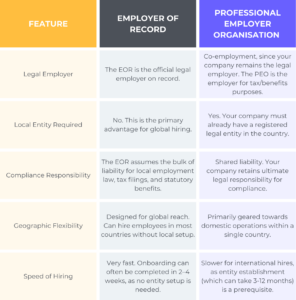
Breaking down the comparison
The legal employer and liability
This is the most significant Employer of Record vs PEO differentiator. With an EOR, the provider is the legal employer, shielding your company from direct liability for employment matters in that jurisdiction.
In a PEO arrangement, your company shares employment responsibilities, but ultimately you are still on the hook for compliance. This distinction is vital in regions with stringent labour laws, such as Germany or France, where missteps can lead to substantial penalties.
The entity requirement
The question of PEO or EOR often boils down to this. If you wish to hire someone in Spain but have no Spanish subsidiary, an EOR is your only viable option.
A PEO cannot operate there without your pre-existing entity. This makes the EOR the default solution for testing new markets or hiring isolated team members abroad.
Operational flexibility and speed
For a startup looking to quickly build a remote team across Europe, an EOR provides unparalleled agility. You can hire in the Netherlands, Italy, and Poland simultaneously, managing everyone through a single provider.
A PEO does not offer this cross-border flexibility within its standard model, making it less suited for rapid internationalisation.
Risk profile
Using an EOR significantly reduces your company’s exposure to the risks of misclassifying employees, miscalculating taxes, or missing critical local regulations. The reputable EOR’s expertise becomes your shield.
With a PEO, while you gain an administrative partner, the core compliance risk remains with your organisation.
When to choose PEO or EOR?
Choosing the right model depends entirely on your company’s location, structure, and ambitions.
When an Employer of Record is the right fit
An EOR is typically the best choice for:
- Companies without any local legal entities abroad. If you lack a subsidiary in your target country, an EOR is your only viable and compliant path to hire. It eliminates the need for a costly and slow entity setup. That can take over six months in countries like Germany or the Netherlands, allowing you to onboard talent in weeks instead.
- Startups and scale-ups prioritising speed and agility in global expansion. When capital and time are precious, an EOR provides the fastest route to build an international team. It lets you secure top talent ahead of competitors and deploy resources into growth. That’s instead of overcoming complex foreign corporate legal procedures.
- Businesses conducting a controlled test of a new market. An EOR offers a low-commitment, flexible entry strategy. You can hire a small commercial team in France or Italy. For example, to validate market demand without the long-term financial and operational burden of establishing your own local company from day one.
- Organisations aiming to decisively mitigate international compliance risk. An EOR transfers the legal liability for local employment laws, tax filings, and statutory benefits to the provider. This shield is crucial in jurisdictions with stringent protections. It ensures adherence to complex regulations in places like Portugal or Belgium without needing in-house expertise.
- Companies hiring a small, distributed team across multiple countries. Establishing entities in several nations is prohibitively expensive. An EOR consolidates this global employment complexity into a single service layer. Therefore, it enables you to manage payroll and compliance for employees in Spain, Sweden, and Poland seamlessly through one partner.
When a Professional Employer Organisation is the right fit
A PEO is often the appropriate solution for:
- Companies that already possess their own registered legal entity in the country of operation. The PEO model is built upon this existing structure, allowing you to outsource HR administration while maintaining your legal status as the employer. For example, it’s a common setup for a UK company with a German GmbH.
- Businesses focusing on consolidating and managing a domestic workforce within a single country. A PEO excels at streamlining HR, payroll, and benefits for all employees in one legal jurisdiction. For instance, managing a team across multiple states in the US from a single American entity.
- Organisations seeking to outsource complex, time-consuming HR administrative tasks and compliance. A PEO acts as an extension of your HR department, expertly handling local payroll calculations, social tax submissions, and pension enrollments. It frees your internal team to focus on strategic people initiatives.
- Companies wanting to leverage the PEO’s buying power to access better employee benefit rates. By pooling employees from multiple client companies, a PEO can often negotiate more competitive rates for private health insurance or other perks.
- Businesses that prefer a co-employment relationship and wish to retain their brand as the primary employer. This model allows you to keep direct legal ties to your staff and your company’s employer identity. Meanwhile, the PEO manages the intricate backend administrative responsibilities.
Final thoughts
Both EOR and PEO services offer valuable pathways to more efficient workforce management, but they serve fundamentally different purposes. The decision between them is not about which is universally better, but about which is the right tool for your specific geographic and operational goals.
For businesses looking beyond their home borders, the Employer of Record model provides a powerful, compliant, and agile framework for global workforce management. It turns the daunting challenge of international hiring into a straightforward operational task.
As a dedicated EOR provider, Hightekers specialises in this very model, empowering companies to build their global teams with confidence, speed, and full legal protection. By understanding the core difference between PEO and EOR, you can make an informed choice. One that supports your growth, protects your business, and unlocks the world’s talent.
Discover our EOR solution supports global hirng
Frequently asked questions
What is the fundamental legal difference between an EOR and a PEO?
The EOR becomes the legal employer for your staff, assuming full liability. A PEO enters a co-employment relationship where your company remains the legal employer, and the PEO handles administrative HR tasks.
Can I use a PEO for hiring employees in other European countries?
Generally, no. A PEO typically requires your company to have a pre-existing legal entity in the country of hire. For hiring in a new country without an entity, an EOR is the standard solution.
What are the main risks of using an EOR?
The primary risk lies in choosing an inexperienced provider. A reputable EOR mitigates risk by ensuring full compliance. The key is to select a provider with a proven track record and direct legal entities in your target countries.
How does Hightekers operate as an EOR?
Hightekers acts as the legal employer for your international team members. We employ them on your behalf under fully compliant local contracts, managing all payroll, tax, benefits, and immigration obligations.
However, you retain complete control over their daily work.
Which is more cost-effective for international hiring: EOR or PEO?
For international hiring, an EOR is almost always more cost-effective when you factor in the alternative. The cost of establishing and maintaining legal entities in multiple countries far exceeds standard EOR fees. This makes the EOR model the efficient choice for global growth.


