

The 183-day rule is a day-count test that many countries use to decide tax residency: spend 183 days or more there within a set period, and you are generally treated as a tax resident. It isn’t one global law. Each country writes its own version, and tax treaties use the same number for a different purpose.
For freelancers, the rule matters because tax residency follows where you are physically present, not where your client is based. Plenty of freelancers assume that being paid by a client abroad keeps them out of the local tax net where they live, but that’s not how tax authorities see it. This guide explains how the 183-day rule and tax residency fit together, how the days are counted, how the US, UK, UAE, Spain, Portugal, France and Switzerland apply it, and where people most often get it wrong.
This article is general information, not tax advice. Your position depends on your full circumstances, so confirm it with a qualified tax adviser in each country involved.
Key takeaways
- The 183-day rule is a residency threshold: 183 or more days in a country within its measurement period usually makes you tax resident there.
- Staying under 183 days is not a guarantee, because a home, family or economic ties can create residency with fewer days.
- Countries count days differently, using a calendar year, a tax year or any rolling 12-month period, and part days often count.
- In tax treaties, 183 days decides which country may tax employment income, which is a separate question from where you are resident.
- US federal tax uses its own version, the substantial presence test, which weights days over three years.
What is the 183-day rule?
The 183-day rule is a physical presence test. 183 days is just over half a year, so someone who spends that long in one country is presumed to have their main life there. Tax residents are usually taxed on their worldwide income, while non-residents are generally taxed only on income from sources in that country.
The number shows up in two different places, which is where most confusion starts:
- Domestic residency rules. Each country’s own tax law decides who is resident for tax purposes. Many include a 183-day threshold, usually alongside tests based on your home, family or center of economic interests.
- Tax treaties. The OECD Model Tax Convention, which most double tax treaties follow, uses 183 days in Article 15. That test decides whether a country where an employee works temporarily can tax their salary. It doesn’t make anyone resident. Article 15 also applies to employees only. For self-employed freelancers, most treaties look at whether they have a permanent establishment or fixed base in the other country, although some older treaties, and those based on the UN Model, keep their own 183-day test for independent services.
So “183 days” can answer two different questions: “Am I a tax resident here?” and “Can this country tax my pay for work done here?” Answering one doesn’t settle the other.
Does the 183-day rule decide tax residency?
Sometimes, but rarely on its own. In most countries, 183 days or more is enough to make you resident, but staying for fewer days doesn’t make you non-resident. Other common triggers include:
- A permanent home available to you in the country.
- Your centre of vital interests: where your family lives, or where your main economic activity and assets are.
- Your habitual abode, meaning where you regularly live over time.
Because these tests work independently, you can be a tax resident in two countries in the same year: one through its day count, the other because your home and family are there. If the two countries have a tax treaty, its tie-breaker rule (Article 4 of the OECD Model) settles residence by looking, in order, at your permanent home, centre of vital interests, habitual abode and nationality. That tie-breaker is how treaties prevent double taxation of the same person as a resident of both countries.
How to calculate 183 days
The arithmetic is simple, but the rules on what counts vary. Before you count, check three things for the country in question.
1. The measurement period
Countries measure over a calendar year (Spain**, France**), a tax year (the UK, 6 April to 5 April), or any rolling 12-month period (Portugal and the UAE). The OECD treaty test also uses any 12 months starting or ending in the fiscal year concerned. A rolling window can catch stays that are split across two calendar years.
2. What counts as a day
Many countries count any part of a day, so arrival and departure days both count. The UK generally counts a day if you are in the country at midnight. Under the OECD treaty test, part days, weekends, holidays and sick days spent in the country count, but days purely in transit don’t.
3. Whether the days must be consecutive
They usually don’t. In most systems, the 183 days are cumulative, so several shorter stays add up. Switzerland is the main exception: it looks at one continuous stay, ignoring short absences, and the threshold is far lower than 183 days.
Example: a freelancer spends 70 days in Portugal from October to December 2025 and 115 days from February to June 2026. Neither calendar year reaches 183 days. But the 12 months from October 2025 to September 2026 contain 185 days, which crosses Portugal’s more-than-183-days test.
The 183-day rule in the US: the substantial presence test
For US federal tax, the 183-day rule takes the form of the IRS substantial presence test. A non-US citizen is treated as a US tax resident for the year if they are physically present for:
- at least 31 days in the current year, and
- 183 days over a three-year period, counting all days this year, one-third of last year’s days, and one-sixth of the days from the year before.
Someone present for 120 days in each of three years counts 120 + 40 + 20 = 180 days, so they don’t meet the test. Some days don’t count at all, including days as an exempt individual (certain students, teachers and trainees on qualifying visas), days when you regularly commute from Canada or Mexico, transit of under 24 hours between two foreign points, days as a crew member of a foreign vessel, and says a medical condition that arose in the US kept you from leaving. A closer connection exception can also apply.
US citizens and green card holders are taxed on worldwide income wherever they live**, so they still have to file tax returns while living abroad. Resident aliens also take on extra reporting requirements, such as reporting foreign bank accounts above certain thresholds.** Many US states also use a 183-day statutory residency test alongside domicile rules, so moving between states raises the same questions on a smaller scale.
How the 183-day rule works by country
Every country writes its own rules, and they change. The table summarizes the headline tests in countries freelancers often deal with, as a starting point rather than a full analysis.
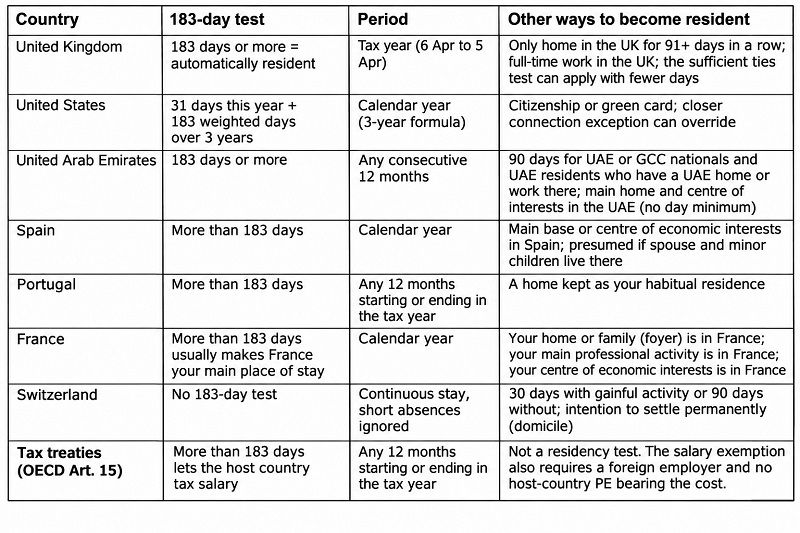
The Netherlands and Belgium don’t use a day count at all. Dutch residence depends on all your personal circumstances, and Belgium looks at where your domicile or the seat of your wealth is, with registration in the national register treated as a presumption.
Spain’s day count covers tax residency only. Its immigration rules are separate (see Spain’s new residency rules).
Real scenarios freelancers face
A freelancer living in Portugal, working for a Dutch client
The client being Dutch doesn’t change where the freelancer lives. Spending more than 183 days in Portugal in any 12-month period, or keeping a home there as their habitual residence, generally makes them a Portuguese tax resident and taxable on worldwide income. Portugal’s Non-Habitual Resident (NHR) regime closed to new applicants on 1 January 2024. Its replacement, known as IFICI, is limited to certain qualifying professions and activities, so eligibility needs checking case by case.
A freelancers based in Dubai with UK clients
The UAE doesn’t levy personal income tax, but residency still matters. Proving UAE tax residence, for example to claim treaty benefits, depends on the UAE tests (183 days in 12 months, or the 90-day and main-home tests). If the freelancer keeps a UK home or spends significant time in the UK, the UK Statutory Residence Test may still treat them as a UK resident. For the local setup, see Financial and Tax Considerations for Freelancers in Dubai.
A freelancer moving between several EU countries
A freelancer who frequently travels between EU countries without reaching 183 days anywhere isn’t resident anywhere. The country where they keep their permanent home or centre of vital interests will usually still claim them. Social security follows its own EU rules too, covered in our guide to the best countries to work remotely in Europe.
Beyond tax residency: social security and permanent establishment
Two other questions sit alongside the 183-day count, and the count doesn’t answer either of them:
- Social security. Within the EU, EEA and Switzerland, EU coordination rules decide which single country’s system you pay into. An A1 certificate proves it. Elsewhere, bilateral social security agreements apply where they exist.
- Permanent establishment (PE). If work done in a country creates a fixed place of business, or someone regularly concludes contracts there, a business can face corporate tax in that country. This can happen well before 183 days.
What happens if you get your tax residency wrong?
Failing to manage your tax residency properly can lead to:
- Double taxation: two countries tax the same income, and relief through a treaty or foreign tax credit needs paperwork you may not have kept.
- Back taxes, interest and penalties when a tax authority decides you were resident and income went undeclared.
- Social security gaps: contributions paid into the wrong system can affect pension and healthcare entitlements.
How to stay compliant as a freelancer
- Keep a day-by-day travel log for each country, including business travel, with evidence such as boarding passes or passport stamps, and count days over that country’s own measurement period.
- Know each country’s other residency tests, not just its day count.
- Keep contracts, invoices and records of where the work was done.
- Check whether a tax treaty applies, and get a tax residence certificate from your country of residence when claiming treaty relief.
- Speak to a qualified tax adviser before relocating, when you are close to a threshold, or when you spend significant time in more than one country.
For the practical side of relocating, see our guide to moving abroad as a freelancer.
Where Hightekers fits
Hightekers isn’t a tax adviser and doesn’t decide where you are tax resident. What it does is take the admin of freelancing across borders off your plate. Hightekers issue you an employment contract, sign's the service agreement with your client, invoices the client, and pays you a monthly salary. Contracts, invoicing and compliance are handled for you, with a dedicated account manager. See how Hightekers works.
Hightekers supports freelancing abroad in France, the Netherlands, Belgium, Spain, Switzerland, and the UAE. Once you and your adviser know where you are resident, it handles the paperwork that follows, so you can focus on client work.
Freelance across borders without the admin
Talk to the Hightekers team about how its employment solution handles contracts, invoicing and compliance while you work internationally. Talk to a Hightekers expert
FAQs
What is the 183-day rule?
The 183-day rule is a day-count test many countries use to decide tax residency. If you spend 183 days or more in a country within its measurement period, you are usually treated as a tax resident there. Each country sets its own version, and tax treaties use 183 days for a separate test on employment income.
How do you calculate 183 days?
Add up every day you were physically present in the country during that country’s measurement period, which may be a calendar year, a tax year or any rolling 12-month window. Many countries count part days, so arrival and departure days usually both count. Check the specific country’s rules, because the UK, for example, counts a day if you are there at midnight.
Do the 183 days have to be consecutive?
No. In most countries, the 183 days are cumulative, so several shorter stays can add up to the threshold. A rolling 12-month window can also combine stays that fall in two different calendar years.
If I stay under 183 days, do I avoid paying tax in that country?
Not necessarily. Many countries can treat you as a resident with fewer days if you have a home, family or your main economic interests there, and income earned from work in a country can be taxable there even if you are not resident. Staying under 183 days lowers one risk, but it is not a safe harbor on its own.
What happens if I spend more than 183 days in the US?
A non-US citizen who is present at least 31 days in the current year and 183 days under the IRS weighted three-year formula generally meets the substantial presence test and is treated as a US tax resident. US residents are taxed on worldwide income, although exceptions such as the closer connection exception or a tax treaty tie-breaker may apply.
Am I a UK tax resident if I live abroad?
You can be. Under the UK Statutory Residence Test, spending 183 days or more in the UK in a tax year makes you automatically resident, and having your only home in the UK or working full-time there can also do so. If you live abroad and spend a few days in the UK, one of the automatic overseas tests may make you non-resident, so the answer depends on your day count and UK ties.
How long can you live in another US state without becoming a resident?
It depends on the state. Many states that tax income treat you as a statutory resident if you keep a permanent place of abode there and spend more than 183 days in the state, even if your legal residence is elsewhere. New York, for example, counts any part of a day spent in the state as a full day. Domicile rules can also make you a resident regardless of days, so check the rules of both the state you are leaving and the one you are in.
Does the 183-day rule apply to freelancers and freelancers?
Yes. Residency day counts apply to individuals, whether they are employees, freelancers or independent freelancers. Where your client is based does not change where you are physically present, which is what the day count measures.