

For professionals building a career in the Netherlands, few documents matter more than the employment contract. A permanent employment contract offers long term stability, stronger job protection, and a clear framework for the relationship between employee and employer.
For expats and international professionals, understanding how these contracts work is especially important. This guide explains what a permanent employment contract in the Netherlands means, when a temporary contract becomes permanent, which rights apply, and what to check before signing.
Key takeaways
- A permanent employment contract in the Netherlands is an open-ended agreement with no fixed end date.
- Employers can only terminate a permanent contract when they have valid legal grounds and follow the required dismissal procedure.
- A temporary contract may automatically become permanent under the Dutch chain rule when the legal limits on successive fixed-term contracts are reached.
What is a permanent contract in the Netherlands?
In simple terms, a permanent contract (known in Dutch as a contract for onbepaalde tijd) is an open-ended employment agreement with no predetermined end date. It forms the foundation of a continuous working relationship until it is terminated by the employee through resignation or by the employer following strict legal procedures.
The Dutch employment law system, primarily outlined in the Dutch Civil Code (Burgerlijk Wetboek), is designed to offer strong protections to employees. This protective nature is a defining feature of the professional landscape, making a permanent contract a significant milestone.
It is the most secure form of employment, distinguishing itself from temporary arrangements by offering unparalleled job security. Even a verbal agreement can be legally considered a permanent contract under certain conditions.
For example, if someone works for you every week for three months or at least 20 hours per month. However, a written Dutch employment contract is always recommended for clarity.
What should a permanent employment contract include?
Although an employment contract in the Netherlands may be agreed verbally, recording the terms in writing gives both parties a clear account of their rights and responsibilities. Employers are also legally required to provide employees with written information about the main conditions of employment.
Within one week of the employee starting work, the employer must provide details including:
- The names and places of residence of the employee and employer
- The job title or nature of the work
- The start date and usual place or places of work
- The agreed salary, including its components and payment schedule
- The usual working hours and arrangements for overtime
- The duration and conditions of any probationary period
Additional information must generally be provided within one month of the employee starting work. This includes holiday entitlement and holiday allowance, other forms of paid leave, notice and dismissal procedures, and confirmation of the type of employment contract. Where applicable, the written terms should also cover pension arrangements, training rights, noncompete or nonsolicitation clauses, restrictions on outside work, and the relevant collective labor agreement.
Employees should check whether a collective labor agreement, known as a Collectieve Arbeidsovereenkomst or CAO, applies. A CAO may determine important conditions such as salary scales, working hours, pensions, and notice periods. Where a CAO conflicts with the individual contract, the CAO generally prevails. A minimum CAO may still allow more favorable terms for the employee.
A permanent contract may include a probationary period of up to two months, but the probationary period must be agreed in writing. A new probationary period is generally not permitted when one contract follows another, unless the new role requires clearly different skills or responsibilities.
Before signing, employees should confirm that the written terms reflect what was discussed during recruitment, particularly the salary, working location, hours, pension arrangements, notice period, and any restrictions on outside work or future employment.
Who qualifies for a permanent contract?
There are two primary ways an employee becomes entitled to a permanent contract under Dutch law, governed by the "chain rule" or ketenregeling:
- After three consecutive contracts: If an employer offers an employee more than three consecutive fixed-term employment contracts.
- After a three-year period: If an employee works for the same employer on a series of temporary contracts for a period exceeding three years.
Once either of these conditions is met, the law automatically converts the employment status to permanent. The only way to "break the chain" of temporary contracts is if there is a gap of more than six months between contracts. This rule ensures that employers cannot keep employees on a string of temporary contracts indefinitely.
Rights and benefits for employees
Securing a permanent contract unlocks a comprehensive suite of rights and benefits designed to provide financial security and a healthy work-life balance.
Job security and protections against dismissal
The most significant right is robust job security. An employer cannot simply end a permanent contract. Termination requires legally recognized grounds. In most cases, it must be approved by an official body. The two main paths for termination are:
- UWV (Employee Insurance Agency): The employer must apply for permission to dismiss for economic reasons (redundancy) or long-term disability.
- The Subdistrict Court (Kantonrechter): The employer must seek court approval to dissolve the contract for personal reasons, like consistent underperformance or a seriously damaged working relationship.
This process is intentionally complex to prevent arbitrary dismissals. Furthermore, employees are protected from being fired while sick during the first two years of illness, as well as during pregnancy or maternity leave.
Financial security: Transition payment and benefits
A key financial benefit is the right to a transition payment (transitievergoeding). This severance pay is designed to support you as you transition to a new role. From the very first day of employment, you are entitled to this payment if your contract is terminated against your will (unless due to serious misconduct).
The amount is calculated as one-third of your gross monthly salary for each full year of service.
The comprehensive benefits package typically includes:
- Holiday allowance: A mandatory payment of at least 8% of your annual gross salary, usually paid in a lump sum each May.
- Pension: While everyone who retires in the Netherlands is entitled to a state pension, most permanent employees are also enrolled in a company pension scheme, to which both you and your employer contribute.
- Generous leave entitlements: Full-time employees are entitled to a minimum of 20 vacation days, though 25 is more common. You also benefit from fully paid maternity leave (16 weeks) and partially paid parental leave.
Other key protections
- Notice periods: If you choose to resign, the statutory notice period is typically one calendar month. For employers, the required notice period increases with your tenure, starting at one month and increasing after five years of service.
- Training and development: Your employer is obligated to provide and fund any training necessary for you to perform your job effectively. Any clause requiring you to repay costs for such mandatory training is not legally valid.
- Protection against non-competes: A non-compete clause is only valid in a permanent contract if the employer can demonstrate a compelling business interest, and it must be drafted precisely. In fixed-term contracts, such clauses are generally unenforceable.
Employer obligations
When hiring on a permanent basis, Dutch law imposes significant responsibilities on employers to ensure fair and lawful treatment of staff.
Providing a written statement and adhering to the law
One of the first obligations is to provide a written statement of employment details within one week of the employee starting work. This document must include essential terms like job title, salary, working hours, and the duration of any trial period.
Furthermore, employers must strictly adhere to the Dutch Civil Code and other relevant regulations, such as the Working Conditions Act (Arbeidsomstandighedenwet), which mandates a safe physical and mental work environment.
Practical tips for avoiding legal disputes
- Document everything: Keep thorough records of performance reviews, feedback sessions, and any disciplinary actions.
- Explore redeployment: Before considering dismissal for redundancy, employers are legally obliged to see if there is a suitable alternative position within the organization for the employee.
- Seek consent for major changes: Unilaterally changing core elements of the employment contract, such as primary work location or fundamental duties, is not permitted. For significant changes, the employer must seek the employee's agreement.
Temporary vs permanent contracts
Understanding how a permanent contract differs from a temporary one is key to recognizing its value. The table below highlights the core distinctions:
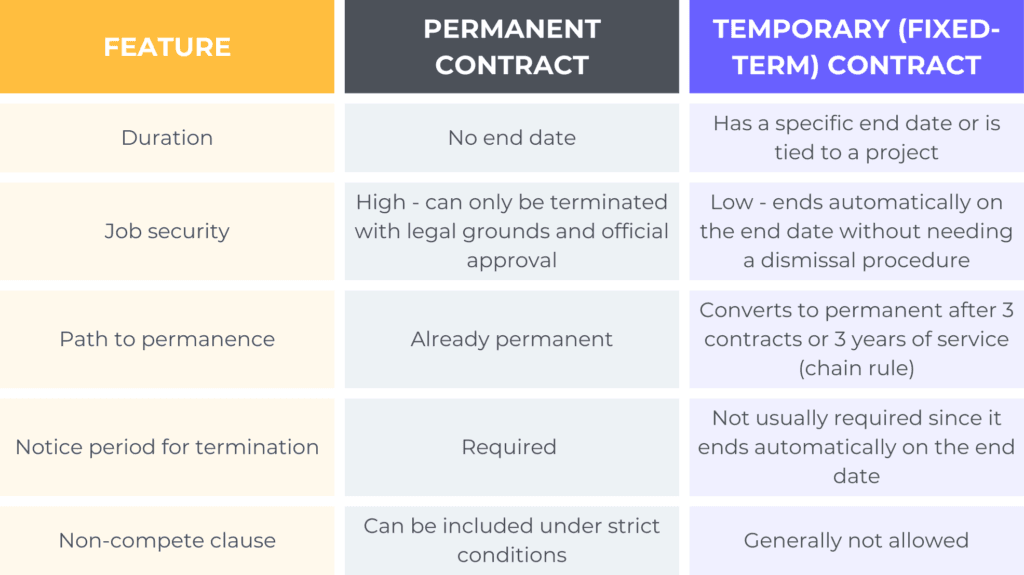
Converting a temporary contract into a permanent one
The conversion from a temporary to a permanent contract is not a matter of negotiation but of legal right once the conditions of the chain rule are met. This automatic conversion is a powerful employee protection.
If your temporary contract is not renewed because the chain rule has been triggered, you may still be entitled to a transition payment.
Permanent employment or freelancing: which is right for you?
A permanent employment contract suits professionals who value predictable income, statutory benefits, and stronger protection against dismissal. It can also make long term financial planning easier, particularly when applying for housing or credit.
Freelancing offers a different kind of security. Rather than relying on one employer, independent professionals can work with several clients, choose the projects they take on, and have greater control over how and where they work. The trade off is that they must manage responsibilities that an employer would normally handle, including contracts, invoicing, payments, insurance, and local compliance.
The right choice depends on your priorities. Permanent employment may be the better fit if stability and employee protections matter most. Freelancing may be more attractive if you value independence, flexibility, and greater control over your career.
For professionals who prefer the freedom of independent work but want support with the administrative side, a freelancer management service can help make that path more manageable.
How Hightekers supports freelancers
The best part of freelancing is doing the work you chose. The least appealing part is everything wrapped around it: contracts, invoices, payment delays, expense claims, and the constant admin needed to keep assignments running.
Hightekers takes care of the practical work behind your projects:
- Client contracts: Hightekers manage the agreement with your client, so you do not have to draft and administer every contract yourself.
- Invoicing and payment follow ups: Hightekers issues client invoices, tracks what has been paid, and follows up when payments are overdue.
- A predictable monthly salary: Instead of planning around different client payment dates, you receive a more stable monthly income.
- Payroll, expenses, and administration: Hightekers handles payroll processing, eligible business expenses, and much of the paperwork connected to your assignments.
- A dedicated account manager: You have one point of contact for onboarding clients, contracts, payments, expenses, and changes to your work.
You continue choosing your clients and focusing on the work. Hightekers manage the machinery behind it, giving you more control over your career without leaving you to handle every administrative detail alone.
Ready to spend less time managing paperwork and more time building your freelance career? Discover how Hightekers can simplify the process.
Frequently asked questions
What is the difference between a permanent and a temporary contract in the Netherlands?
A permanent contract has no end date and offers strong dismissal protections, requiring an employer to get official permission to terminate it.
In comparison, a temporary contract has a fixed end date and automatically expires on that date without the need for a dismissal procedure.
Can my employer easily fire me if I have a permanent contract?
No, Dutch law makes it deliberately difficult. Your employer must have a legally recognized ground (like redundancy, long-term illness, or consistent underperformance).
In most cases, obtain prior permission from the UWV agency or the subdistrict court before they can dismiss you.
What is a transition payment (transitievergoeding)?
It is a statutory severance pay. If your permanent contract is terminated by your employer (and it's not your fault), you are entitled to a payment from your first day of employment.
Furthermore, it’s calculated as one-third of your gross monthly salary for each full year you worked for the employer.
How many holiday days am I entitled to with a permanent contract?
By law, you are entitled to a minimum of four times your weekly working hours. For a standard 40-hour week, this is 20 days. However, many collective labor agreements or company policies offer 25 or more days per year.
What notice period applies when I reach retirement age?
The notice period depends on the employment contract and any applicable collective agreements. If the contract states that the employment relationship ends at retirement age, it may end automatically. Otherwise, the employer can generally terminate it with one month of notice after the employee reaches the Dutch state pension age.
Why should a permanent employment contract be a written agreement?
A written agreement gives both the employer and employee a clear record of the salary, working hours, job description, notice arrangements, and other conditions. Although a Dutch employment relationship can arise without a signed contract, written terms can help prevent misunderstandings and legal disputes.